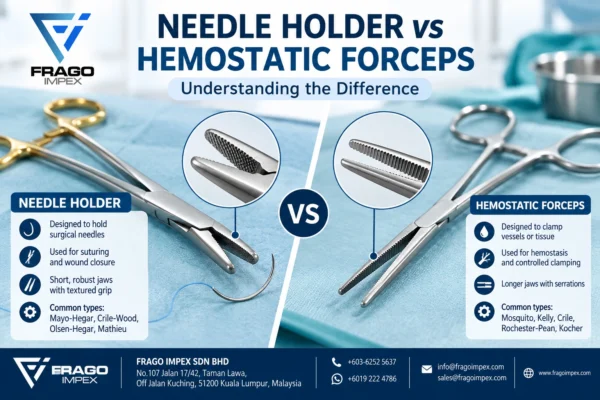
Needle Holder vs Hemostatic Forceps:
Needle holders and hemostatic forceps are both commonly found on surgical instrument trays, and at first glance they can appear similar. Both have finger rings, hinged jaws and a locking mechanism on many designs.
However, they are designed for different surgical tasks.
A needle holder, also called a needle driver, is primarily designed to securely hold a surgical needle during suturing. A hemostatic forceps, often called an artery forceps or hemostat, is designed to grasp and temporarily control blood vessels or other tissue structures.
Understanding the difference is important for surgeons, operating-room staff, instrument technicians and medical procurement teams because selecting the correct instrument affects handling, control and the intended surgical task.


Quick Comparison: Needle Holder vs Hemostatic Forceps
| Feature | Needle Holder | Hemostatic Forceps |
|---|---|---|
| Primary purpose | Holding surgical needles during suturing | Grasping and controlling vessels or tissue |
| Common alternative name | Needle driver | Hemostat / artery forceps |
| Jaw design | Short, robust jaws designed for needle control | Longer jaws designed for grasping and clamping |
| Jaw surface | Often textured or serrated for needle grip | Serrated or patterned for tissue/vessel grip |
| Typical use | Suturing and wound closure | Hemostasis and tissue handling |
| Common examples | Mayo-Hegar, Crile-Wood, Olsen-Hegar | Mosquito, Kelly, Crile, Rochester-Pean, Kocher |
| Main requirement | Precise needle control | Secure temporary clamping |
The two instruments can look similar, but their jaw design and intended function are the main differences.
What Is a Surgical Needle Holder?
A surgical needle holder is an instrument used to hold and manipulate a suture needle during suturing.
The jaws are designed to grip the needle securely while allowing the user to control its direction and movement through tissue.
Needle holders are especially important when precise needle placement is required.
For example, the Mayo-Hegar needle holder is a widely recognized pattern used for general suturing applications.
FRAGO IMPEX supplies different needle-holder designs, including Mayo-Hegar Needle Holders and Crile-Wood Needle Holders.
Common Types of Needle Holders
Different needle holders are available for different surgical techniques and handling preferences.
1. Mayo-Hegar Needle Holder
The Mayo-Hegar pattern has relatively broad, robust jaws and is commonly used for general suturing.
Its design provides a firm grip on the needle and is suitable for a range of routine surgical applications.
2. Crile-Wood Needle Holder
The Crile-Wood design has narrower jaws than some general-purpose needle holders.
This can provide more precise control when working with smaller needles or where greater delicacy is required.
3. Olsen-Hegar Needle Holder
The Olsen-Hegar combines a needle holder with scissors.
This allows the user to hold the needle and cut suture material using the same instrument.
See the Olsen-Hegar Needle Holder for an example of this design.
4. Other Specialized Designs
Needle holders are also available in different lengths, jaw configurations and handle designs to suit particular procedures and user preferences.
For a broader overview, see FRAGO IMPEX’s guide to Surgical Needle Holders: Types, Uses and How to Choose the Right One.
What Are Hemostatic Forceps?
Hemostatic forceps are clamping instruments used primarily to grasp and temporarily control blood vessels or other structures during surgery.
They are commonly referred to as hemostats or artery forceps.
Unlike a needle holder, a hemostatic forceps is not primarily designed to hold a suture needle.
The jaws generally have longitudinal serrations or another gripping pattern intended to help maintain a hold on the structure being clamped.


Common Types of Hemostatic Forceps
Mosquito Hemostatic Forceps
Mosquito forceps are relatively small hemostatic instruments and are commonly used when a smaller clamping instrument is appropriate.
They may be available in straight or curved configurations.
Kelly Hemostatic Forceps
Kelly forceps are larger than mosquito forceps and are commonly recognized by their characteristic jaw serration pattern.
They are used for clamping and controlling vessels or tissue structures.
Crile Hemostatic Forceps
Crile forceps are another common hemostatic pattern. Their jaws typically feature transverse serrations along the working portion.
Rochester-Pean Forceps
Rochester-Pean forceps have longer and heavier jaws and are designed for applications requiring a larger clamping instrument.
Kocher Forceps
Kocher forceps, also known as Ochsner forceps, incorporate teeth at the tip.
The toothed tip provides a strong grasp but means that the instrument should be used appropriately for the intended tissue or surgical application.
You can also read our detailed guide to Hemostatic Forceps: Types, Uses and Differences Between Common Designs.
Key Differences Between Needle Holders and Hemostatic Forceps
1. Their Primary Function Is Different
The most important distinction is what the instrument is designed to do.
A needle holder is designed to hold a surgical needle.
A hemostatic forceps is designed to clamp or grasp a vessel or tissue structure.
Although both instruments can grip objects, their working characteristics are optimized for different tasks.
2. Jaw Design
The jaws are one of the easiest ways to distinguish the two instruments.
Needle holders generally have relatively short and sturdy jaws that provide controlled contact with a surgical needle.
Hemostatic forceps typically have longer, narrower jaws with serrations intended to grip the structure being clamped.
When inspecting an instrument tray, examining the shape, length and surface pattern of the jaws can help identify the instrument.
3. Jaw Surface
The gripping surfaces are also different.
A needle holder needs to grip a needle firmly without allowing it to rotate unexpectedly during suturing.
Hemostatic forceps use serrated jaws to maintain a grip on vessels or other structures.
This difference in surface design reflects the different mechanical requirements of the instruments.
4. Intended Handling
Needle holders are used for controlled needle manipulation.
The surgeon needs to position the needle correctly, pass it through tissue and release or reposition it as required.
Hemostatic forceps are primarily used for grasping and clamping.
Therefore, simply choosing an instrument that “looks similar” is not an appropriate substitute for selecting the correct instrument for the task.
Needle Holder vs Hemostatic Forceps: Visual Identification
When identifying instruments on a surgical tray, consider the following features:
Needle holder:
- Shorter, robust working jaws
- Designed for needle control
- Gripping surface suited to needles
- Commonly used during suturing
- Examples include Mayo-Hegar and Crile-Wood
Hemostatic forceps:
- Usually longer, narrower jaws
- Serrated gripping surfaces
- Designed for clamping
- Commonly used for hemostasis
- Examples include Mosquito, Kelly and Crile


Can a Hemostatic Forceps Be Used as a Needle Holder?
In general, a hemostatic forceps should not be treated as a direct substitute for a needle holder.
Although the jaws of a hemostatic forceps can grip objects, they are designed for clamping and grasping rather than controlled needle manipulation.
Using an instrument outside its intended purpose can also affect instrument performance and may contribute to damage or inappropriate handling.
For suturing, the appropriate needle holder should be selected according to the needle size, procedure and required handling characteristics.
Similarly, when temporary clamping is required, the appropriate hemostatic forceps should be selected.
How to Choose the Right Needle Holder
When selecting a needle holder for a surgical setting, consider:
Needle Size
The needle holder should provide an appropriate grip for the needle being used.
Very small needles may require a more delicate design, while larger needles may require a stronger instrument.
Procedure
Different procedures may require different jaw lengths, handle designs or instrument configurations.
Jaw Configuration
Consider the jaw shape and gripping surface according to the type of needle and suturing technique.
Instrument Length
The required length depends on the working depth and surgical application.
Ergonomics
The handle should allow controlled manipulation and comfortable operation during the intended procedure.
How to Choose the Right Hemostatic Forceps
For hemostatic forceps, consider:
Vessel or Tissue Size
The size of the structure being clamped influences the appropriate instrument pattern.
Straight or Curved Design
Straight and curved forceps can provide different access and visualization depending on the surgical field.
Jaw Length
Longer jaws may be useful for deeper access, while shorter designs can provide more compact handling.
Serration Pattern
The jaw pattern should be appropriate for the intended clamping application.
Instrument Quality
Hospitals and clinics should consider material quality, manufacturing consistency, finishing and compatibility with their instrument-processing protocols.
For general surgical instrument care, see Surgical Instrument Care: How to Clean & Maintain Stainless Steel Instruments.
Why Correct Instrument Selection Matters
Correct instrument selection is important for both clinical workflow and instrument management.
Using the appropriate instrument can provide:
- Better control during the intended task
- More predictable handling
- Reduced risk of inappropriate instrument use
- Better organization of surgical trays
- More consistent instrument processing
- Easier procurement and inventory management
For hospitals and procurement teams, clearly identifying instrument patterns can also help when preparing surgical sets and replacement orders.
Common Mistakes When Identifying These Instruments
Mistake 1: Assuming All Ring-Handled Instruments Are Similar
Many surgical instruments have finger rings and ratchets. Their similar appearance does not mean they have the same function.
Mistake 2: Choosing Based Only on Overall Length
Two instruments may have similar overall dimensions but very different jaw designs.
The working end should always be examined.
Mistake 3: Ignoring the Jaw Surface
The serration or gripping pattern can provide an important clue when distinguishing a needle holder from a hemostatic forceps.
Mistake 4: Using One Instrument for Every Task
A needle holder and hemostatic forceps are designed around different surgical requirements. Instrument selection should follow the intended application.
Needle Holder vs Hemostatic Forceps for Procurement Teams
Medical-equipment procurement teams should avoid ordering instruments based only on generic descriptions such as “forceps” or “needle holder.”
A purchase specification should clearly identify the required:
- Instrument name
- Pattern or design
- Straight or curved configuration
- Approximate length
- Jaw configuration
- Intended application
- Quantity
- Required surgical set or department
Where applicable, procurement teams should also verify product information, regulatory requirements and documentation with the supplier and relevant authorities.
For Malaysian medical-device information, refer to the Medical Device Authority (MDA) Malaysia.
Care and Maintenance
Both needle holders and hemostatic forceps require appropriate cleaning, inspection and sterilization according to the healthcare facility’s validated procedures and the manufacturer’s instructions.
After use, instruments should be inspected for:
- Damaged or misaligned jaws
- Worn serrations
- Corrosion or staining
- Loose joints
- Damaged ratchets
- Problems with opening and closing
- Reduced gripping performance
Instruments that show damage or abnormal function should be evaluated according to the facility’s instrument-management procedures.
Frequently Asked Questions
Is a needle holder the same as a hemostatic forceps?
No. A needle holder is designed primarily for holding surgical needles during suturing, while a hemostatic forceps is designed primarily for clamping and controlling vessels or tissue structures.
Is a needle holder also called a needle driver?
Yes. “Needle holder” and “needle driver” are commonly used terms for instruments designed to hold surgical needles.
Are artery forceps the same as hemostatic forceps?
In many surgical contexts, artery forceps and hemostatic forceps refer to instruments used for clamping vessels and achieving temporary hemostatic control.
Can hemostatic forceps hold a suture needle?
They may physically grip a needle, but they are not designed to provide the controlled needle handling of a dedicated needle holder. The appropriate instrument should be selected for the intended procedure.
What is the main difference between their jaws?
Needle-holder jaws are designed for secure needle control, while hemostatic-forceps jaws generally feature serrations designed to grip and clamp vessels or tissue structures.
Which needle holder is used for general suturing?
Mayo-Hegar is a commonly recognized general-purpose needle-holder pattern, although the appropriate instrument depends on the procedure, needle and surgeon’s requirements.
Final Takeaway
The difference between a needle holder and a hemostatic forceps comes down primarily to their intended function and working-end design.
A needle holder is designed to provide controlled grip and manipulation of a surgical needle during suturing. A hemostatic forceps is designed primarily for grasping and temporarily clamping vessels or other structures.
When identifying or purchasing surgical instruments, look beyond the handles and overall appearance. Jaw shape, jaw surface, instrument pattern and intended application are more useful indicators.
FRAGO IMPEX SDN BHD supplies surgical instruments and medical equipment for healthcare facilities and medical professionals. To explore available surgical instruments, visit the FRAGO IMPEX Surgical Instruments category.
FRAGO IMPEX SDN BHD
No.107 Jalan 17/42, Taman Lawa, Off Jalan Kuching, 51200 Kuala Lumpur, Malaysia
Tel: +603-6252 5637
WhatsApp: +6019 222 4786
Email: info@fragoimpex.com
Sales: sales@fragoimpex.com
Website: www.fragoimpex.com