Surgical Scissors:
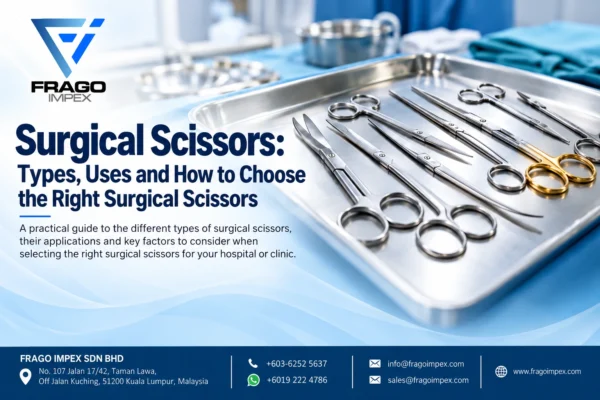
Surgical scissors are precision instruments used for cutting and dissecting tissue, sutures, dressings and other materials during surgical and clinical procedures. Although many scissors may look similar, their blade shape, tip configuration, length and construction determine how they should be used.
Choosing the right surgical scissors is therefore more than selecting a particular size. The intended application, material being cut, access required and level of precision should all be considered.
This guide explains the common types of surgical scissors, their applications, the differences between important designs, and practical factors hospitals and clinics should consider when selecting them.


What Are Surgical Scissors?
Surgical scissors are hinged cutting instruments designed for controlled cutting or dissection. They normally consist of two blades joined at a pivot and operated using ring handles.
Depending on their design, surgical scissors may be intended for:
- Tissue dissection
- Cutting sutures
- Cutting dressings and bandages
- General surgical cutting
- Fine dissection
- Specialized procedures
Important design differences include:
- Straight or curved blades
- Sharp-sharp tips
- Sharp-blunt tips
- Blunt-blunt tips
- Fine or heavier blades
- Different lengths
- Specialized blade and tip configurations
The correct instrument should be selected according to its intended application rather than simply because it is available in the operating room.
FRAGO IMPEX also provides a broader guide to Basic Surgical Instruments Every General Surgery Clinic Should Have, which explains the role of scissors alongside forceps, needle holders, retractors and other commonly used instruments. (Frago Impex SDN BHD)
Main Types of Surgical Scissors
There are many surgical-scissor patterns. The most practical way to understand them is by looking at blade shape, tip design and intended application.
1. Straight Surgical Scissors
Straight surgical scissors have blades that follow a relatively straight path from the joint to the tips.
They can be useful when a direct cutting path is required and are available in different tip configurations.
For example, FRAGO IMPEX lists Operating Scissors Straight Sharp–Sharp in 13 cm, 15 cm, 18 cm and 20 cm sizes. (Frago Impex SDN BHD)


2. Curved Surgical Scissors
Curved surgical scissors have blades that follow a curved profile.
The curvature can provide a different angle of access and may improve visibility when working around or between tissue structures.
FRAGO IMPEX lists Operating Scissors Curved Blunt–Blunt in 13 cm, 15 cm, 18 cm and 20 cm sizes. (Frago Impex SDN BHD)


Sharp-Sharp, Sharp-Blunt and Blunt-Blunt Scissors
Tip configuration is one of the most important differences between surgical scissors.
Sharp-Sharp Scissors
Both tips are pointed.
This configuration can be appropriate for cutting and dissection where pointed tips are required.
FRAGO IMPEX’s Operating Scissors Straight Sharp–Sharp features straight blades with sharp tips and is listed for professional surgical use. (Frago Impex SDN BHD)
Sharp-Blunt Scissors
One tip is sharp while the other is blunt.
This provides a combination of a pointed cutting tip and a less-pointed tip. The appropriate application depends on the particular instrument and procedure.
FRAGO IMPEX’s Operating Scissors Straight Sharp–Blunt is listed in 13 cm, 15 cm, 18 cm and 20 cm sizes. (Frago Impex SDN BHD)
Blunt-Blunt Scissors
Both tips are blunt or rounded.
These scissors may be selected when the intended application calls for blunt tips.
FRAGO IMPEX’s Operating Scissors Curved Blunt–Blunt uses curved blades with blunt tips. (Frago Impex SDN BHD)


Mayo Scissors
Mayo scissors are generally associated with a stronger, heavier construction than delicate dissecting scissors.
They are commonly used for general cutting and dissection where a more robust instrument is appropriate.
Mayo scissors can be available in straight and curved patterns, depending on the specific instrument.
Typical considerations include:
- Blade strength
- Straight or curved configuration
- Overall length
- Intended cutting application
The exact use should always be confirmed against the manufacturer’s specification and clinical protocol.
Metzenbaum Scissors
Metzenbaum scissors are generally finer instruments associated with delicate tissue dissection.
They typically have relatively long shanks and finer blades than heavier general-purpose scissors.
They are commonly selected when controlled, delicate tissue dissection is required.
The important distinction is that Mayo and Metzenbaum scissors are not simply interchangeable versions of the same instrument. Their designs serve different cutting requirements.
FRAGO IMPEX’s existing surgical-scissor inspection guide also distinguishes Mayo scissors, Metzenbaum scissors, Iris scissors, operating scissors and tenotomy scissors by their design and intended applications. (Frago Impex SDN BHD)


Specialized Surgical Scissors
Some scissors are designed for specific clinical tasks rather than general surgical cutting.
Lister Bandage Scissors
Lister bandage scissors are designed for cutting bandages and dressings.
Their angled design and blunt tip are intended for use around dressings where a pointed tip may be unsuitable.
FRAGO IMPEX lists Lister Bandage Scissors in several sizes, including 14 cm, 18 cm and 20 cm.
Littauer Stitch Scissors
Littauer scissors are designed for cutting and removing sutures.
Their distinctive hook-shaped tip can help engage a stitch before cutting.
ENT and Specialty Scissors
Specialized scissors are also available for ENT, ophthalmic, obstetric, gynaecological and other procedures.
For example, specialized surgical instruments may have blade shapes or tip designs developed for a particular anatomical area or procedure.
For procurement teams, the key point is to match the instrument to the procedure rather than selecting a specialty instrument solely by name.
Surgical Scissors Comparison
| Type | Main design characteristic | Typical application |
|---|---|---|
| Straight operating scissors | Straight blades | General cutting and selected surgical applications |
| Curved operating scissors | Curved blades | Cutting or dissection where curved access is useful |
| Sharp-sharp scissors | Two sharp tips | Precise cutting or dissection where pointed tips are appropriate |
| Sharp-blunt scissors | One sharp and one blunt tip | Applications requiring mixed tip configuration |
| Blunt-blunt scissors | Two blunt tips | Applications where blunt tips are preferred |
| Mayo scissors | Heavier construction | More robust cutting and dissection |
| Metzenbaum scissors | Fine, longer-shank design | Delicate tissue dissection |
| Lister scissors | Angled blade with blunt tip | Bandage and dressing cutting |
| Littauer scissors | Hook-shaped tip | Suture cutting and removal |
| Specialty scissors | Procedure-specific construction | Specialized surgical applications |
These are general categories. The exact function and specification can vary between manufacturers and individual instrument patterns.
How to Choose the Right Surgical Scissors
Selecting surgical scissors should start with the intended task.
1. Identify What Needs to Be Cut
First determine whether the instrument will be used for:
- Delicate tissue
- Heavier tissue
- Sutures
- Ligatures
- Dressings
- Bandages
- Other materials
A delicate tissue-dissection scissor should not automatically be used for heavier materials.
2. Consider Straight or Curved Blades
Straight and curved scissors provide different working geometries.
Straight blades can be useful when a direct cutting path is preferred, while curved blades can provide a different angle of access.
3. Select the Correct Tip Configuration
Consider whether the procedure requires:
- Sharp-sharp
- Sharp-blunt
- Blunt-blunt
- A specialized tip
Tip configuration should be matched to the intended clinical application.
4. Choose the Appropriate Length
Surgical scissors are available in different lengths.
Shorter scissors may provide convenient control for accessible areas, while longer instruments can provide additional reach.
For example, FRAGO IMPEX’s straight and curved operating scissors are available in several listed lengths. (Frago Impex SDN BHD)
5. Consider Blade Construction
A delicate instrument and a heavier cutting instrument should not be treated as interchangeable.
The blade thickness, overall construction and intended application should be considered before purchasing.
6. Check the Manufacturer’s Specifications
Before ordering surgical scissors, confirm:
- Instrument type
- Blade configuration
- Tip configuration
- Overall length
- Material
- Joint design
- Intended use
- Reprocessing instructions
- Available sizes
This is particularly important for hospitals purchasing instruments in volume.


Why Surgical Scissor Size Matters
The length of a surgical scissor affects its working distance, reach and handling characteristics.
When selecting a size, consider:
- Procedure type
- Working depth
- Access to the surgical field
- Surgeon preference
- Instrument control
- Surgical-set standardization
Hospitals may benefit from maintaining commonly required sizes while keeping specialized lengths available for procedures that require them.
The goal is not to purchase every possible size, but to maintain an inventory that reflects the procedures performed by the facility.
Surgical Scissors for Hospitals and Clinics
A general hospital or clinic may need several different scissor patterns rather than one universal type.
A surgical inventory may include:
- Straight operating scissors
- Curved operating scissors
- Mayo scissors
- Metzenbaum scissors
- Suture scissors
- Bandage scissors
- Specialty scissors
The appropriate inventory depends on the clinical services provided.
FRAGO IMPEX’s Surgical Instruments category includes surgical scissors alongside forceps, needle holders, retractors and other surgical instruments.
For procurement teams, standardizing frequently used patterns can simplify ordering, staff familiarity and inventory management.
Common Mistakes When Choosing Surgical Scissors
Choosing Only by Appearance
Two scissors may look similar but have different blade geometry, tip configuration or intended applications.
Always review the manufacturer’s specifications.
Using Delicate Scissors for Heavy Materials
Fine dissecting scissors should not be used indiscriminately for materials that require greater cutting force.
Ignoring Blade Curvature
Straight and curved scissors can provide different access and handling characteristics.
Purchasing Only One Length
Different procedures may require different working lengths.
Selecting a Specialty Instrument Without Confirming Its Purpose
Names such as Mayo, Metzenbaum, Littauer and Lister describe recognizable instrument patterns, but the exact product specification should still be checked.
Ignoring Reprocessing Requirements
For reusable surgical instruments, cleaning, disinfection and sterilization should follow the manufacturer’s instructions and the healthcare facility’s validated procedures.
The World Health Organization describes decontamination as involving cleaning, disinfection and/or sterilization and emphasizes that the process requires appropriate infrastructure, procedures and quality control. (World Health Organization)
The FDA similarly notes that reusable medical devices require device-specific reprocessing procedures and appropriate cleaning, disinfection or sterilization before reuse. (U.S. Food and Drug Administration)
Surgical Scissors Care and Reprocessing
Surgical scissors are precision instruments and should be handled according to the manufacturer’s instructions.
Healthcare facilities should establish appropriate procedures for:
- Point-of-use handling
- Cleaning
- Inspection
- Disinfection
- Sterilization
- Drying
- Storage
- Pre-use inspection
The exact reprocessing method depends on the instrument and manufacturer’s validated instructions.
For a detailed inspection discussion, see FRAGO IMPEX’s How to Inspect Surgical Scissors: 6 Key Points Every Healthcare Professional Should Check. That article covers functional inspection, blade condition, alignment, joint condition and other inspection considerations. (Frago Impex SDN BHD)
How Procurement Teams Can Standardize Surgical Scissors
Hospitals purchasing surgical scissors in volume can create a simple specification checklist.
| Specification | What to confirm |
|---|---|
| Instrument type | Operating, dissecting, suture, bandage or specialty |
| Blade shape | Straight or curved |
| Tip configuration | Sharp-sharp, sharp-blunt or blunt-blunt |
| Length | Required working length |
| Construction | Fine or heavy |
| Material | Manufacturer-specified material |
| Joint | Screw joint or other design |
| Intended use | Tissue, suture, dressing or specialty application |
| Reprocessing | Manufacturer’s instructions |
| Quantity | Based on actual procedure requirements |
| Replacement | Availability of matching instruments |
This approach allows procurement teams to compare products using consistent specifications rather than relying only on product names.
Frequently Asked Questions
What are surgical scissors used for?
Surgical scissors are used for cutting or dissecting tissue, sutures, dressings, bandages and other materials depending on their design.
What is the difference between Mayo and Metzenbaum scissors?
Mayo scissors generally have a heavier construction and are associated with more robust cutting and dissection tasks. Metzenbaum scissors are generally finer and commonly associated with delicate tissue dissection.
What is the difference between straight and curved surgical scissors?
Straight scissors have relatively straight blades, while curved scissors have blades following a curved profile. The appropriate choice depends on the procedure and required access.
What does sharp-sharp mean?
Sharp-sharp means that both scissor tips are pointed.
What does sharp-blunt mean?
Sharp-blunt means that one tip is sharp and the other is blunt.
Are surgical scissors reusable?
Some surgical scissors are manufactured as reusable instruments. Reusability and reprocessing requirements should always be confirmed from the manufacturer’s documentation.
How do I choose the correct surgical scissors?
Start with the intended cutting task, then consider blade shape, tip configuration, length, construction and manufacturer specifications.
Can one type of surgical scissors be used for every procedure?
No. Different procedures and materials require different instrument designs. Surgical scissors should be selected according to their intended application.
Final Thoughts
Surgical scissors are available in many designs because different surgical and clinical tasks require different cutting characteristics.
Straight and curved blades, sharp and blunt tips, different lengths, and lighter or heavier constructions all serve different purposes.
For surgeons and clinical staff, the most important consideration is matching the scissor to the intended task. For hospital procurement teams, consistent specifications can make purchasing and inventory management more straightforward.
Whether the requirement is for operating scissors, dissecting scissors, suture scissors, bandage scissors or specialty instruments, selection should be based on the intended application and verified manufacturer specifications.
FRAGO IMPEX SDN BHD supplies surgical instruments and medical equipment for hospitals, clinics and healthcare professionals.
FRAGO IMPEX SDN BHD
No. 107 Jalan 17/42, Taman Lawa, Off Jalan Kuching
51200 Kuala Lumpur, Malaysia
Tel: +603-6252 5637
WhatsApp: +6019 222 4786
Email: info@fragoimpex.com
Sales: sales@fragoimpex.com
Website: https://fragoimpex.com
For surgical scissors, surgical instrument sets or other medical-equipment requirements, contact the FRAGO IMPEX team for product and procurement information.