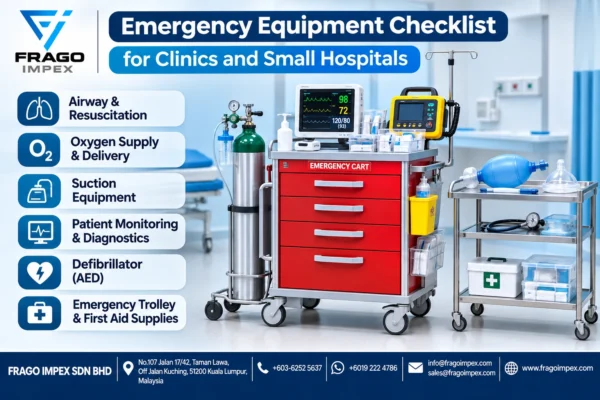
Emergency Equipment Checklist: Clinics and small hospitals need appropriate emergency equipment to respond to sudden illness, breathing difficulties, cardiac emergencies, injuries and other urgent medical situations. Even facilities that do not operate a dedicated emergency department should assess the equipment required for the services they provide and the patients they treat.
An effective emergency equipment checklist helps healthcare managers identify essential devices, organize supplies, assign inspection responsibilities and reduce the risk of discovering missing or non-functional equipment during an emergency.
The World Health Organization (WHO) provides an Essential Emergency Equipment List and an Emergency Care Toolkit to support emergency-care planning. These resources can help facilities develop an inventory suited to their clinical services.
This guide covers key equipment categories, procurement considerations and practical maintenance checks for clinics, outpatient centres and small hospitals.
1. Airway Management and Resuscitation Equipment
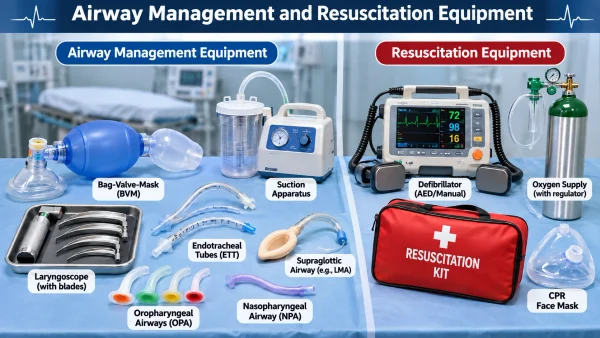
Airway and resuscitation equipment is a priority for facilities that may need to support patients with breathing difficulties or other life-threatening conditions while providing initial care or arranging transfer.
The equipment required depends on the facility’s scope of practice and the competencies of its clinical staff.
Common items to assess include:
- Bag-valve-mask resuscitator: Allows trained healthcare professionals to provide manual ventilation when indicated.
- Resuscitation masks: Appropriate sizes and compatible connections for the intended patient population.
- Oropharyngeal airways: Selected sizes for use by appropriately trained personnel.
- Laryngoscope and airway accessories: Where advanced airway management is within the facility’s services and staff competencies.
- Compatible airway adjuncts: Selected according to local protocols and the procedures performed.
- Protective equipment: Gloves, masks, eye protection and other required barriers.
Facilities treating both adults and children should assess whether separate sizes and configurations are needed.
Do not purchase advanced airway devices simply because they appear on a generic checklist. Their inclusion should reflect clinical requirements, staff training, manufacturer instructions and applicable protocols.
2. Oxygen Supply and Delivery Equipment
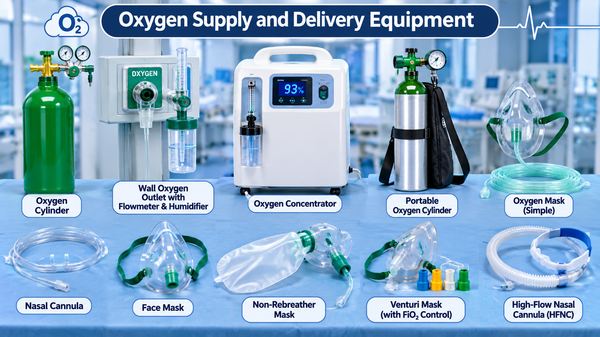
Oxygen equipment may be needed for patients with specific respiratory or other medical emergencies. Facilities should assess the appropriate supply source, delivery devices and backup arrangements.
Items to consider include:
- Oxygen cylinder or concentrator, where appropriate.
- Compatible regulator and flowmeter.
- Oxygen masks in suitable sizes.
- Nasal cannulae.
- Oxygen tubing and compatible connectors.
- Cylinder trolley or suitable secure storage.
- Backup supply arrangements according to the facility’s risk assessment.
Before purchasing, confirm the device’s intended use, supply capacity, connection compatibility, maintenance requirements and applicable safety requirements.
For oxygen cylinders, staff should follow the relevant procedures for secure storage, handling and inspection. Oxygen supports combustion, so storage and use require appropriate fire-safety precautions.
The correct oxygen delivery equipment and clinical use must be determined by qualified healthcare professionals according to the patient’s condition and local protocols.
3. Suction Equipment
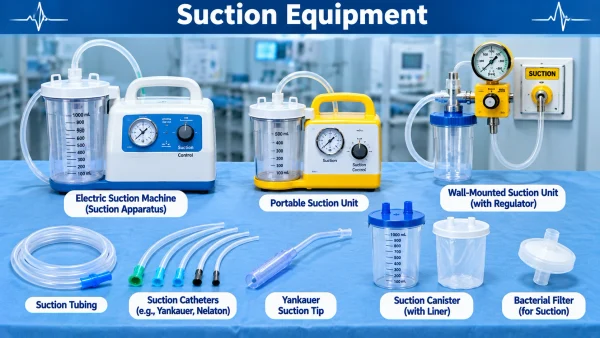
Suction equipment helps remove secretions and fluids when required for airway management or other clinical procedures.
Depending on the facility, the inventory may include:
- Portable or electric suction machine.
- Compatible suction tubing.
- Collection canisters.
- Suction catheters and other appropriate accessories.
- Yankauer-type suction tips, where indicated.
- Filters and replacement components specified by the manufacturer.
When selecting a suction machine, review its intended application, power requirements, portability, collection system, cleaning instructions and accessory availability.
A facility that already has central suction should still assess whether portable equipment is required for particular clinical areas or emergency-response arrangements.
Routine readiness checks: Confirm that the unit powers on, the tubing and connectors are available, the collection system is correctly assembled and the equipment performs according to the manufacturer’s checking procedure.
4. Patient Monitoring and Diagnostic Equipment
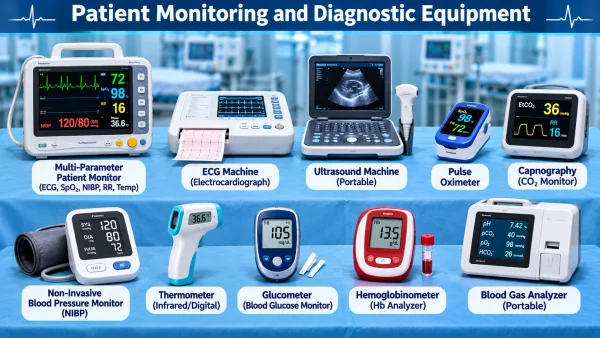
Monitoring devices help clinical staff assess a patient’s condition and identify changes that may require urgent evaluation.
The appropriate selection depends on the type of patients seen, the procedures performed and the facility’s emergency-response capability.
| Equipment | Purpose |
|---|---|
| Blood pressure monitor | Measures blood pressure |
| Pulse oximeter | Measures peripheral oxygen saturation and pulse rate |
| Stethoscope | Supports clinical assessment |
| Thermometer | Measures body temperature |
| Blood glucose meter | Measures blood glucose when indicated |
| ECG machine | Records electrical activity of the heart |
| Multiparameter patient monitor | Displays selected physiological parameters, depending on the model |
A pulse oximeter is not a substitute for a complete clinical assessment. Likewise, an ECG machine and a multiparameter monitor serve different purposes, so facilities should choose according to their intended applications.
Before procurement, check the required measurement functions, accessories, power arrangements, maintenance needs and availability of replacement sensors or consumables.
5. Defibrillator and Cardiac Emergency Equipment
Facilities should assess whether an automated external defibrillator (AED) or another appropriate defibrillator is required for their services and emergency protocols.
Relevant considerations include:
- Defibrillator suitable for the intended clinical setting.
- Compatible electrode pads.
- Appropriate adult and paediatric accessories, where required.
- Battery and self-test status indicators.
- Replacement pads and consumables.
- Staff training and emergency-response procedures.
- An accessible, clearly identified storage location.
The appropriate device depends on the facility’s patient population, clinical services, available staff and applicable requirements.
Where a defibrillator is provided, the facility should establish a documented readiness process that follows the manufacturer’s instructions. Staff must know how to locate the device and activate the facility’s emergency response.
6. Emergency Trolley or Resuscitation Cart
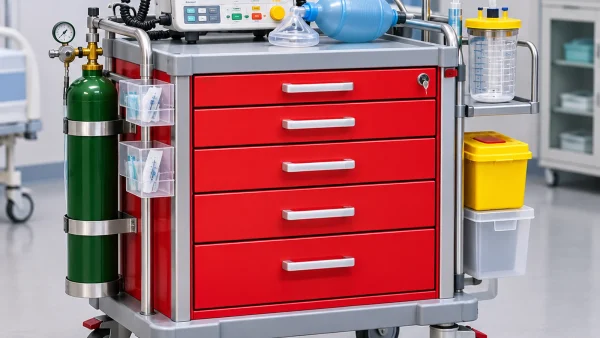
An emergency trolley helps keep essential equipment and supplies organized and accessible. A well-planned arrangement can reduce the need to search through separate rooms or cupboards during an emergency.
Depending on the facility, a trolley may hold or organize:
- Airway and resuscitation supplies.
- Monitoring accessories.
- Emergency consumables.
- Intravenous access supplies, where indicated.
- Emergency medicines managed under institutional policy.
- Gloves and other required protective equipment.
- Documentation, checklists and equipment inventory records.
The layout should be standardized within the facility. Staff should know where important items are stored and how to identify missing supplies.
Consider trolley dimensions, mobility, locking arrangements, drawer organization, cleaning requirements and access to replacement components when purchasing.
FRAGO IMPEX lists an Emergency Cart / Resuscitation Cart category with products for hospital equipment planning.
7. First Aid and Wound Management Supplies
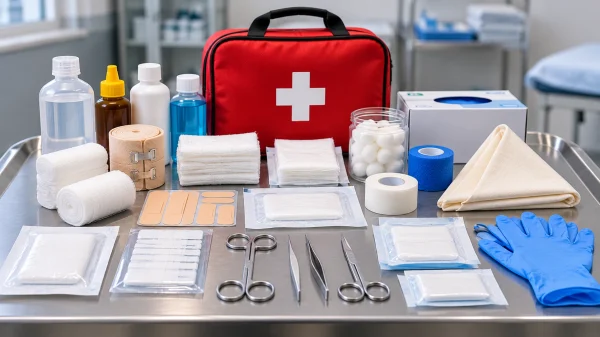
Clinics and small hospitals may need supplies for initial wound care, minor injuries and other situations within their scope of practice.
Common items to assess include:
- Sterile gauze and wound dressings.
- Appropriate bandages.
- Adhesive dressings and medical tape.
- Sterile and examination gloves.
- Antiseptic products approved for the intended use.
- Scissors and suitable forceps.
- Splints for relevant injury-management services.
- Sharps containers.
- Clinical waste containers.
The exact inventory should reflect the procedures performed and the facility’s infection prevention and waste-management policies.
Do not assume that a first aid kit intended for workplace use contains everything required for clinical emergency care. Workplace first aid kits and healthcare resuscitation supplies have different purposes.
FRAGO IMPEX lists DOSH first aid kits as well as other medical and surgical supplies.
8. Intravenous Access and Supporting Supplies
For facilities whose clinical services include intravenous access or fluid administration, the emergency inventory may include:
- Intravenous cannulas in appropriate sizes.
- Compatible infusion sets and extension tubing.
- Syringes and needles appropriate to the intended procedures.
- Tourniquets.
- Skin antisepsis supplies.
- Dressings and securement products.
- Approved sharps-disposal containers.
The required quantities depend on expected demand, patient population, shelf life and restocking arrangements.
Facilities should also establish clear processes for checking expiry dates, storing supplies according to manufacturer instructions and disposing of used sharps safely.
Medicines, intravenous fluids and other treatment products should be selected and managed by the responsible clinical team under approved protocols.
9. Emergency Transport and Patient Handling Equipment
Some patients need to be moved within a facility or transferred to another healthcare service. The appropriate equipment depends on the patient’s condition, the building layout, transport arrangements and the staff available.
Items to assess include:
- Patient transfer trolley or stretcher.
- Wheelchair, where appropriate.
- Suitable patient transfer accessories.
- Secure storage and parking arrangements.
- Equipment for safe handling according to facility policy.
Check the product’s intended use, dimensions, safe working load, stability, restraint arrangements where applicable, cleaning requirements and compatibility with the facility’s environment.
FRAGO IMPEX lists an Emergency Stretcher and a Soft Stretcher for facilities evaluating patient transport equipment. Confirm that the selected product is appropriate for the intended transfer task.
10. Personal Protective Equipment and Infection Prevention
Emergency care should be supported by suitable infection prevention measures. Staff may need protective equipment when assessing or treating patients, depending on the anticipated exposure and applicable precautions.
Consider maintaining:
- Examination gloves.
- Medical masks and other required respiratory protection.
- Eye and face protection.
- Protective gowns or aprons.
- Hand hygiene supplies.
- Clinical waste bags and sharps containers.
- Cleaning and disinfection supplies suitable for the equipment and environment.
Selection should follow the facility’s infection prevention policy and the anticipated exposure risks.
Reusable equipment should be cleaned and reprocessed according to the manufacturer’s instructions. Single-use items should not be reused unless the manufacturer and applicable requirements specifically permit it.
Emergency Equipment Checklist for Clinics and Small Hospitals
Use this list as a starting point for an inventory review. Mark each item according to whether it is required, available, functional and adequately stocked.
Airway and resuscitation
- Adult bag-valve-mask resuscitator, if required.
- Paediatric resuscitation equipment, if children are treated.
- Appropriate masks and airway accessories.
- Additional airway equipment according to staff competencies and clinical services.
Oxygen and suction
- Appropriate oxygen source.
- Compatible regulator, flowmeter and delivery accessories.
- Oxygen masks and tubing.
- Functional suction equipment where required.
- Compatible suction tubing, canister and accessories.
Monitoring and cardiac emergencies
- Blood pressure monitor.
- Pulse oximeter.
- Stethoscope and thermometer.
- Blood glucose meter, where indicated.
- ECG or multiparameter monitor, where required.
- Defibrillator or AED, where indicated.
- Compatible accessories and replacement consumables.
Emergency trolley and supplies
- Emergency trolley or organized storage.
- First aid and wound care supplies.
- Intravenous access supplies, where required.
- Emergency medicines managed under clinical policy.
- Personal protective equipment.
- Sharps and clinical waste containers.
Transport and readiness
- Appropriate stretcher or patient transfer equipment.
- Clearly identified emergency equipment locations.
- Documented inspection schedule.
- Expiry-date and stock checks.
- Staff training and emergency procedures.
- Replenishment and equipment fault-reporting process.
This checklist is a planning aid, not a universal minimum standard. The final list should be approved by the facility’s responsible clinical and operational personnel.
How to Choose Emergency Equipment for a Clinic
1. Start with the services provided
A general outpatient clinic may have different needs from a facility performing minor procedures, providing paediatric care, administering sedation or managing higher-acuity patients.
Identify the emergencies reasonably foreseeable within the facility’s scope of practice and plan equipment accordingly.
2. Assess the patient population
Consider whether the facility treats adults, children, older patients or patients with specific clinical needs. This affects equipment sizes, accessories and monitoring requirements.
3. Check staff competencies
Equipment should match the training and authorized responsibilities of the staff who will use it. Advanced devices require appropriate training, protocols and maintenance arrangements.
4. Verify compatibility
Confirm that accessories, sensors, masks, tubing, electrodes and replacement components are compatible with the selected device. Similar-looking products are not necessarily interchangeable.
5. Review documentation and local requirements
Check manufacturer instructions, intended use, maintenance requirements and applicable medical-device regulatory requirements. In Malaysia, consult the Medical Device Authority (MDA) for relevant regulatory information.
6. Consider total ownership cost
Compare not only the initial purchase price but also consumables, replacement parts, servicing, training and expected maintenance needs.
7. Establish a readiness system
Assign responsibility for routine checks, documentation, replenishment, fault reporting and follow-up. Equipment that is unavailable, expired or not functioning may not be ready when needed.
Emergency Equipment Maintenance and Readiness
A purchase is only the first step. Emergency equipment should remain accessible, functional and appropriately stocked throughout its service life.
A facility’s readiness process should address:
- Location: Keep equipment in designated, clearly identified areas.
- Function: Complete the checks specified by the manufacturer.
- Consumables: Confirm availability and compatibility.
- Expiry dates: Check dated products according to the facility’s schedule.
- Power: Review battery status, charging arrangements and backup supplies where applicable.
- Cleaning: Follow manufacturer instructions and infection prevention procedures.
- Documentation: Record inspections, faults, replacements and corrective actions.
- Training: Ensure staff know where equipment is located and how to activate the emergency response.
The frequency and scope of checks should be determined by the device instructions, facility risk assessment and applicable standards. A general checklist should not replace a model-specific maintenance programme.
Common Mistakes to Avoid
- Buying a generic emergency kit without assessing clinical needs. The kit may not cover the facility’s actual services or patient population.
- Ignoring paediatric requirements. Facilities that treat children should assess the need for appropriate sizes and configurations.
- Overlooking consumables. A device may be available but unusable if compatible accessories are missing or expired.
- Failing to check functionality. Equipment should be inspected according to the manufacturer’s instructions.
- Storing emergency equipment where it is difficult to access. Staff should know its location and how to obtain it quickly.
- Purchasing equipment without considering training. Devices must be appropriate for the facility’s competencies and approved procedures.
- Neglecting replenishment and maintenance. Responsibilities should be assigned and documented.
Frequently Asked Questions
What emergency equipment should every clinic have?
There is no single universal list for every clinic. Facilities should assess their services and applicable requirements. Common categories include resuscitation equipment, appropriate oxygen and suction arrangements, basic monitoring equipment, first aid supplies, protective equipment and an emergency-response process.
Does every clinic need a defibrillator?
The need depends on the facility’s clinical services, risk assessment and applicable requirements. Clinics should evaluate whether an AED or another appropriate defibrillator is needed and establish the associated training and readiness arrangements.
What is the purpose of an emergency trolley?
An emergency trolley organizes selected equipment and supplies in one accessible location. Its contents should be based on the facility’s clinical needs and standardized so that staff can locate items consistently.
How often should emergency equipment be checked?
There is no single interval suitable for every device. Follow the manufacturer’s instructions, applicable requirements and facility risk assessment. Document inspections, faults, replenishment and corrective actions.
What should a small hospital consider before buying emergency equipment?
Assess the services provided, patient population, staff competencies, equipment specifications, compatible accessories, regulatory documentation, maintenance, training and availability of replacement supplies.
Where can clinics obtain emergency equipment in Malaysia?
Clinics can review suitable medical equipment suppliers and verify product specifications, documentation, compatibility and after-sales support before ordering. FRAGO IMPEX SDN BHD lists emergency carts, stretchers, first aid kits and other medical supplies on its website.
Conclusion
An effective emergency equipment checklist helps clinics and small hospitals plan their inventory, maintain readiness and identify gaps before an emergency occurs. The most appropriate equipment depends on the services offered, the patients treated, staff competencies and applicable requirements.
Facilities should combine a needs-based procurement list with documented inspections, maintenance, staff training and a reliable replenishment process. Equipment availability alone is not sufficient; staff must also know how to access it and follow the facility’s approved emergency procedures.
FRAGO IMPEX SDN BHD supplies medical and surgical equipment for healthcare facilities. Review the available emergency equipment, emergency carts and resuscitation carts and stretchers to explore relevant product options.
Contact FRAGO IMPEX SDN BHD
Website: https://www.fragoimpex.com
Address: No.107 Jalan 17/42, Taman Lawa, Off Jalan Kuching, 51200 Kuala Lumpur, Malaysia
Tel: +603-6252 5637
WhatsApp: +6019 222 4786
Email: info@fragoimpex.com
Sales: sales@fragoimpex.com
This article is for equipment-planning and educational purposes. It does not replace clinical protocols, professional training, manufacturer instructions or applicable regulatory requirements.