Skip to content


Kocher Forceps: Uses, Features and When They Are Used in Surgery
Kocher forceps are locking surgical instruments recognized by their serrated jaws and characteristic terminal teeth. They are also commonly referred to as Kocher clamps, Kocher artery forceps or Rochester-Ochsner forceps.
The toothed tip gives the instrument a firm mechanical grip, making the Kocher pattern particularly useful when secure grasping or clamping is required for appropriate tissue or structures.
However, the toothed design is also important when deciding when not to use the instrument. Kocher forceps should not automatically replace atraumatic or non-toothed forceps because the teeth can exert a more aggressive grip.
The WHO MEDEVIS database lists Rochester-Ochsner (Kocher) forceps as a surgical instrument and identifies the device within the hemostatic-forceps category. MEDEVIS


Kocher forceps are available in straight and curved patterns, with the characteristic toothed tip visible at the working end.
What Are Kocher Forceps?
Kocher forceps are ring-handled, ratcheted surgical clamps with serrated jaws and a terminal tooth.
The tooth is one of the most useful visual clues for distinguishing a conventional Kocher forceps from many other hemostatic instruments.
Typical features include:
- Finger-ring handles
- Ratchet locking mechanism
- Box joint
- Serrated jaws
- Terminal 1×2 tooth configuration
- Straight or curved working ends
- Different lengths for different surgical applications
The exact construction and available sizes depend on the manufacturer and model.
FRAGO IMPEX’s Kocher Artery Forceps Straight is listed as a BENZ instrument with a 1×2 toothed tip and straight configuration. The published sizes are 13 cm, 14 cm, 15 cm, 18 cm and 20 cm. Frago Impex SDN BHD
Why Do Kocher Forceps Have Teeth?
The terminal teeth are designed to provide a secure mechanical grip.
Unlike a smooth or non-toothed jaw, the interlocking tooth can help prevent suitable tissue or structures from slipping from the instrument.
This characteristic can be useful when firm tissue control is required.
However, the teeth also mean that Kocher forceps are not appropriate for every type of tissue.
A useful principle is:
Choose the forceps according to the tissue and procedure, not simply according to how firmly the instrument grips.
This distinction is particularly important when comparing Kocher forceps with atraumatic tissue-holding instruments.
Main Uses of Kocher Forceps
1. Grasping Tough or Dense Tissue
One of the most recognized applications of Kocher forceps is the firm grasping of appropriate tough or dense tissue.
Depending on the surgical procedure, examples can include:
- Fascia
- Aponeurotic tissue
- Tough tissue edges
- Dense tissue structures requiring secure temporary control
The serrated jaws and terminal tooth help maintain the grip.
For this reason, Kocher forceps are often included in general surgical instrument sets.
2. Temporary Hemostatic Clamping
Kocher forceps are also used as hemostatic instruments.
When appropriate for the anatomy and procedure, the instrument can be used to provide temporary mechanical control of a bleeding structure.
However, the term “Kocher artery forceps” does not mean that every Kocher configuration is suitable for every vessel.
The correct instrument depends on:
- The size and characteristics of the structure
- Surgical access
- Required jaw configuration
- Procedure
- Surgeon preference
- Manufacturer’s intended application
The WHO classifies Rochester-Ochsner (Kocher) forceps within reusable hemostatic forceps. MEDEVIS
3. Holding Appropriate Tissue During Surgery
Kocher forceps may be used to hold or manipulate tissue when a firm grip is required.
The toothed design can provide more retention than many smooth-jaw instruments.
This can be useful during selected surgical procedures where tissue is sufficiently robust to tolerate the instrument’s gripping characteristics.
It should not, however, be interpreted as a general recommendation for applying toothed forceps to delicate structures.
4. General Surgical Applications
Kocher forceps can be found in general surgical instrument sets and may be used in different operative environments.
FRAGO IMPEX’s published Kocher product information describes its straight model for applications including general surgery, orthopedics, gynecology and trauma-related procedures. Frago Impex SDN BHD
The exact clinical use should always be determined by the surgical team and the particular instrument configuration.
Straight vs Curved Kocher Forceps
Kocher forceps are commonly available in straight and curved configurations.
Straight Kocher Forceps
A straight Kocher forceps provides a direct line between the handle and working end.
It may be preferred when:
- The target structure is easily accessible
- Direct visualization is available
- Straight-line access is convenient
- The surgeon prefers a direct approach
FRAGO IMPEX supplies the BENZ Kocher Artery Forceps Straight in several lengths, including 13 cm, 14 cm, 15 cm, 18 cm and 20 cm. Frago Impex SDN BHD
Curved Kocher Forceps
A curved Kocher changes the orientation of the jaws relative to the handle.
This can be useful when:
- Access is deeper
- A curved approach is more convenient
- The surrounding anatomy limits straight access
- The working end needs to be positioned at an angle
Straight and curved forceps should not automatically be considered interchangeable. The appropriate configuration depends on the surgical procedure and operative access.
Kocher Forceps vs Other Surgical Clamps
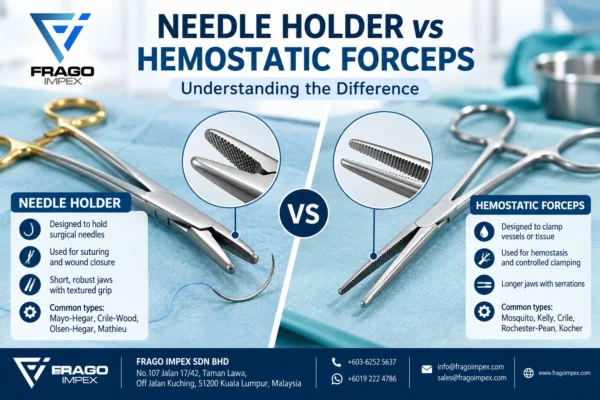
Several ring-handled surgical instruments can look similar when placed together on a surgical tray.
The most useful way to distinguish them is by examining the jaw design, serrations and tip.
| Instrument | Main identifying feature | General function |
|---|---|---|
| Kocher forceps | Serrated jaws + terminal tooth | Firm grasping and appropriate clamping |
| Allis Tissue Forceps | Multiple interlocking teeth | Firm tissue holding |
| Babcock Tissue Forceps | Rounded fenestrated jaws | Holding appropriate delicate structures |
| Rochester Pean Forceps | Larger, fully serrated jaws | Heavier clamping applications |
| Spencer Wells Forceps | Fine serrated jaws | Hemostatic clamping |
For hospitals and procurement teams, the exact product specification should always be checked because instrument patterns can vary between manufacturers.
Kocher Forceps vs Allis Tissue Forceps
Kocher and Allis forceps are both associated with toothed gripping designs, but they are not the same instrument.
Kocher Forceps
- Serrated jaws
- Characteristic terminal tooth
- Ring handles
- Ratchet lock
- Firm gripping profile
Allis Tissue Forceps
- Multiple interlocking teeth
- Ring handles
- Ratchet mechanism
- Tissue-holding design
FRAGO IMPEX supplies Allis Tissue Forceps by BENZ. The published product information identifies the instrument as an Allis tissue/intestinal holding forceps with a 4×5 tooth configuration and sizes of 15 cm, 19 cm and 23 cm. Frago Impex SDN BHD


The important distinction is the tooth pattern and jaw geometry, not simply the fact that both instruments have teeth.
Kocher Forceps vs Babcock Forceps
The difference becomes even clearer when comparing Kocher with Babcock.
Babcock Tissue Forceps use broad, rounded, fenestrated jaws rather than the toothed tip associated with the conventional Kocher pattern. FRAGO IMPEX lists the BENZ Babcock model in 16 cm, 20 cm and 23 cm sizes. Frago Impex SDN BHD
| Feature | Kocher | Babcock |
|---|---|---|
| Jaw | Serrated | Rounded/fenestrated |
| Teeth | Terminal tooth | No conventional Kocher-style terminal tooth |
| Grip | Firm toothed grip | Broader tissue-holding design |
| Typical consideration | Tougher tissue / suitable clamping | Appropriate delicate or tubular structures |
| Ratchet | Yes | Yes |


The choice should be based on the tissue and surgical application rather than simply choosing the instrument with the strongest grip.
Kocher Forceps vs Rochester Pean Forceps
Rochester Pean forceps are another heavier hemostatic pattern.
FRAGO IMPEX supplies the BENZ Rochester Pean Hemostatic Forceps Curved. The product is listed with fully serrated jaws and sizes of 13 cm, 14 cm, 16 cm, 18 cm and 20 cm. Frago Impex SDN BHD
The major visual difference is that Rochester Pean forceps have fully serrated jaws without the characteristic Kocher terminal tooth.


This makes jaw and tip inspection particularly useful when identifying instruments in a surgical tray.
Kocher Forceps vs Spencer Wells Forceps
Spencer Wells forceps are another hemostatic pattern.
FRAGO IMPEX’s BENZ Spencer Wells Artery Forceps Straight is listed with finely serrated jaws and straight configuration, with sizes ranging from 13 cm to 23 cm. Frago Impex SDN BHD
Unlike a conventional Kocher pattern, the Spencer Wells design does not have the characteristic terminal tooth.
Therefore:


Terminal tooth + serrated jaws → Kocher pattern
Fine serrated jaws without the Kocher tooth → consider another hemostatic pattern such as Spencer Wells, depending on the exact instrument.
When Should Kocher Forceps Not Be Used?
The toothed design is an advantage in some applications but a limitation in others.
Kocher forceps should not automatically be selected for delicate tissue simply because they provide a secure grip.
For delicate structures, an atraumatic instrument may be more appropriate.
The correct selection depends on:
- Tissue characteristics
- Surgical procedure
- Required degree of tissue protection
- Instrument design
- Manufacturer’s intended use
- Surgeon preference
The distinction between secure grip and atraumatic handling is important when assembling surgical instrument sets.
How to Choose the Right Kocher Forceps
Hospitals and procurement teams should consider several factors when purchasing Kocher forceps.
1. Check the Tooth Configuration
Confirm that the instrument has the required terminal tooth arrangement.
A conventional Kocher pattern is commonly associated with a 1×2 tooth configuration.
2. Select the Correct Length
Shorter instruments may be convenient for accessible surgical fields, while longer versions can provide additional reach.
The correct length depends on the procedure and surgical approach.
FRAGO IMPEX’s straight BENZ model is listed in 13 cm, 14 cm, 15 cm, 18 cm and 20 cm sizes. Frago Impex SDN BHD
3. Choose Straight or Curved
Consider whether the surgical application requires direct or angled access.
4. Inspect the Jaws
Check that:
- Serrations are intact
- Teeth are properly formed
- Jaws align correctly
- There is no visible damage
5. Check the Ratchet
The locking mechanism should engage and release properly.
6. Verify the Product Specification
For procurement, confirm:
- Product name
- Instrument pattern
- Size
- Jaw configuration
- Straight or curved design
- Material
- Reprocessing instructions
- Manufacturer
- Product code
Purchasing simply by the word “Kocher” may not provide enough information when several configurations are available.
Care and Inspection of Kocher Forceps
If a particular Kocher forceps is labelled by its manufacturer as reusable, it should be processed according to the manufacturer’s instructions and the healthcare facility’s validated reprocessing procedures.
Before use, inspect:
- Jaw alignment
- Terminal tooth
- Serrations
- Box joint
- Ratchet
- Handles
- Surface condition
- Corrosion or pitting
The instrument should open and close smoothly, and the ratchet should engage and release correctly.
For reusable medical devices, manufacturers’ processing instructions are important. ISO 17664-1 addresses information manufacturers provide concerning processing of medical devices, including cleaning, inspection, maintenance, packaging and sterilization.
ISO 17664-1 — Processing of health care products
Common Mistakes When Selecting Kocher Forceps
Mistake 1: Choosing by Name Alone
“Kocher forceps” may refer to different configurations.
Better approach: Check the exact product specification.
Mistake 2: Ignoring the Tooth
The terminal tooth is one of the defining features of the conventional Kocher pattern.
Mistake 3: Using a Toothed Clamp on Delicate Tissue
A firm grip is not always desirable.
Better approach: Match the instrument to the tissue.
Mistake 4: Selecting the Wrong Length
Instrument length affects access and handling.
Mistake 5: Failing to Inspect the Ratchet
A damaged or poorly functioning locking mechanism can affect instrument control.
Kocher Forceps in a Surgical Instrument Set
A well-organized surgical instrument set should contain instruments selected according to the procedures performed by the facility.
Kocher forceps may be appropriate where the surgical team requires a firm toothed clamp or grasping instrument.
They may be used alongside other instrument patterns rather than replacing them.
For example, a general surgical set might contain different tissue forceps and hemostatic patterns because each design provides different mechanical characteristics.
FRAGO IMPEX’s broader Surgical Instruments collection includes forceps, scissors, needle holders, retractors and other instruments for clinical and surgical applications. Frago Impex SDN BHD
Frequently Asked Questions
What are Kocher forceps used for?
Kocher forceps are commonly used for firm grasping of suitable tough tissue and for selected clamping or hemostatic applications where a toothed locking instrument is appropriate.
What makes Kocher forceps different from other hemostatic forceps?
The most recognizable feature is the terminal tooth combined with serrated jaws.
Are Kocher forceps and Ochsner forceps the same?
Kocher forceps are commonly associated with the Rochester-Ochsner or Ochsner naming convention. Exact configurations should be confirmed from the manufacturer’s product information.
The WHO MEDEVIS database lists “Rochester-Ochsner (Kocher)” as an alternative naming relationship for the instrument. MEDEVIS
Are Kocher forceps atraumatic?
The conventional toothed Kocher pattern should not be considered an atraumatic instrument. The tooth provides a firm grip and can cause tissue injury if used on inappropriate structures.
Are Kocher forceps straight or curved?
Both straight and curved patterns exist. The appropriate configuration depends on the surgical application and access requirements.
What sizes are available?
Sizes vary by manufacturer. FRAGO IMPEX currently lists its BENZ straight Kocher artery forceps in 13 cm, 14 cm, 15 cm, 18 cm and 20 cm configurations. Frago Impex SDN BHD
What is the difference between Kocher and Allis forceps?
Kocher forceps have serrated jaws with a characteristic terminal tooth, while Allis forceps have multiple interlocking teeth designed for tissue holding.
FRAGO IMPEX’s Allis Tissue Forceps is a specific product example. Frago Impex SDN BHD
What is the difference between Kocher and Babcock forceps?
Kocher forceps have a toothed gripping tip, while Babcock Tissue Forceps have rounded, fenestrated jaws intended for appropriate tissue-holding applications. Frago Impex SDN BHD
How should reusable Kocher forceps be processed?
Follow the manufacturer’s instructions for use and the healthcare facility’s validated reprocessing procedure. Processing requirements should not be assumed from the instrument name alone.
Conclusion
Kocher forceps are distinctive surgical instruments characterized by serrated jaws, a locking ratchet and a terminal tooth.
Their principal advantage is a secure grip, which makes them useful for appropriate tough tissue and selected clamping applications. That same feature means they should be used carefully and should not automatically replace atraumatic instruments.
When selecting Kocher forceps, hospitals and clinics should consider:
- Tooth configuration
- Jaw design
- Straight or curved pattern
- Instrument length
- Intended application
- Manufacturer specifications
- Reprocessing requirements
- Surgical team preference
For hospitals, clinics and medical-equipment buyers looking for surgical instruments, FRAGO IMPEX SDN BHD provides a range of surgical and medical equipment for healthcare applications in Malaysia and international markets.
FRAGO IMPEX SDN BHD
No. 107 Jalan 17/42, Taman Lawa, Off Jalan Kuching
51200 Kuala Lumpur, Malaysia
Tel: +603-6252 5637
WhatsApp: +6019 222 4786
Email: info@fragoimpex.com
Sales: sales@fragoimpex.com
Website: https://www.fragoimpex.com