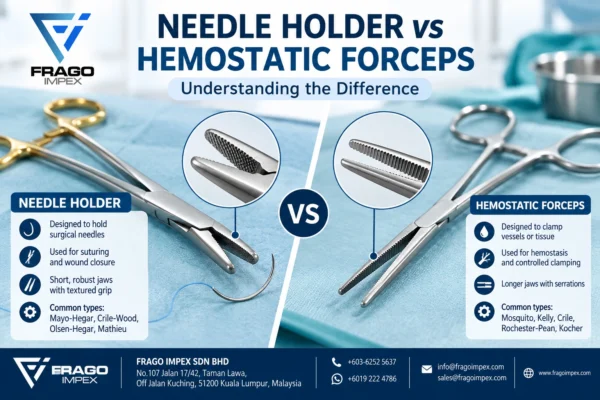
common surgical forceps
common surgical forceps: Surgical forceps are among the most commonly used instruments in operating rooms, procedure rooms, clinics and surgical sets. Although many forceps may look similar at first glance, their tip design, jaw pattern, teeth, serrations, handle construction and locking mechanism can indicate very different functions.
Knowing how to identify common surgical forceps is useful for surgeons, nurses, operating-room staff, sterile processing teams, medical students and healthcare procurement professionals.
For procurement teams, accurate identification is also important when checking surgical sets, replacing damaged instruments or ordering additional instruments. FRAGO IMPEX offers a broad range of surgical instruments, including tissue forceps, artery forceps and other operating-room instruments.


5
The easiest way to identify an unfamiliar forceps is not to rely on its name or overall appearance alone. Instead, examine the instrument systematically:
- Handle design
- Jaw shape
- Tip configuration
- Teeth or serrations
- Straight or curved profile
- Overall size
- Intended function
This approach makes it much easier to distinguish similar-looking instruments.
1. Start by Identifying the Handle Design
The first question to ask is:
Does the instrument have finger rings and a ratchet, or does it work like tweezers?
This immediately separates many forceps into two broad groups.
Thumb Forceps
Thumb forceps resemble tweezers.
They generally have:
- No finger rings
- No ratchet
- Two spring-action arms
- A gripping tip
- A broad or narrow handling area depending on the design
Common examples include:
- Adson Tissue Forceps
- Dressing forceps
- Rat-tooth tissue forceps
- DeBakey-pattern forceps
- Fine dissecting forceps
The user squeezes the arms together to close the tips.
Locking Forceps
Locking forceps generally have:
- Finger rings
- A ratchet mechanism
- Opposing jaws
- Straight or curved jaws
Examples include:
- Allis Tissue Forceps
- Babcock Tissue Forceps
- Mosquito forceps
- Kelly forceps
- Crile forceps
- Kocher Artery Forceps
- Sponge-holding forceps
This simple handle check is one of the quickest ways to narrow down an unfamiliar surgical forceps.
2. How to Identify Adson Forceps


6
Adson forceps are commonly recognized by their relatively broad handling area that tapers into a fine working tip.
FRAGO IMPEX lists Adson Tissue Forceps 1×2 Teeth and Adson Dressing Forceps within its thumb dressing and tissue forceps range.
A toothed Adson pattern commonly has a 1 × 2 tooth configuration.
Typical design
- Thumb-forceps construction
- Broad proximal handling area
- Shorter overall profile than many long dissecting forceps
- Fine working tip
- Toothed or serrated tip depending on the model
Typical applications
Toothed versions may be used for controlled tissue handling, particularly where a secure grip is required.
The exact application depends on the instrument configuration and the procedure.
Identification clue
Look for:
Broad thumb handle → short profile → fine tip → teeth or serrations.
3. How to Identify Toothed Tissue Forceps
One of the easiest forceps to recognize is a 1 × 2 toothed tissue forceps.
FRAGO IMPEX currently lists a Thumb Dressing Tissue Forceps 1×2 Teeth product in its surgical instrument range.


6
The tips have interlocking teeth.
Why the teeth matter
The teeth provide a secure mechanical grip on tissue and reduce the need for excessive continuous pressure.
These forceps may be used for tissue handling during procedures such as wound closure and suturing, depending on the specific design.
Identification clue
If the instrument resembles tweezers and has clearly visible interlocking teeth at the tip, it is likely a toothed tissue forceps.
4. How to Identify DeBakey Forceps
DeBakey-pattern forceps are distinguished primarily by their fine gripping surface.


5
Instead of large interlocking teeth, the working end typically has fine longitudinal grooves or serrations.
Key characteristics
- Long, narrow tips
- Fine gripping surface
- Longitudinal serrations or grooves
- Thumb-forceps construction
- Designed for controlled tissue handling
They are particularly associated with delicate and vascular surgical applications.
How to recognize them
Do not focus on the handle.
Look closely at the tip.
If you see fine longitudinal grooves rather than large teeth, you may be looking at a DeBakey-pattern forceps.
Because manufacturers can offer variations of established instrument patterns, the exact model should be confirmed using the manufacturer’s product information when precise identification is required.
5. How to Identify Allis Tissue Forceps


4
Allis Tissue Forceps are locking tissue-holding instruments with a distinctive toothed jaw design.
FRAGO IMPEX’s Allis Tissue Forceps are described as having interlocking serrated jaws and finger-ring handles.
Key features
- Finger-ring handles
- Ratchet lock
- Interlocking teeth
- Serrated jaws
- Straight or curved configurations depending on model
Typical function
The strong gripping design allows the instrument to securely hold tissue during appropriate surgical procedures.
Because toothed forceps can exert a firm grip, the instrument should be selected according to the tissue and procedure rather than simply because it provides a strong hold.
Identification clue
Finger rings + ratchet + multiple interlocking teeth = Allis.
6. How to Identify Babcock Tissue Forceps
Babcock Tissue Forceps can look similar to other ring-handled tissue-holding forceps, but their jaw design provides the important identification clue.
FRAGO IMPEX’s Babcock Tissue Forceps use fenestrated jaws designed for holding delicate structures.


5
Key features
- Finger-ring handles
- Ratchet mechanism
- Broad jaws
- Fenestrated gripping area
- Rounded design
Typical applications
Babcock forceps are commonly associated with handling delicate tissues and tubular structures.
FRAGO IMPEX describes its Babcock forceps for applications involving structures such as intestine, appendix, fallopian tubes and ureters.
Allis vs Babcock
| Feature | Allis | Babcock |
|---|---|---|
| Handle | Ring | Ring |
| Ratchet | Yes | Yes |
| Jaw design | Interlocking teeth | Fenestrated/rounded |
| Grip | Firm toothed grip | Broader, gentler gripping design |
| Identification clue | Teeth | Fenestrated jaws |
When comparing the two, look at the jaws first.
7. How to Identify Kocher Forceps
Kocher Artery Forceps have a particularly recognizable gripping tip.
FRAGO IMPEX’s straight Kocher Artery Forceps are described with a 1 × 2 toothed tip for secure clamping and tissue grasping.


5
Key characteristics
- Finger-ring handles
- Ratchet
- Serrated jaws
- Terminal interlocking tooth
- Straight or curved configurations
The combination of transverse serrations and terminal teeth is a useful way to distinguish Kocher-type forceps from many ordinary hemostatic forceps.
Identification clue
Look closely at the very end of the jaws.
A prominent terminal tooth is a major clue.
8. How to Identify Mosquito Forceps
Mosquito forceps, also known as Halsted mosquito forceps, are small hemostatic instruments.
FRAGO IMPEX identifies Mosquito Forceps as part of its artery-forceps range and describes them as having small, delicate jaws.


5
Key features
- Small overall size
- Finger-ring handles
- Ratchet
- Fine, narrow jaws
- Straight or curved versions
- Fine serrations
Typical function
They are commonly used where a smaller hemostatic clamp is required, including fine vessel clamping and other applications where a small instrument is appropriate.
Identification clue
Among common ring-handled hemostats, the small size and fine jaws are strong clues that the instrument is a mosquito forceps.
9. How to Identify Kelly Forceps
Kelly forceps are another common type of hemostatic forceps.
They typically have:
- Ring handles
- Ratchet
- Straight or curved jaws
- Transverse serrations
- Larger jaws than mosquito forceps
FRAGO IMPEX’s published artery-forceps guide identifies Kelly Forceps by their characteristic partial serration pattern and associates them with medium-sized vessel clamping.


5
Kelly vs Mosquito
| Feature | Mosquito | Kelly |
|---|---|---|
| General size | Smaller | Larger |
| Jaw | Fine and narrow | Larger |
| Ratchet | Yes | Yes |
| Serrations | Fine | Characteristic partial jaw serration |
| Typical role | Fine hemostatic applications | General hemostatic clamping |
The exact configuration can vary between manufacturers, so the product specification should be checked when purchasing or cataloguing instruments.
10. How to Identify Crile Forceps
Crile forceps are also locking hemostatic instruments.
A key design characteristic is the transverse serration pattern extending along the gripping portion of the jaws.
FRAGO IMPEX’s artery-forceps guide distinguishes Crile Forceps from Kelly Forceps by identifying Crile forceps with full-length serrations.


6
Identification features
- Finger rings
- Ratchet
- Straight or curved configuration
- Transverse serrations
- Serrations extending along the working jaw
Kelly vs Crile
The easiest comparison is the serration pattern.
Kelly: serrations generally occupy part of the jaw.
Crile: serrations extend along the working portion of the jaw.
This distinction is particularly useful when several hemostatic forceps are laid out together.
11. Dressing Forceps: Examine the Fine Tip
Dressing forceps are generally thumb-operated instruments designed primarily for handling dressings and other materials.
FRAGO IMPEX lists Adson Dressing Forceps Serrated 12cm and other dressing forceps in its thumb dressing and tissue forceps category.
Typical characteristics
- No finger rings
- No ratchet
- Long, narrow arms
- Fine tips
- Smooth or serrated gripping surfaces
They are commonly used for handling gauze, dressings, sutures and other materials.
The important point is that dressing forceps and tissue forceps should not automatically be considered interchangeable. The tip configuration determines how the instrument interacts with the material or tissue.
12. Sponge-Holding Forceps: Look for Large Rounded Jaws
Sponge-holding forceps are easily distinguished from fine tissue forceps because of their larger gripping jaws.
They typically have:
- Ring handles
- Ratchet
- Long shaft
- Rounded or oval jaws
- Smooth or serrated gripping surfaces depending on the model


4
The large gripping area is designed for holding sponges, swabs and similar materials.
When identifying this type of forceps, the large rounded jaw is usually the most obvious clue.
13. Bayonet Forceps: Identify the Offset Shape
Bayonet forceps are recognized by their unusual profile.
Instead of the handle and tip forming one straight line, the shaft has an offset or bayonet-shaped configuration.


5
This configuration can improve visibility and access in confined operative areas.
However, “bayonet forceps” describes a design style rather than one single instrument. The actual application depends on the specific model.
For that reason, an instrument should not be identified by shape alone when exact product identification is required.
Common Surgical Forceps Identification Chart
| Forceps | Main Design Feature | Typical Function |
|---|---|---|
| Adson Tissue Forceps | Fine toothed or serrated tip | Tissue handling |
| Thumb Dressing Tissue Forceps | 1 × 2 teeth | Tissue manipulation |
| DeBakey Forceps | Fine longitudinal grooves | Delicate tissue handling |
| Allis Tissue Forceps | Multiple interlocking teeth | Firm tissue holding |
| Babcock Tissue Forceps | Fenestrated rounded jaws | Delicate tissue holding |
| Kocher Artery Forceps | Terminal tooth + serrations | Firm clamping |
| Mosquito Forceps | Small fine jaws | Fine hemostatic clamping |
| Kelly Forceps | Partial jaw serrations | Hemostatic clamping |
| Crile Forceps | Full-length serrations | Hemostatic clamping |
| Sponge Forceps | Large rounded jaws | Holding sponges |
| Bayonet Forceps | Offset shaft | Specialized access |
How to Identify an Unknown Surgical Forceps
If an unfamiliar instrument is found in a surgical tray, use this five-step process.
Step 1: Examine the Handle
Determine whether it is:
- A thumb forceps
- A ring-handled forceps
- A locking instrument
Step 2: Examine the Tip
Look for:
- Smooth surfaces
- Fine serrations
- Longitudinal grooves
- Interlocking teeth
- Terminal teeth
- Rounded jaws
- Fenestrations
Step 3: Examine the Jaw Shape
Determine whether the jaws are:
- Straight
- Curved
- Narrow
- Broad
- Rounded
- Fenestrated
- Offset
Step 4: Examine the Serration Pattern
This is particularly important for hemostatic forceps.
The location and direction of the serrations can help distinguish instruments such as Kelly and Crile forceps.
Step 5: Verify the Manufacturer’s Product Information
Visual identification is useful, but it should not replace the manufacturer’s catalog, product reference number or institutional instrument list when exact identification is required.
This is especially important when ordering replacement instruments.
Toothed vs Serrated Forceps
The difference between toothed and serrated forceps is important.
Toothed Forceps
Toothed forceps use interlocking teeth to create a secure mechanical grip.
Examples include:
They may be useful when a firm grip is required.
Serrated or Grooved Forceps
These instruments use fine serrations or grooves to provide controlled gripping.
Examples include:
- DeBakey-pattern forceps
- Kelly forceps
- Crile forceps
- Mosquito forceps
The correct design depends on the intended clinical application.
A stronger grip is not automatically a better grip. Instrument selection should take into account the tissue, procedure and manufacturer’s intended use.
Common Mistakes When Identifying Surgical Forceps
1. Identifying by Size Alone
Two forceps may have similar lengths but completely different functions.
Better approach: Examine the tip and jaw pattern.
2. Assuming All Ring-Handled Forceps Are the Same
Mosquito, Kelly, Crile, Allis and Babcock forceps can all have finger rings and ratchets.
Better approach: Compare the jaws and serrations.
3. Confusing Allis and Babcock Forceps
Their overall shapes may look similar.
Better approach: Look for the teeth on Allis and the fenestrated, rounded jaws of Babcock.
4. Ignoring the Serration Pattern
Kelly and Crile forceps can look very similar.
Better approach: Examine exactly where the serrations extend along the jaws.
5. Assuming a Product Name Is a Universal Specification
Names such as Adson, Kelly, Crile and Kocher describe established instrument patterns, but manufacturers can offer different sizes and configurations.
Better approach: Confirm the exact product specification before ordering.
Inspect Forceps Before Use
Correct identification is only one part of surgical instrument management.
Reusable instruments should also be checked for:
- Bent tips
- Misaligned jaws
- Damaged teeth
- Damaged serrations
- Corrosion
- Pitting
- Cracks
- Loose joints
- Faulty ratchets
- Residual contamination
Proper cleaning, inspection, maintenance and sterilization are essential parts of reusable surgical-instrument processing.
For more information, see the FRAGO IMPEX guide on Surgical Instrument Care and Maintenance.
Follow the manufacturer’s instructions for use and the healthcare facility’s validated cleaning, disinfection and sterilization procedures.
How Hospitals Can Improve Forceps Identification
Hospitals and clinics managing large surgical inventories can benefit from a standardized identification system.
1. Use Instrument Photographs
Photograph the complete instrument and its working tip.
2. Record the Exact Name
Use standardized instrument names rather than informal descriptions.
3. Record the Product Code
Where available, maintain the manufacturer’s reference or product code.
4. Record the Size
Document instrument length and relevant dimensions.
5. Record the Intended Application
Use the manufacturer’s product information and institutional procedures as the reference.
6. Record the Surgical Set
Document which surgical tray or procedure set contains the instrument.
This can make instrument replacement, tray assembly and inventory management easier.
Why Correct Forceps Identification Matters for Procurement
For healthcare procurement teams, identifying the correct forceps is more than simply matching a familiar name.
Before placing an order, consider:
- Exact instrument type
- Jaw design
- Straight or curved configuration
- Instrument length
- Material
- Finish
- Reprocessing requirements
- Manufacturer
- Product code
- Intended application
- Required quantity
A purchase request for “Kelly forceps” alone may not provide enough information if multiple sizes or configurations are available.
The same principle applies to Allis, Babcock, Adson, Kocher, Mosquito and other surgical forceps.
For hospitals and clinics, precise product identification reduces the risk of receiving an instrument that looks similar but does not match the intended surgical set.
Final Takeaway
Identifying common surgical forceps becomes much easier when you focus on design rather than appearance alone.
Start with the handle:
Thumb forceps or locking forceps?
Then examine the working end:
Smooth, serrated, toothed, grooved, rounded or fenestrated?
Finally, consider the jaw shape, curvature and overall size.
Some of the most useful identification clues are:
- Adson Tissue Forceps → fine toothed or serrated tip
- DeBakey → fine longitudinal grooves
- Allis Tissue Forceps → interlocking teeth
- Babcock Tissue Forceps → rounded fenestrated jaws
- Kocher Artery Forceps → terminal tooth
- Mosquito → small fine hemostatic jaws
- Kelly → characteristic partial serration pattern
- Crile → serrations along the working portion of the jaws
- Sponge forceps → large rounded jaws
- Bayonet forceps → offset shaft
Understanding these differences helps healthcare professionals identify instruments more accurately and helps procurement teams order the correct products for surgical sets.
FRAGO IMPEX’s Surgical Instruments range includes tissue forceps, artery forceps and other surgical instruments for healthcare facilities and medical professionals.
Frequently Asked Questions
What are the main types of surgical forceps?
Common categories include tissue forceps, dressing forceps, hemostatic forceps, grasping forceps, sponge-holding forceps and specialized forceps designed for particular surgical applications.
How can I identify Adson forceps?
Look for a relatively broad thumb-forceps handle that tapers into a fine tip. Depending on the model, the tip may have teeth or serrations.
What is the difference between Allis and Babcock forceps?
Allis Tissue Forceps have interlocking toothed jaws, while Babcock Tissue Forceps have broad, rounded, fenestrated jaws.
What is the difference between Kelly and Mosquito forceps?
Both are locking hemostatic forceps, but mosquito forceps are generally smaller and finer. Their jaw and serration patterns also differ.
What is the difference between Kelly and Crile forceps?
A commonly used identification distinction is the serration pattern. Kelly forceps generally have serrations over part of the jaw, while Crile forceps have serrations extending along the working portion.
What are DeBakey forceps used for?
DeBakey-pattern forceps are designed for controlled tissue handling and are commonly associated with delicate and vascular surgical applications. Fine longitudinal grooves are an important identification feature.
What makes Kocher forceps different?
Kocher Artery Forceps have serrated jaws with a characteristic terminal tooth, giving the instrument a distinctive gripping design.
Are surgical forceps reusable?
Some surgical forceps are reusable medical devices, while others may be designed for single use. Always verify the manufacturer’s labeling and instructions for use before reprocessing an instrument.
About FRAGO IMPEX SDN BHD
FRAGO IMPEX SDN BHD
Medical Supplies & Surgical Instruments Supplier in Malaysia
Address: No. 107, Jalan 17/42, Taman Lawa, Off Jalan Kuching, 51200 Kuala Lumpur, Malaysia
Tel: +603-6252 5637
WhatsApp: +6019 222 4786
Email: info@fragoimpex.com
Sales: sales@fragoimpex.com
Website: www.fragoimpex.com
FRAGO IMPEX supplies surgical instruments, medical devices, hospital equipment and clinical supplies to healthcare organizations, medical professionals, distributors and procurement teams.