Surgical Needle Holder:
A surgical needle holder is a small but important instrument used during suturing. It allows the surgeon to grasp and control a suture needle while passing it through tissue.
Although many needle holders look similar at first glance, they are available in different patterns, lengths, jaw designs and configurations. Some are designed specifically for fine needle control, while others provide a stronger grip or combine needle holding with suture cutting.
For hospitals, clinics and procurement teams, choosing the right needle holder means looking beyond the instrument name. Length, jaw design, grip, locking mechanism, needle size, surgical application and instrument construction should all be considered.
FRAGO IMPEX currently lists a dedicated Needle Holders collection with 15 listed products, including Mayo Hegar, Olsen Hegar, Crile Wood, Mathieu, Langenbeck, Gillies and other needle-holder patterns. (Frago Impex SDN BHD)


What Is a Surgical Needle Holder?
A surgical needle holder, also called a needle driver, is a hand-held surgical instrument used to grasp and manipulate a suture needle during suturing.
A typical needle holder consists of:
- Handles
- Finger rings or operating handles
- A ratchet or locking mechanism on many designs
- A box joint or other joint construction
- Jaws designed to grip the needle
The jaws are particularly important because they need to provide controlled needle handling without allowing unnecessary movement.
The World Health Organization’s MEDEVIS database describes reusable needle holders as surgical instruments designed to grasp a suture needle while the needle and attached suture are passed through tissue. It also recognizes that needle holders are available in different designs and sizes. (MEDEVIS)
Why Are Needle Holders Important?
During suturing, the needle must be controlled accurately as it passes through tissue.
A suitable needle holder can help the surgeon:
- Secure the needle
- Control needle direction
- Rotate the needle when required
- Maintain a consistent grip
- Perform suturing with an appropriate instrument size
- Work with different needle sizes and suture applications
The exact instrument should be selected according to the procedure, needle characteristics and the preferences of the surgical team.
A needle holder should not simply be chosen because it is the most common pattern available. The instrument should match the intended application.
Main Types of Surgical Needle Holders
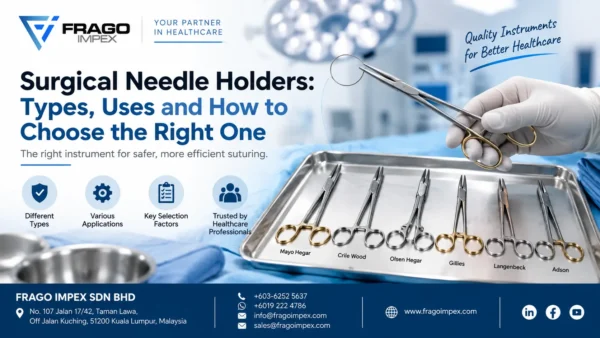
There are many needle-holder patterns available. The following are some commonly encountered designs, including several models currently listed by FRAGO IMPEX.
1. Mayo Hegar Needle Holder
The Mayo Hegar needle holder is a widely recognized needle-holder design used for general suturing.
Its box-joint construction and ratchet mechanism provide a controlled grip on the needle.
FRAGO IMPEX currently lists a Mayo Hegar Needle Holder in sizes including 13 cm, 15 cm, 18 cm and 20 cm. (Frago Impex SDN BHD)
Typical considerations
- General suturing applications
- Different available lengths
- Serrated jaw design
- Ratchet locking mechanism
- Appropriate selection according to needle size
Mayo Hegar needle holders are commonly included when building or reviewing general surgical instrument inventories.
2. Crile Wood Needle Holder
The Crile Wood needle holder is a fine needle-handling instrument featuring tungsten carbide jaw inserts in the FRAGO IMPEX model.
Tungsten carbide inserts can provide a durable gripping surface and are commonly used in needle holders designed for precise needle control.
The FRAGO IMPEX Crile Wood Needle Holder is listed as a 15 cm box-joint instrument with tungsten carbide jaw inserts. (Frago Impex SDN BHD)
When considering a Crile Wood design
Look at:
- Jaw condition
- Insert condition
- Alignment
- Ratchet function
- Needle compatibility
- Intended suturing application
3. Olsen Hegar Needle Holder
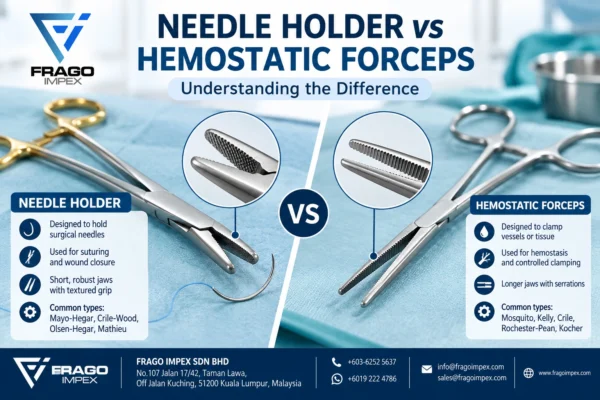
The Olsen Hegar needle holder combines two functions: needle holding and suture cutting.
Its integrated scissors allow the operator to hold the needle and cut suture without changing to a separate pair of scissors.
FRAGO IMPEX lists an Olsen Hegar Needle Holder with integrated scissors and available sizes of 14 cm and 16 cm. (Frago Impex SDN BHD)
Main advantage of the design
The combined configuration can reduce the need to exchange instruments during suturing.
However, whether this design is appropriate depends on the surgical technique and the preferences of the clinical team.
4. Gillies Needle Holder
The Gillies needle holder is another design that combines needle holding and suture cutting.
FRAGO IMPEX lists a Gillies Needle Holder with a combined needle-holder and scissors configuration at 16 cm. (Frago Impex SDN BHD)
This type of instrument may be considered when both needle manipulation and suture cutting are required within the same workflow.
5. Langenbeck Needle Holder
The Langenbeck needle holder, also known as a Vienna pattern needle holder, is designed for controlled needle handling.
FRAGO IMPEX currently lists the Langenbeck Needle Holder in 16 cm, 18 cm and 20 cm sizes. (Frago Impex SDN BHD)
When selecting between different sizes, consider the depth and accessibility of the operative field and the needle being used.
6. Adson Needle Holder
The Adson needle holder is another option for controlled needle manipulation.
The FRAGO IMPEX Adson Needle Holder is listed with a box-joint construction and available sizes ranging from 13 cm to 23 cm. (Frago Impex SDN BHD)
The appropriate size should be selected according to the intended procedure and required working access.
7. Finochietto Needle Holder
The Finochietto needle holder is a longer instrument designed for applications where additional reach may be useful.
FRAGO IMPEX lists the Finochietto Needle Holder with curved jaws and a 27 cm length. (Frago Impex SDN BHD)
Longer needle holders can be useful when the surgical field requires greater reach, but the correct choice depends on the procedure and surgeon preference.
Needle Holder Types at a Glance
| Needle Holder | Key Characteristic | Example FRAGO IMPEX Product |
|---|---|---|
| Mayo Hegar | General-purpose box-joint design | Mayo Hegar Needle Holder |
| Crile Wood | Tungsten carbide jaw inserts | Crile Wood Needle Holder |
| Olsen Hegar | Needle holder with integrated scissors | Olsen Hegar Needle Holder |
| Gillies | Combined needle holder and scissors | Gillies Needle Holder |
| Langenbeck | Vienna pattern, multiple lengths | Langenbeck Needle Holder |
| Adson | Available in multiple lengths | Adson Needle Holder |
| Finochietto | Long, curved-jaw configuration | Finochietto Needle Holder |
The table is intended as a general comparison. The correct instrument should be selected according to the actual surgical application and relevant manufacturer information.
How to Choose the Right Surgical Needle Holder
Choosing a needle holder should start with the procedure and needle, rather than the instrument name alone.
1. Consider the Needle Size
Needle holders are available with different jaw sizes and configurations.
A small needle may require a finer gripping surface, while larger needles may require a more substantial instrument.
The jaw should grip the needle securely without unnecessarily damaging it.
2. Consider Instrument Length
Length is one of the most important selection factors.
Common considerations include:
- Shorter instruments for accessible fields
- Medium-length instruments for general procedures
- Longer instruments where additional reach is required
FRAGO IMPEX lists needle holders in several lengths, from approximately 13 cm for some Adson and Mayo Hegar models to 27 cm for certain Finochietto models. (Frago Impex SDN BHD)
The correct length should be determined by the procedure and working depth.
3. Examine the Jaw Design
The jaws are responsible for gripping the needle.
When evaluating a needle holder, check:
- Jaw shape
- Serrations
- Alignment
- Surface condition
- Insert condition where applicable
- Ability to grip the intended needle
A damaged or misaligned jaw can affect instrument performance.
4. Check the Ratchet Mechanism
Many needle holders use a ratchet mechanism to maintain the instrument in a closed position.
The ratchet should:
- Engage properly
- Release smoothly
- Maintain the intended grip
- Not feel excessively loose
- Not bind during operation
During routine instrument inspection, the ratchet should be checked along with the jaws and box joint.
5. Consider Tungsten Carbide Inserts
Some needle holders use tungsten carbide inserts in their jaws.
For example, the FRAGO IMPEX Crile Wood Needle Holder is listed with tungsten carbide jaw inserts. (Frago Impex SDN BHD)
When purchasing instruments with inserts, procurement and sterile-processing teams should also consider the condition of those inserts during inspection and maintenance.
6. Decide Whether Integrated Scissors Are Useful
Olsen Hegar and Gillies patterns combine needle holding with suture cutting.
This can be useful where the surgical workflow benefits from having both functions in one instrument.
However, a combined instrument should not automatically replace separate needle holders and scissors. The appropriate configuration depends on the surgical technique, instrument preference and facility requirements.
Needle Holder vs Needle Driver
The terms needle holder and needle driver are commonly used to describe instruments used to grasp and control suture needles.
In practical healthcare and procurement contexts, you may encounter both terms in:
- Product catalogues
- Surgical instrument lists
- Hospital purchasing documents
- Instrument sets
- Manufacturer documentation
When searching for products, using both terms can help procurement teams identify relevant instruments.
What Materials Are Surgical Needle Holders Made From?
Reusable surgical needle holders are commonly manufactured from stainless steel.
The exact material specification and construction should be verified against the manufacturer’s product information rather than assumed from the appearance of the instrument.
FRAGO IMPEX product listings for several needle holders identify stainless steel construction. For example, the Mayo Hegar, Adson, Crile Wood and Langenbeck models are listed with stainless steel as the material. (Frago Impex SDN BHD)
For a broader explanation of surgical instrument materials, see:
Surgical Instrument Materials: Stainless Steel, Titanium and Other Common Materials Explained
How to Inspect a Needle Holder Before Use
Before an instrument is returned to service, healthcare facilities should follow their own validated inspection and processing procedures.
Points that may be checked include:
Jaw Alignment
The jaws should meet appropriately and maintain their intended alignment.
Jaw Surface
Inspect serrations or carbide inserts for damage or excessive wear.
Ratchet
Check that the ratchet engages and releases correctly.
Box Joint
The joint should move appropriately without excessive looseness.
Handles
Check for damage, deformation or abnormal movement.
Surface
Look for corrosion, pitting, staining or other visible defects.
Overall Function
The instrument should perform its intended function correctly.
If an instrument does not function properly, it should be handled according to the healthcare facility’s instrument-management and maintenance procedures.
Cleaning and Sterilization of Needle Holders
Reusable surgical instruments require appropriate cleaning and reprocessing.
The specific process should always follow:
- The manufacturer’s instructions for use
- The healthcare facility’s validated procedures
- Applicable infection-prevention requirements
- The validated sterilization process
WHO guidance identifies surgical instruments as critical items requiring sterilization between patients when they are thermoresistant. (Iris)
For more practical information, see:
How to Maintain and Sterilize Needle Holders for Long-Lasting Performance
You can also read:
Surgical Instrument Care: How to Clean & Maintain Stainless Steel Instruments
Common Mistakes When Choosing Needle Holders
Choosing Only by Price
A low purchase price does not necessarily mean the instrument is suitable for the intended application.
Consider specifications, construction, size, jaw design and expected use.
Selecting the Wrong Length
A needle holder that is too short or too long may not be appropriate for the working field.
Ignoring the Needle
The instrument should be selected according to the type and size of needle being used.
Not Checking the Jaw
The jaw is one of the most important functional parts of the instrument.
Ignoring the Ratchet
A poorly functioning ratchet can affect controlled needle handling.
Buying More Features Than Needed
A combined needle holder and scissors may be useful in some workflows, but a conventional needle holder may be more appropriate in others.
Surgical Needle Holder Procurement Checklist
Hospitals and clinics can use the following checklist when purchasing needle holders.
| Requirement | What to Check |
|---|---|
| Instrument type | Mayo Hegar, Crile Wood, Olsen Hegar, etc. |
| Length | Appropriate for procedure and access |
| Jaw design | Serrated, fine, carbide insert, etc. |
| Needle compatibility | Appropriate for intended needle |
| Ratchet | Secure engagement and smooth release |
| Joint | Proper movement and alignment |
| Material | Verify manufacturer specification |
| Finish | Inspect surface condition |
| Maintenance | Manufacturer’s instructions available |
| Reprocessing | Compatible with facility’s validated process |
| Quantity | Based on procedure volume and instrument turnover |
| Supplier | Product identification and availability |
Why Hospitals Should Standardize Needle Holders
Hospitals may use multiple needle-holder patterns because different procedures and surgical teams have different requirements.
However, unnecessary variation can make inventory management more complicated.
Standardization can help with:
- Stock management
- Reordering
- Instrument identification
- Surgical-set preparation
- Staff familiarity
- Replacement planning
Standardization should still allow appropriate variation where clinical requirements justify different designs or sizes.
How Many Needle Holders Does a Hospital Need?
There is no universal number that applies to every hospital.
The required quantity depends on factors such as:
- Number of operating rooms
- Procedure volume
- Surgical specialties
- Number of instrument sets
- Sterilization turnaround
- Instrument replacement rate
- Emergency requirements
- Surgeons’ preferred configurations
A hospital should determine its inventory based on actual procedure requirements and instrument-processing capacity.
FRAGO IMPEX Needle Holders
FRAGO IMPEX provides a dedicated Needle Holders collection featuring multiple needle-holder patterns. The current category includes 15 listed products, including Adson, Collier, Crile Wood, Finochietto, Gillies, Johnson, Langenbeck, Masson, Mathieu, Mayo Hegar, Olsen Hegar and Wangensteen models. (Frago Impex SDN BHD)
Some of the available products include:
- Mayo Hegar Needle Holder
- Crile Wood Needle Holder
- Olsen Hegar Needle Holder
- Gillies Needle Holder
- Langenbeck Needle Holder
- Adson Needle Holder
- Finochietto Needle Holder
For hospitals, clinics and procurement teams, the appropriate model should be selected according to the procedure, needle characteristics, required dimensions and the facility’s specifications.
Frequently Asked Questions
What is a surgical needle holder?
A surgical needle holder is an instrument used to securely grasp and control a suture needle during suturing.
What is another name for a needle holder?
A needle holder is also commonly called a needle driver.
What is the most common type of needle holder?
Mayo Hegar is a widely recognized general surgical needle-holder pattern, although the appropriate type depends on the procedure, needle and surgical technique.
What is an Olsen Hegar needle holder?
An Olsen Hegar combines a needle holder with integrated scissors, allowing the instrument to hold the needle and cut suture.
What is a Crile Wood needle holder?
Crile Wood is a needle-holder design that can feature tungsten carbide jaw inserts. FRAGO IMPEX lists a 15 cm Crile Wood model with tungsten carbide inserts. (Frago Impex SDN BHD)
How do I choose the correct needle holder size?
Consider the surgical procedure, access to the operative field, needle size and the required degree of control. Needle holders are available in different lengths and configurations.
Can surgical needle holders be sterilized?
Reusable needle holders must be processed according to the manufacturer’s instructions and the healthcare facility’s validated cleaning and sterilization procedures. WHO identifies thermoresistant surgical instruments as critical items requiring sterilization between patients. (Iris)
Conclusion
Surgical needle holders are essential suturing instruments, but selecting the right model requires more than choosing a familiar name.
Hospitals and clinics should consider needle size, instrument length, jaw design, ratchet mechanism, material, construction, intended procedure and reprocessing requirements before purchasing.
Different patterns serve different requirements. Mayo Hegar provides a commonly used general-purpose configuration, while Crile Wood, Olsen Hegar, Gillies, Langenbeck, Adson and Finochietto designs offer other combinations of length, jaw configuration and functionality.
For hospitals and healthcare facilities reviewing their surgical instrument inventory, the FRAGO IMPEX Needle Holders collection provides multiple patterns and sizes for evaluation. (Frago Impex SDN BHD)
Contact FRAGO IMPEX SDN BHD
FRAGO IMPEX SDN BHD
No. 107 Jalan 17/42, Taman Lawa, Off Jalan Kuching
51200 Kuala Lumpur, Malaysia
Tel: +603-6252 5637
WhatsApp: +6019 222 4786
Email: info@fragoimpex.com
Sales: sales@fragoimpex.com