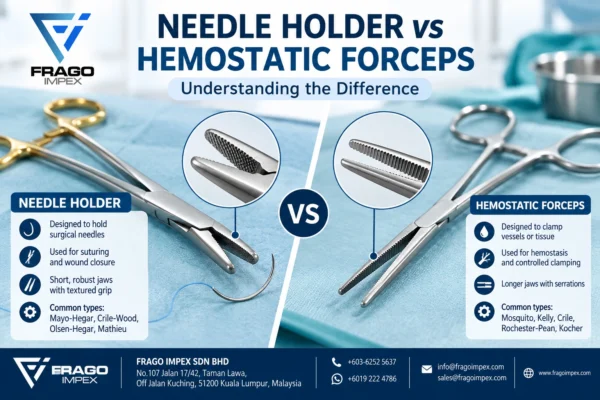
Hemostatic Forceps:
Hemostatic forceps are locking surgical instruments used to clamp blood vessels or other suitable tissue structures during procedures where temporary control is required. They are also commonly called hemostats, haemostatic forceps or artery forceps.
Although many hemostatic forceps look similar, their size, jaw shape, curvature and serration pattern can significantly differ. These design differences are important when selecting an instrument for a particular surgical application.
Common patterns include Mosquito, Kelly, Crile, Kocher and Rochester Pean forceps. Understanding how these designs differ helps surgeons, operating-room staff, sterile processing personnel and procurement teams identify the appropriate instrument more accurately.


What Are Hemostatic Forceps?
Hemostatic forceps are hinged instruments with finger rings, a ratchet locking mechanism and opposing jaws. When the handles are closed, the ratchet allows the jaws to remain closed without continuous hand pressure.
Their primary function is temporary mechanical clamping. Depending on the instrument design and procedure, a hemostat may be used to clamp an appropriate blood vessel, secure a tissue structure or assist with bleeding control.
The basic construction usually includes:
- Finger-ring handles
- Ratchet locking mechanism
- Box joint
- Straight or curved jaws
- Serrated gripping surfaces
- Different jaw lengths and widths
The specific design determines how the instrument should be used. Hemostatic forceps should therefore be selected according to the procedure, anatomical site and manufacturer’s specifications rather than simply by appearance.
The University of Saskatchewan’s veterinary surgical instrument guide similarly identifies hemostats by their jaw serrations, size and straight or curved configuration. (wcvm)
How Do Hemostatic Forceps Control Bleeding?
The serrated jaws provide a controlled mechanical grip when the instrument is applied to an appropriate structure. The ratchet then maintains the closed position.
The purpose is not simply to “clamp anything that is bleeding.” The instrument pattern and application need to match the structure being controlled.
For example:
- A small, fine hemostat may be selected when working around small vessels.
- A larger hemostat may be appropriate when a stronger or broader clamp is required.
- A curved jaw can provide access around structures or within deeper operative fields.
- A straight jaw may be useful when direct access is available.
The actual clinical application should always follow the procedure, institutional practice and instructions for the specific instrument.
Common Types of Hemostatic Forceps
Several hemostatic patterns are commonly encountered in surgical instrument sets. The most useful way to distinguish them is by examining jaw size and serration pattern, rather than relying only on the instrument’s name.
1. Mosquito Forceps
Mosquito forceps, also known as Halsted Mosquito forceps, are relatively small and fine hemostatic instruments.
They are designed for applications where a smaller clamp is appropriate, including control of smaller vessels and delicate operative work.
Typical characteristics
- Small overall profile
- Fine jaws
- Ring handles
- Ratchet lock
- Straight and curved configurations
- Fine transverse serrations
Because Mosquito forceps are smaller than many standard hemostats, they can be useful when the operative field requires a more delicate instrument.


Mosquito forceps are commonly associated with:
- Small-vessel hemostasis
- Fine surgical procedures
- Areas requiring a smaller clamp
- Procedures where a larger hemostat would be unnecessarily bulky
The exact dimensions and jaw configuration can vary between manufacturers, so the product specification should be checked when precise instrument identification is required.
2. Kelly Forceps
Kelly forceps are another widely recognized hemostatic pattern.
One of their most useful identification characteristics is the partial serration pattern commonly associated with the jaws. Conventional Kelly forceps have transverse serrations over the distal portion of the jaw rather than across its entire length. (wcvm)
Typical characteristics
- Finger-ring handles
- Ratchet mechanism
- Straight or curved jaws
- Transverse serrations
- Larger and more substantial jaws than Mosquito forceps
Kelly forceps are commonly used for general hemostatic applications and clamping suitable vessels or tissue structures.


When identifying a Kelly forceps, opening the jaws and inspecting the serration coverage is more useful than judging the overall shape alone.
3. Crile Forceps
Crile forceps resemble Kelly forceps in their general construction, which is why they are frequently confused.
The important traditional distinction is the serration pattern.
Crile forceps typically have:
- Ring handles
- Ratchet lock
- Straight or curved jaws
- Transverse serrations extending along the full working portion of the jaws
This contrasts with the conventional Kelly pattern, where serrations are generally limited to the distal portion of the jaws. (Medical Forceps)


Crile vs Kelly
| Feature | Kelly Forceps | Crile Forceps |
|---|---|---|
| Handle | Ring handles | Ring handles |
| Ratchet | Yes | Yes |
| Jaw shape | Straight or curved | Straight or curved |
| Serration pattern | Commonly distal portion | Commonly full working length |
| General role | Hemostatic clamping | Hemostatic clamping |
| Main identification point | Partial serration | Full serration |
This distinction is useful when checking an existing surgical set or ordering replacement instruments.
However, instrument patterns can vary between manufacturers. If the exact model is important, the manufacturer’s catalogue or product specification should take precedence over a generic textbook description.
4. Rochester Pean Forceps
Rochester Pean forceps are larger, heavier hemostatic forceps designed for applications requiring a more substantial clamp.
They are available in straight and curved configurations, with the curved version providing an angled approach to the operative field.


A curved Rochester Pean pattern generally has:
- Long jaws
- Fully serrated gripping surfaces
- Finger-ring handles
- Ratchet mechanism
- A relatively heavy-duty construction
For example, the Rochester Pean Hemostatic Forceps Curved listed for surgical use is available in several lengths, including 13 cm, 14 cm, 16 cm, 18 cm and 20 cm, with a stainless-steel construction.
Typical applications
Rochester Pean forceps may be selected when the procedure requires a larger or heavier hemostatic clamp, including appropriate applications involving larger vessels or thicker tissue structures.
The exact clinical use should be determined by the surgeon and procedure rather than by the instrument name alone.
5. Kocher Forceps: Similar Appearance, Different Tip
Kocher forceps are sometimes discussed alongside hemostatic forceps because they have a similar ring-handle and ratchet construction.
However, their jaws have an important identifying feature: a terminal tooth.
The conventional Kocher pattern combines serrated jaws with a tooth at the tip, producing a substantially different gripping profile from a standard non-toothed hemostat. (Frago Impex SDN BHD)
This distinction matters because a toothed instrument should not automatically be substituted for a conventional hemostatic clamp.


Hemostatic Forceps Comparison
The following table provides a practical identification guide.
| Instrument | Jaw profile | Serration pattern | General size/profile | Common role |
|---|---|---|---|---|
| Mosquito | Fine, narrow | Fine transverse serrations | Small | Fine vessel control |
| Kelly | Moderate | Commonly distal-half serrations | Medium | General hemostatic clamping |
| Crile | Moderate | Commonly full-length transverse serrations | Medium | General hemostatic clamping |
| Rochester Pean | Larger/heavier | Full serrations | Larger | Larger vessels or thicker structures |
| Kocher | Heavier gripping tip | Serrations plus terminal tooth | Medium/heavy | Firm tissue/vessel grasping where specified |
These are conventional pattern descriptions. Individual manufacturers may produce variations in jaw geometry, length, finish and configuration.
Straight vs Curved Hemostatic Forceps
Another important distinction is whether the jaws are straight or curved.
Straight Hemostatic Forceps
Straight forceps provide a direct line between the handle and working tip.
They may be useful when:
- The target structure is readily accessible.
- Direct jaw visualization is available.
- Straight-line clamping is appropriate.
Curved Hemostatic Forceps
Curved forceps change the angle of the working end relative to the handle.
They may help when:
- Access is deeper.
- An angled approach is useful.
- The surrounding anatomy makes a straight instrument less convenient.
- The surgeon needs to keep the handle away from the immediate operative field.
Straight and curved versions should not be considered interchangeable simply because they belong to the same instrument family.
What Is the Difference Between Mosquito, Kelly and Crile Forceps?
This is one of the most common questions when identifying hemostatic instruments.
Mosquito vs Kelly
The Mosquito is generally smaller and finer, while Kelly forceps are larger and have a broader working profile.
Kelly vs Crile
The conventional distinction is primarily the serration coverage:
- Kelly: serrations commonly cover the distal portion of the jaw.
- Crile: serrations commonly extend across the full working length.
(wcvm)
Mosquito vs Crile
A Mosquito is generally smaller and finer. A Crile has a more substantial jaw and is commonly identified by full-length transverse serrations.
The key point is that size and serration pattern should be considered together.
How to Choose the Right Hemostatic Forceps
For hospitals and procurement teams, selecting a hemostatic forceps should involve more than choosing a familiar name.
Consider the following factors.
1. Intended Application
Start with the procedure and the structure being clamped.
Do not select an instrument solely because it is described as a “hemostat.”
2. Jaw Size
A small vessel may require a finer instrument, while a larger structure may require a broader and heavier pattern.
3. Serration Pattern
Check whether the jaws are:
- Fine or coarse
- Partially serrated
- Fully serrated
- Longitudinally grooved
- Toothed
This can be one of the most important identification features.
4. Straight or Curved Configuration
Consider the depth and accessibility of the operative field.
5. Instrument Length
Longer instruments can provide reach in deeper fields, while shorter instruments may provide more convenient control in superficial procedures.
6. Jaw Alignment
The jaws should meet appropriately and should not be visibly twisted, misaligned or damaged.
7. Ratchet Function
The locking mechanism should engage properly and release smoothly according to the instrument’s intended design.
8. Surface Condition
For reusable instruments, inspect for:
- Corrosion
- Pitting
- Staining
- Surface damage
- Cracks
- Joint problems
- Damaged serrations
Instrument inspection and reprocessing should follow the facility’s established sterile-processing procedures and the manufacturer’s instructions.
Common Mistakes When Selecting Hemostatic Forceps
Choosing by name alone
Names such as Kelly, Crile or Rochester Pean describe established patterns, but variations exist. Always verify the actual product configuration.
Confusing Kelly and Crile
The two can look almost identical when the jaws are closed. Open the jaws and inspect the serration coverage.
Ignoring jaw curvature
Straight and curved versions may provide different access to the operative field.
Selecting a larger forceps unnecessarily
A larger or heavier instrument is not automatically appropriate for every application.
Replacing one pattern with another without checking specifications
Two instruments may both be called artery forceps while having different jaw geometry, dimensions or intended applications.
Failing to inspect the locking mechanism
A damaged ratchet or poorly functioning joint can affect instrument performance and should be addressed according to institutional instrument-management procedures.
Hemostatic Forceps and Medical Device Regulation in Malaysia
For healthcare organizations purchasing medical devices in Malaysia, product selection should also include appropriate regulatory checks.
The Medical Device Authority (MDA), Ministry of Health Malaysia, states that medical devices must be registered under the Medical Device Act 2012 before they are imported, exported or placed on the Malaysian market, subject to the applicable regulatory requirements. MDA also provides the Malaysia Medical Device Register (MMDR) for checking registered medical devices and licensed establishments. (MDA)
The MDA classification guidance specifically lists simple surgical instruments among examples of Class A general medical devices, although the applicable classification depends on the device’s intended purpose and the relevant classification rules. (Ministry of Domestic Affairs)
For current Malaysian regulatory information, refer directly to the Medical Device Authority (MDA) – Medical Device Registration Information and the Malaysia Medical Device Register (MMDR).
This is particularly relevant for procurement teams comparing suppliers, checking product documentation or verifying regulatory status.
Practical Identification Checklist
When an unfamiliar hemostatic forceps is placed on an instrument tray, check it in this order:
- Does it have finger rings?
- Does it have a ratchet?
- Are the jaws straight or curved?
- How long and wide are the jaws?
- Are the serrations partial or full length?
- Are the serrations transverse or longitudinal?
- Is there a terminal tooth?
- How fine or heavy is the instrument?
- Does the jaw alignment look correct?
- Does the instrument match the manufacturer’s identification and specifications?
This systematic approach is more reliable than identifying an instrument from its overall appearance alone.
Frequently Asked Questions
What are hemostatic forceps used for?
Hemostatic forceps are locking clamps used for temporary mechanical control of suitable blood vessels or tissue structures during surgical procedures.
Are hemostatic forceps and artery forceps the same?
The terms are often used interchangeably in surgical instrument catalogues. “Hemostatic forceps” describes the function, while “artery forceps” is a commonly used name for many instruments within this family.
What is the difference between Kelly and Crile forceps?
The conventional distinction is their serration pattern. Kelly forceps commonly have serrations on the distal portion of the jaws, while Crile forceps commonly have transverse serrations across the full working length. (Medical Forceps)
What are Mosquito forceps used for?
Mosquito forceps are relatively small and fine hemostatic instruments commonly associated with smaller-vessel control and delicate surgical applications.
What makes Rochester Pean forceps different?
Rochester Pean forceps generally have a larger, heavier jaw profile and are available in longer sizes. Curved versions can provide angled access in deeper operative fields. (Frago Impex SDN BHD)
Should I choose straight or curved hemostatic forceps?
The choice depends on the operative field, access angle, procedure and instrument specification. Straight forceps provide direct access, while curved versions can be useful when an angled approach is required.
How can I tell a Kocher forceps from a standard hemostat?
Look at the tip. A conventional Kocher pattern has a terminal tooth in addition to the serrated gripping surface. (Frago Impex SDN BHD)
What should hospitals check before purchasing hemostatic forceps?
Procurement teams should verify the exact pattern, jaw configuration, length, straight/curved design, material and finish, manufacturer information, documentation and applicable Malaysian regulatory requirements.
Conclusion
Hemostatic forceps may appear similar, but their differences are important. Mosquito, Kelly, Crile, Rochester Pean and Kocher patterns can be distinguished by combinations of jaw size, serration pattern, curvature, tip design and overall construction.
For routine identification, the most useful features to examine are the jaw profile and serrations. Kelly and Crile, for example, can be separated primarily by their conventional serration coverage, while Mosquito forceps are generally smaller and finer. Rochester Pean forceps have a heavier profile, and Kocher forceps are identifiable by their terminal tooth.
For healthcare procurement, the final selection should be based on the intended application, exact manufacturer specification, instrument quality and applicable regulatory requirements rather than relying on the generic instrument name alone.