Skip to content
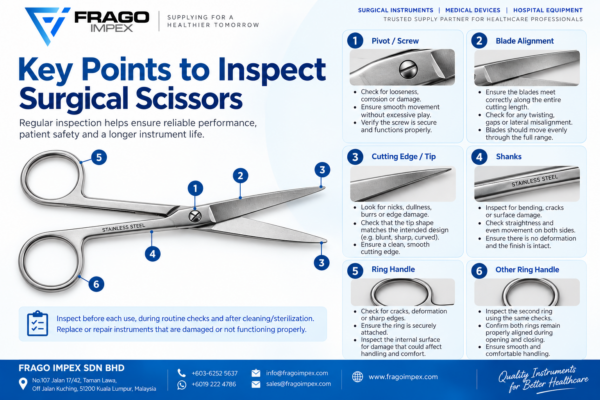
How to Inspect Surgical Scissors:
Surgical scissors are precision instruments used across operating rooms, clinics, procedure rooms and other healthcare environments. Their performance depends not only on the quality of the instrument, but also on appropriate handling, cleaning, inspection and maintenance.
A pair of scissors may look perfectly acceptable at first glance while having a loose pivot, damaged cutting edge, poor blade alignment, corrosion or a bent component.
For this reason, surgical scissors should be inspected systematically rather than simply checked for visible cleanliness.
The World Health Organization recommends inspecting reusable medical devices for cleanliness, damage and function during the inspection stage of reprocessing. (Iris)
This guide explains six important areas to check when inspecting surgical scissors.


Quick Overview: The 6 Inspection Points
When inspecting surgical scissors, pay particular attention to:
- Pivot and screw
- Blade alignment
- Cutting edge and tip
- Shanks
- Ring handle
- Second ring handle
These areas provide a practical framework for identifying common mechanical, structural and surface problems.
Visual reference: The FRAGO IMPEX surgical-scissors inspection infographic can be used as a quick visual checklist alongside your facility’s established inspection procedure.
1. Inspect the Pivot and Screw
The pivot is the central mechanical connection that allows the two blades to open and close.
Because it is a moving part, it can experience wear over time. A problem at the pivot can also affect the relationship between the two blades.
Check for:
- Excessive looseness
- Unusual lateral movement
- Corrosion or staining
- Damaged screw head
- Stiff or restricted movement
- Irregular opening and closing
- Signs of mechanical damage
Open and close the scissors carefully several times.
The movement should be appropriate for the particular instrument and should not show obvious abnormal resistance or excessive play.
Why the pivot matters
The blades need to maintain their intended relationship as the instrument opens and closes. Excessive looseness or mechanical damage can affect blade alignment and cutting performance.
Do not attempt to modify, tighten or repair an instrument simply because the pivot feels unusual unless this is covered by the manufacturer’s instructions or an approved maintenance procedure.
2. Check Blade Alignment
Blade alignment is another important inspection point.
Close the scissors carefully and examine how the blades meet.
Depending on the design, the blades should follow their intended cutting relationship without obvious twisting, deformation or displacement.
Look for:
- Twisted blades
- Visible gaps where the blades should meet
- Uneven blade contact
- Lateral displacement
- Bent blades
- Abnormal movement during opening and closing
Different surgical scissors have different blade geometries, so the inspection should be based on the instrument’s original design.
For example, operating scissors may be available with straight or curved blades and different tip configurations. FRAGO IMPEX’s current surgical-instrument range includes multiple surgical-scissor types. (Frago Impex SDN BHD)
Practical inspection
Move the blades slowly through their normal range.
If they appear to catch, scrape unusually, separate incorrectly or fail to function as intended, the instrument should be evaluated according to the facility’s procedure.
3. Examine the Cutting Edge and Tip
The cutting edge is one of the most important areas to inspect because it directly affects the intended cutting function of the scissors.
Inspect the blades under good lighting.
Where appropriate, magnification can help identify small defects that may not be obvious during a quick visual check. WHO guidance specifically describes using suitable lighting and magnification during inspection of reusable medical devices. (Pan American Health Organization)
Look for:
- Dullness
- Nicks
- Burrs
- Chips
- Deformation
- Corrosion
- Uneven edges
- Damaged tips
The tip configuration should also be considered.
Surgical scissors can have different configurations, including sharp-sharp and sharp-blunt designs. FRAGO IMPEX, for example, lists both straight sharp-sharp and straight sharp-blunt operating scissors. (Frago Impex SDN BHD)
Therefore, the objective is not to make every pair of scissors look identical. The objective is to determine whether the instrument still corresponds to its intended design and functions appropriately.


4. Inspect the Shanks
The shanks connect the handles and pivot area to the blades.
Although they may appear relatively simple, damaged or bent shanks can affect the overall geometry and handling of the instrument.
Inspect for:
- Bending
- Twisting
- Cracks
- Dents
- Surface damage
- Corrosion
- Deformation
- Uneven movement
Examine both sides of the instrument under adequate lighting.
If one side appears visibly different from the other or the scissors no longer move as intended, further assessment may be necessary.
Surface condition also matters
Stainless steel surgical instruments are designed to resist corrosion, but stainless steel is not completely immune to staining or corrosion.
Poor handling, inappropriate chemicals, inadequate rinsing, moisture and dried biological material can contribute to instrument deterioration.
WHO notes that dried blood and saline can make instruments more difficult to clean and may contribute to deterioration of stainless-steel instruments. (Iris)
FRAGO IMPEX’s surgical-instrument care guidance similarly recommends inspecting reusable instruments for corrosion, pitting, cracks, bent components, misalignment and other defects after cleaning. (Frago Impex SDN BHD)
5. Check the Ring Handle
The ring handles are easy to overlook during an inspection because they are not directly involved in cutting.
However, they are part of the instrument’s overall mechanical structure and are important for handling and control.
Check for:
- Cracks
- Deformation
- Sharp edges
- Surface damage
- Corrosion
- Loose connections
- Damage to the internal ring surface
Run a visual inspection around the entire ring rather than checking only the outer surface.
The handle should remain structurally sound and should not have damage that could interfere with normal handling.
6. Inspect the Second Ring Handle
The second ring should receive the same inspection as the first.
Check:
- Ring shape
- Internal surface
- External surface
- Attachment to the shank
- Surface condition
- Alignment with the opposite ring
- Smooth opening and closing
It is easy to inspect one handle and overlook the other, especially when instruments are being processed in large quantities.
A systematic six-point inspection helps reduce this problem.
Why Surgical Scissors Should Be Inspected After Cleaning
Inspection should not be treated as a substitute for cleaning.
Cleaning and inspection are separate parts of the reprocessing process.
The CDC recommends thorough cleaning of reusable medical devices before disinfection or sterilization and notes that dried blood or tissue can make cleaning more difficult. The CDC also recommends inspecting equipment for damage that could interfere with cleaning, disinfection or sterilization. (CDC)
WHO guidance similarly places inspection after cleaning and recommends checking instruments for cleanliness, damage and function. (Iris)
A practical workflow is therefore:
Use → Point-of-use preparation → Cleaning → Rinsing → Inspection → Maintenance where applicable → Packaging → Sterilization → Storage
The exact workflow should follow the healthcare facility’s validated procedures and the manufacturer’s instructions for use.
What Should You Look for During a Post-Cleaning Inspection?
After appropriate cleaning, examine the scissors for both cleanliness and condition.
Check for contamination
Look for:
- Blood
- Tissue
- Organic residue
- Cleaning residue
- Water deposits
If visible contamination remains, the instrument should be returned for appropriate cleaning rather than simply packaged or sterilized.
Check for physical damage
Look for:
- Corrosion
- Pitting
- Cracks
- Bent components
- Damaged tips
- Misalignment
- Loose joints
- Cutting-edge damage
The CDC states that equipment that no longer functions as intended or cannot be adequately cleaned and processed should be repaired or discarded as appropriate. (CDC)
Common Problems Found in Surgical Scissors
| Problem | What to Look For | Possible Action |
|---|---|---|
| Loose pivot | Excessive play or abnormal movement | Further assessment/approved repair |
| Blade misalignment | Uneven contact or displacement | Remove for assessment |
| Dull edge | Reduced cutting performance or visible edge wear | Sharpening/service or replacement according to procedure |
| Nicks or burrs | Small defects along the cutting edge | Further assessment |
| Bent shank | Visible deformation or abnormal movement | Remove from service for assessment |
| Corrosion | Rust-like spots, pitting or surface deterioration | Investigate cause and assess instrument |
| Damaged tip | Deformed, chipped or broken tip | Remove for assessment |
| Damaged handle | Cracks, sharp edges or deformation | Further assessment/replacement |
This table is a general educational guide. The appropriate disposition should always follow your facility’s procedures and the applicable manufacturer’s instructions.
When Should Surgical Scissors Be Removed From Service?
A damaged instrument should not simply be returned to the surgical set because the defect appears minor.
Particular attention should be given to instruments with:
- Broken or significantly damaged tips
- Cracks
- Severe corrosion or pitting
- Misaligned blades
- Excessive pivot looseness
- Deformed components
- Abnormal movement
- Poor cutting performance
- Damage that prevents adequate cleaning
- Any other defect affecting intended function
WHO recommends inspection and function testing of reusable devices before assembly and packaging. (Pan American Health Organization)
The correct decision may be repair, sharpening, further technical assessment or replacement, depending on the instrument and the defect.
Surgical Scissors Maintenance: What to Avoid
Proper inspection is only one part of instrument care.
Healthcare facilities should also avoid practices that can unnecessarily damage surgical scissors.
Do not use scissors for inappropriate materials
A surgical scissor should be used according to its intended application.
FRAGO IMPEX’s surgical-instrument care guidance specifically advises against using delicate surgical scissors to cut hard materials that may damage their blades. (Frago Impex SDN BHD)
Do not ignore corrosion
Repeated staining or corrosion should not simply be polished away without considering the underlying cause.
Water quality, cleaning chemicals, rinsing, drying and processing conditions may all need to be reviewed.
Do not use household oils
Where lubrication is required, use only a product compatible with the instrument and the applicable reprocessing process, and follow the manufacturer’s instructions.
FRAGO IMPEX’s instrument-care guidance recommends appropriate water-soluble instrument lubricant where lubrication is specified and advises against household oil, machine oil, grease and other unapproved lubricants. (Frago Impex SDN BHD)
Do not force damaged instruments
If a scissor is stiff, misaligned or damaged, forcing it through repeated cycles can potentially worsen the problem.
Remove it for appropriate evaluation.
How Different Surgical Scissors Affect Inspection
Not all surgical scissors should be evaluated using exactly the same functional expectations.
For example:
Mayo Scissors
Generally heavier than delicate dissecting scissors and commonly available in straight and curved configurations.
Metzenbaum Scissors
Typically designed with longer, more delicate blades for tissue dissection.
Iris Scissors
Small scissors intended for fine, precise work.
Operating Scissors
Available in different lengths, blade shapes and tip configurations for general surgical applications.
Tenotomy Scissors
Designed for more delicate surgical applications and available in specialized configurations.
FRAGO IMPEX’s surgical-scissors range includes multiple designs and surgical instrument categories. (Frago Impex SDN BHD)
This is why inspection should always consider the specific instrument design and intended use.
Surgical Scissors Inspection Checklist
For routine visual reference, healthcare professionals can use the following checklist alongside their facility’s approved SOP:
Pivot / Screw
- Is the pivot secure?
- Is there excessive looseness?
- Is there corrosion or visible damage?
- Does the joint move appropriately?
Blade Alignment
- Are the blades correctly aligned?
- Is there visible twisting or deformation?
- Do they move correctly through their intended range?
Cutting Edge / Tip
- Are the edges free from obvious nicks or burrs?
- Is there visible damage or deformation?
- Does the tip correspond to the original design?
Shanks
- Are the shanks straight?
- Are there cracks, dents or corrosion?
- Is there any visible deformation?
Ring Handles
- Are both rings intact?
- Are there cracks or sharp edges?
- Are the handles appropriately aligned?
Overall Function
- Is the instrument visibly clean?
- Does it function as intended?
- Is there any damage that could interfere with cleaning or sterilization?
A Simple Six-Point Inspection Method
For busy CSSD or surgical teams, the process can be remembered as:
P – Pivot
Check the screw, joint and movement.
B – Blades
Check alignment and blade condition.
E – Edge
Inspect the cutting edge and tip.
S – Shanks
Look for bending, cracks and corrosion.
H – Handles
Inspect both ring handles.
F – Function
Confirm the instrument remains suitable for its intended function.
This should complement—not replace—the facility’s formal inspection procedure.
How Proper Instrument Care Supports Longer Service Life
Surgical scissors are repeatedly exposed to handling, cleaning, sterilization, transportation and storage.
Poor instrument care can contribute to:
- Corrosion
- Staining
- Dull cutting edges
- Damaged tips
- Stiff joints
- Misalignment
- Surface deterioration
Good instrument management therefore involves more than simply sterilizing the instrument.
It includes appropriate point-of-use handling, cleaning, inspection, drying, maintenance where applicable, sterilization, storage and regular evaluation.
WHO describes decontamination and reprocessing as a sequence of steps that must be performed correctly, with quality control throughout the process. (World Health Organization)
For a more detailed guide, see FRAGO IMPEX’s article on Surgical Instrument Care: How to Clean & Maintain Stainless Steel Instruments. (Frago Impex SDN BHD)


Choosing the Right Surgical Scissors
Inspection is important after an instrument has entered service, but selecting the appropriate instrument in the first place is equally important.
Consider:
- Intended clinical application
- Scissor type
- Blade length
- Straight or curved configuration
- Tip configuration
- Instrument size
- Handling requirements
- Reprocessing requirements
- Manufacturer’s instructions
- Facility procurement requirements
For example, FRAGO IMPEX currently offers operating scissors in configurations including straight sharp-sharp and straight sharp-blunt, with different size options. (Frago Impex SDN BHD)
You can browse the broader FRAGO IMPEX Surgical Instruments collection or the dedicated Surgical Instruments range. (Frago Impex SDN BHD)
Frequently Asked Questions
How often should surgical scissors be inspected?
The frequency depends on the facility’s instrument-management and reprocessing procedures. Inspection should be incorporated into the established workflow rather than performed only when an instrument appears obviously damaged.
WHO recommends inspection and function testing of reusable medical devices as part of the processing workflow. (Iris)
How can you tell if surgical scissors are damaged?
Look for visible corrosion, cracks, bent components, damaged tips, blade misalignment, excessive pivot looseness, abnormal movement and poor cutting performance.
How do you check surgical scissors for alignment?
Open and close the scissors slowly while observing the blades. Look for obvious twisting, displacement, abnormal gaps or movement inconsistent with the instrument’s intended design.
What should you do with dull surgical scissors?
A dull instrument should be assessed according to the facility’s maintenance procedure and the manufacturer’s recommendations. Depending on the instrument and condition, professional sharpening, repair or replacement may be appropriate.
Why should surgical scissors be inspected after cleaning?
Cleaning removes contamination that can obscure defects. Post-cleaning inspection allows trained personnel to assess cleanliness, damage and function before the instrument proceeds through the next processing stage. (Iris)
Can all surgical scissors be maintained in the same way?
No. Designs, materials, finishes, joints and intended applications can differ. Always follow the applicable manufacturer’s instructions for cleaning, maintenance, sterilization and handling.
Final Thoughts
Knowing how to inspect surgical scissors is an important part of surgical-instrument management.
A proper inspection goes beyond checking whether the instrument looks clean. The pivot, blade alignment, cutting edge, tip, shanks and both ring handles should all be examined, together with the instrument’s overall movement and condition.
Regular inspection can help identify instruments that require cleaning, maintenance, repair or replacement before they are returned to service.
The key is to use a consistent process and to combine visual inspection with appropriate functional checks, while following the manufacturer’s instructions and the healthcare facility’s validated procedures.
For hospitals, clinics, CSSD departments and healthcare procurement teams looking for surgical instruments, FRAGO IMPEX Surgical Instruments provides access to a broad range of surgical instrument categories and configurations. (Frago Impex SDN BHD)
FRAGO IMPEX SDN BHD
Medical Supplies & Surgical Instruments Supplier in Malaysia
Address:
No. 107, Jalan 17/42, Taman Lawa,
Off Jalan Kuching, 51200 Kuala Lumpur, Malaysia
Tel: +603-6252 5637
WhatsApp: +6019 222 4786
Email: sales@fragoimpex.com / info@fragoimpex.com
Website: www.fragoimpex.com
For enquiries about surgical scissors, surgical instruments, medical supplies and hospital equipment, contact the FRAGO IMPEX team. The company’s contact details are also available on its official contact page. (Frago Impex SDN BHD)