Sponge Holding Forceps:
Sponge holding forceps are simple-looking instruments, but their design serves an important purpose in the operating room. They allow a surgical sponge, gauze or swab to be held securely while the clinician works within the operative field.
Unlike ordinary tissue forceps, sponge holding forceps generally have ring handles, a locking ratchet, a long shaft and rounded or oval fenestrated jaws. The jaw configuration gives the instrument a broad gripping surface for holding a sponge or swab.
Depending on the design, these instruments may be used in general surgery, gynecology, obstetrics, wound care and other clinical procedures where controlled handling of sponges or similar materials is required.


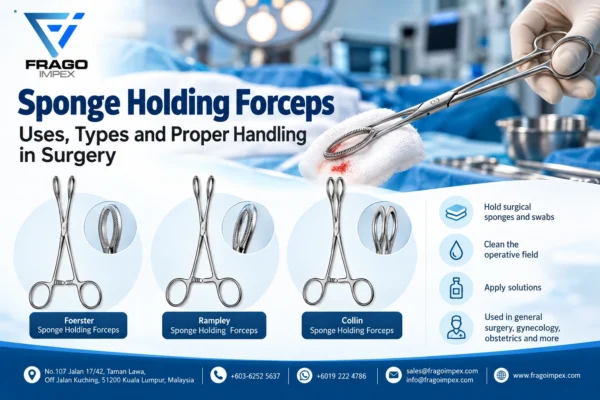
Example image: Sponge holding forceps with ring handles, long shafts and rounded gripping jaws.
What Are Sponge Holding Forceps?
Sponge holding forceps are locking surgical instruments designed primarily to grasp and manipulate surgical sponges, gauze and swabs.
Their basic construction usually includes:
- Ring handles
- A ratchet locking mechanism
- A box-lock or similar joint
- Long shafts
- Rounded, oval or fenestrated jaws
- Smooth or serrated gripping surfaces
The jaws are substantially different from the narrow tips found on instruments such as dressing forceps. Their larger shape allows them to hold a folded sponge or swab more securely.
Foerster-type sponge forceps, for example, use rounded looped jaws, while Rampley designs commonly have elongated jaws intended for holding sponges and swabs.
The exact design should always be matched to the intended clinical application rather than assuming that all sponge forceps are interchangeable.
Main Uses of Sponge Holding Forceps
The primary function is straightforward: holding a sponge or swab without requiring the clinician to grasp the material directly.
Common applications include:
1. Holding Surgical Sponges and Swabs
The most common application is holding gauze or a surgical sponge during a procedure.
The instrument gives the operator an extended handle and controlled grip, which can be useful when the material needs to be positioned accurately within the operative field.
2. Cleaning the Operative Field
A sponge held with forceps can be used to remove blood, fluid or other material from an appropriate surgical area.
This can help maintain visibility while the procedure is being performed.
3. Applying Solutions
Depending on the procedure and institutional technique, sponge holding forceps may be used to hold gauze or swabs during preparation or application of solutions.
The instrument should be used according to the procedure-specific technique and the healthcare facility’s protocols.
4. Gynecological and Obstetric Procedures
Sponge holding forceps are commonly associated with gynecological procedures because their long shaft and rounded jaws can be useful for controlled handling of swabs and sponges.
Rampley and other sponge-holding patterns are available in lengths suited to different applications.
5. Dressing and Wound Care
Appropriate sponge-holding designs can also be used for handling gauze and dressing materials where controlled, indirect manipulation is required.
The instrument should not automatically be treated as a substitute for a dedicated tissue forceps or other specialized instrument.
Common Types of Sponge Holding Forceps
There are several designs commonly encountered in surgical instrument catalogs. The names can vary between manufacturers, so the jaw shape, curvature, length and intended use should be checked when ordering.
Foerster Sponge Holding Forceps
Foerster forceps, also known as sponge forceps or sponge clamps, are characterized by their rounded or loop-shaped jaws.
They are available in straight and curved configurations, with smooth or serrated jaw surfaces depending on the model.
A straight Foerster design may be useful where a relatively direct approach is required, while a curved pattern can provide a different angle of access.
Foerster-type sponge forceps: the rounded jaw profile is one of the easiest features to recognize.
For a specific product configuration, see the Foerster Sponge Holding Forceps Straight, which is listed in 18 cm and 24 cm sizes.
Rampley Sponge Holding Forceps
Rampley sponge holding forceps generally feature elongated, fenestrated jaws and a locking mechanism.
They are commonly used for holding sponges, swabs and gauze in general surgical and gynecological applications.
The straight design can be useful when the instrument needs to approach the operative field without an additional shaft curvature.
The Rampley Sponge Holding Forceps Straight is available in 18 cm and 24 cm configurations.
Collin Sponge Holding Forceps
Collin sponge holding forceps have a different jaw configuration, with rounded, double-fenestrated jaws.
This design can provide a broad gripping surface for sponge and gauze handling.
A Collin pattern may be particularly relevant where the procedure calls for a different jaw geometry from conventional Foerster or Rampley patterns.
The Collin Sponge Holding Forceps is listed in 16 cm and 18 cm sizes.
Straight vs Curved Sponge Holding Forceps
One of the most practical choices is whether a straight or curved instrument is appropriate.
| Feature | Straight Design | Curved Design |
|---|---|---|
| Shaft | Relatively direct | Angled or curved |
| Access | Direct approach | Can provide an alternative approach angle |
| Common consideration | Surface or directly accessible areas | Procedures where shaft curvature assists positioning |
| Selection | Based on procedure and working area | Based on procedure, access and operator preference |
There is no universal rule that one configuration should replace the other.
The correct choice depends on the procedure, working depth, operative approach and the instrument preferences established by the surgical team.
Smooth vs Serrated Jaws
Sponge holding forceps can also differ in the internal surface of their jaws.
Smooth Jaws
Smooth jaws provide a relatively gentle contact surface and may be selected when the instrument is primarily being used for sponges, gauze or other materials.
Serrated Jaws
Serrations can provide additional grip on the material being held.
However, serrated jaws should not automatically be interpreted as suitable for every tissue-handling application. Tissue interaction depends on the specific instrument design and intended purpose.
For procurement teams, the jaw surface should therefore be included in the product specification rather than simply ordering by the generic term “sponge forceps.”
How to Handle Sponge Holding Forceps Properly
Correct handling involves more than simply closing the ratchet.
The instrument should be used according to the surgical team’s established technique, manufacturer instructions and the facility’s infection-prevention procedures.
1. Inspect the Instrument Before Use
Before the instrument enters the sterile field, inspect:
- Jaw alignment
- Ratchet function
- Joint movement
- Surface condition
- Serrations or jaw edges
- Cracks, corrosion or pitting
- Any signs of deformation
A forceps with damaged jaws or an unreliable ratchet should not be placed into clinical service until it has been assessed according to the facility’s instrument-management process.
2. Use the Correct Jaw Size
The sponge should fit securely within the jaws without requiring excessive force.
An instrument that is too small may not hold the intended material effectively, while an unnecessarily large instrument may be cumbersome for the particular application.
This is why hospitals commonly maintain several sizes and patterns.
3. Avoid Excessive Pressure
The ratchet is designed to maintain the jaws in a selected position.
It should not be used to apply unnecessary crushing force to tissue or materials.
If tissue manipulation is required, the surgical team should select an instrument specifically designed for that tissue and application.
4. Maintain Sterile Handling
Sponge holding forceps used in a sterile procedure must be handled according to the facility’s sterile-field practices.
The instrument should only be used for its intended purpose and should not be passed between sterile and non-sterile environments in a way that compromises aseptic technique.
5. Keep Sponge Counts Separate From Instrument Handling
Sponge holding forceps themselves do not replace the operating-room sponge-count process.
This is an important distinction.
The Ministry of Health Malaysia’s National Operating Room Nursing Audit (NORNA) specifies preoperative, intraoperative and postoperative counting of sponges, sharps and instruments. The 2026 version also specifies documentation of these counts. (Ministry of Health Malaysia)
The WHO safe-surgery guidance likewise recommends systematic sponge and instrument counts at defined points during surgery and emphasizes reconciliation of discrepancies before the procedure is completed. (IRIS)
Therefore, a sponge held with forceps remains part of the overall sponge-management and counting process.
Cleaning and Sterilization Considerations
Reusable sponge holding forceps require appropriate cleaning, inspection and sterilization according to the manufacturer’s instructions and the healthcare facility’s validated reprocessing procedures.
A typical instrument-care workflow includes:
- Point-of-use handling according to facility protocol
- Cleaning and removal of organic material
- Thorough rinsing where applicable
- Inspection of joints and jaws
- Drying
- Lubrication where specified by the instrument manufacturer
- Packaging or preparation for sterilization
- Sterilization using the validated method
- Inspection before return to service
For reusable instruments, the manufacturer’s instructions for use (IFU) should take priority over a generic cleaning routine.
Pay particular attention to the box joint and ratchet because debris can accumulate around moving components.
The instrument should also be inspected after processing. A clean instrument is not necessarily a serviceable instrument; jaw alignment, ratchet engagement and surface integrity still need to be checked.
How to Choose Sponge Holding Forceps for a Hospital or Clinic
When purchasing sponge holding forceps, procurement teams should consider more than the instrument name.
1. Intended Application
Determine whether the instrument will primarily be used for:
- General surgery
- Gynecology
- Obstetrics
- Wound care
- Dressing applications
- Other specific procedures
2. Jaw Configuration
Check whether the required model has:
- Round jaws
- Oval jaws
- Fenestrated jaws
- Smooth surfaces
- Serrated surfaces
3. Straight or Curved Pattern
The shaft profile should correspond to the intended working area and procedure.
4. Length
Length can affect access, control and handling.
For example, currently listed Rampley models include 18 cm and 24 cm versions, while the straight Foerster model is listed in 18 cm and 24 cm sizes. (Frago Impex SDN BHD)
5. Construction
For reusable instruments, examine:
- Material specification
- Surface finish
- Joint construction
- Ratchet design
- Corrosion resistance
- Compatibility with the facility’s reprocessing system
6. Documentation
Hospitals and distributors should also verify relevant product documentation, manufacturer information and applicable regulatory requirements before purchasing.
For the Malaysian market, the Medical Device Authority (MDA) provides the Malaysia Medical Device Register (MMDR), which can be used to search registered medical devices and licensed establishments. The register includes entries for sponge forceps and surgical sponge forceps. (MDA Malaysia)
Sponge Holding Forceps vs Tissue Forceps
These instruments can look similar at first glance, but their intended functions are different.
| Characteristic | Sponge Holding Forceps | Tissue Forceps |
|---|---|---|
| Primary purpose | Holding sponges, gauze and swabs | Grasping or manipulating tissue |
| Handle | Usually ring handles | Ring or thumb-forceps style depending on design |
| Ratchet | Common | Depends on instrument |
| Jaw shape | Usually broad, rounded or fenestrated | Varies considerably |
| Typical examples | Foerster, Rampley | Allis, Babcock, Adson, DeBakey |
| Selection | Based on sponge/material handling and access | Based on tissue type and surgical application |
For example, Babcock Tissue Forceps have fenestrated jaws intended for controlled handling of delicate structures such as intestine, appendix and other suitable tissues; they should not simply be substituted for a sponge forceps because both have fenestrated jaws. (Frago Impex SDN BHD)
The jaw design and intended purpose are what matter.
Common Mistakes When Using Sponge Holding Forceps
Using the wrong forceps for tissue
A sponge forceps should not automatically be used as a general-purpose tissue-grasping instrument.
Ignoring jaw alignment
Misaligned jaws can reduce grip and may indicate that the instrument requires maintenance or removal from service.
Overloading the jaws
The sponge should be held securely without forcing an excessive amount of material into the jaw opening.
Failing to inspect the ratchet
A worn or damaged ratchet can affect control.
Treating cleaning as an afterthought
Organic material left around joints or serrations can interfere with instrument function and reprocessing.
Separating sponge handling from sponge counting
Sponge management is part of the broader operating-room safety process. Malaysia’s current NORNA documentation specifically addresses sponge, sharp and instrument counts. (Ministry of Health Malaysia)
Sponge Holding Forceps in the Malaysian Healthcare Setting
Sponge forceps are established surgical instruments and are represented in the Malaysian medical-device market.
For example, the Malaysian Medical Device Register includes entries for “Surgical – Forceps, sponge” and “SPONGE FORCEPS”, demonstrating that this category is represented in Malaysia’s medical-device registration system. (MDA Malaysia)
For regulatory checks, procurement teams should use current MDA information rather than relying solely on supplier descriptions.
Frequently Asked Questions
What are sponge holding forceps used for?
They are primarily used to hold surgical sponges, gauze and swabs during procedures. They can assist with cleaning the operative field, handling dressings and other appropriate applications depending on the instrument design and clinical technique.
What is the difference between Foerster and Rampley sponge forceps?
Both are sponge-holding instruments, but their jaw geometry and overall pattern can differ. Foerster designs commonly have rounded looped jaws, while Rampley patterns commonly use elongated jaws. Exact configurations vary by manufacturer.
Are sponge holding forceps straight or curved?
Both configurations are available. The choice depends on the procedure, access requirements and the surgical team’s preferred technique.
Are sponge holding forceps reusable?
Some models are manufactured as reusable instruments, while other products may be designed for single use. The product’s labeling and manufacturer instructions should always be checked rather than assuming that a particular pattern is reusable.
How long are sponge holding forceps?
Lengths vary by design and manufacturer. Common examples include approximately 18 cm, 20 cm, 24 cm and 25 cm configurations. Specific product specifications should be checked before ordering.
Are sponge holding forceps included in surgical counts?
The forceps itself may be included in the instrument count according to the facility’s counting procedure, while the sponge being held remains subject to the applicable sponge-count process. Malaysian operating-room guidance specifically addresses sponge, sharp and instrument counting. (Ministry of Health Malaysia)
Final Thoughts
Sponge holding forceps are designed around a relatively simple requirement: securely holding a sponge or swab while giving the operator controlled access to the surgical field.
The differences between Foerster, Rampley, Collin and other patterns are mainly found in their jaw geometry, shaft profile, length and gripping surfaces. These details become important when a hospital or clinic is selecting instruments for specific procedures.
For clinical users, proper inspection, sterile handling, appropriate use and compliance with local operating-room protocols are essential. For procurement teams, product specifications, intended use, reprocessing requirements and applicable Malaysian regulatory information should be checked before purchase.
A suitable sponge holding forceps should therefore be selected based on function and application rather than appearance alone.
About the supplier
Kuala Lumpur, Malaysia
Tel: +603-6252 5637
WhatsApp: +6019 222 4786
Email: sales@fragoimpex.com
Website: fragoimpex.com