Basic Surgical Instruments
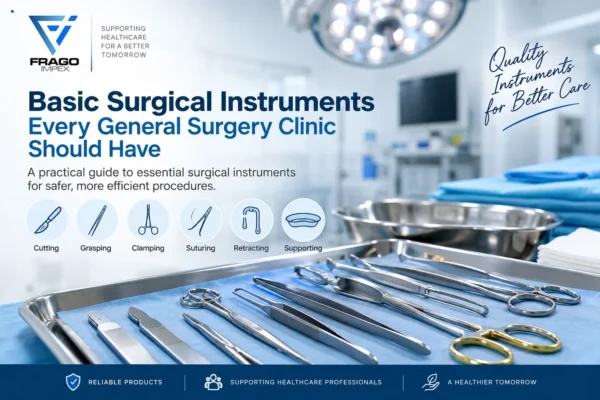
A general surgery clinic needs a practical, well-organized selection of surgical instruments that supports the procedures performed by its surgical team. The objective is not to stock every instrument available, but to maintain the right combination of instruments for cutting, grasping, clamping, suturing, tissue handling, retraction and surgical exposure.
For hospitals, clinics and procurement teams, understanding the purpose of each instrument is important before purchasing. The correct size, jaw design, tip configuration and intended application can make a significant difference in how an instrument performs.
This guide covers the basic surgical instruments commonly considered for a general surgery clinic and explains what to look for when building or reviewing an instrument inventory.
Why General Surgery Clinics Need the Right Instruments
Surgical instruments are designed for specific functions. A scalpel is intended for controlled cutting, forceps for grasping or handling, clamps for appropriate clamping applications, needle holders for suturing and retractors for maintaining surgical exposure.
A clinic that relies on an incomplete or poorly organized instrument inventory may experience unnecessary interruptions during procedures. At the same time, purchasing excessive quantities of rarely used instruments can increase inventory and maintenance costs.
A practical inventory should therefore be based on:
- Procedures performed by the clinic
- Number of procedure or operating rooms
- Number of procedures performed
- Surgical team preferences
- Sterilization and reprocessing capacity
- Instrument replacement requirements
- Applicable medical-device requirements
The WHO Surgical Safety Checklist is designed to improve communication and reduce errors and adverse events during surgery, reinforcing the importance of organized preparation and teamwork around surgical procedures. (World Health Organization)
1. Scalpel Handles and Surgical Blades
Scalpels are among the most basic instruments in general surgery.
A scalpel handle holds a compatible blade and provides the surgeon with a controlled cutting instrument. Different handle designs and blade sizes are used according to the procedure and required handling characteristics.


Common Scalpel Handles
A general surgery clinic may need different handle configurations, including commonly used No. 3 and No. 4 handles.
The correct choice depends on:
- Blade compatibility
- Required grip
- Surgical application
- Instrument size
- Manufacturer specifications
The handle and blade combination should always be used according to the applicable manufacturer’s instructions.
For clinics reviewing their scalpel inventory, see the FRAGO IMPEX guide on Scalpel Handle No. 3 vs No. 4.
2. Surgical Scissors
Surgical scissors are used for cutting tissue, sutures, dressings or other materials depending on their design.
Different scissors have different blade thicknesses, lengths, tips and cutting characteristics. For this reason, Mayo scissors, Metzenbaum scissors and other operating scissors should not simply be treated as interchangeable instruments.


Common Surgical Scissors
A general surgery inventory may include:
- Mayo scissors
- Metzenbaum scissors
- Straight operating scissors
- Curved operating scissors
- Sharp-sharp scissors
- Sharp-blunt scissors
- Suture scissors
The appropriate instrument depends on the intended application.
When inspecting scissors, check whether the blades move smoothly, meet correctly and maintain their intended cutting performance.
FRAGO IMPEX has published a detailed guide on How to Inspect Surgical Scissors, covering important inspection points for healthcare professionals.
3. Tissue Forceps
Tissue forceps allow surgeons to grasp and manipulate tissue during appropriate surgical procedures.
Their jaws can vary considerably. Some have teeth designed for a firmer grip, while others have serrated or less aggressive configurations.


Common Tissue Forceps
A general surgery clinic may consider:
- Adson forceps
- Toothed tissue forceps
- Plain tissue forceps
- Rat-tooth forceps
- Fine tissue forceps
The choice should depend on the intended tissue-handling application.
A forceps designed for firm tissue grasping should not automatically be substituted for an instrument intended for more delicate handling.
For more information, read Common Surgical Forceps: How to Identify by Design and Function.
4. Dressing Forceps
Dressing forceps are commonly used for handling dressings, gauze and other materials.
They can be useful in:
- Wound dressing
- Minor surgical procedures
- Handling gauze
- Preparing an operative area
- Removing or positioning dressing materials


Dressing forceps are generally different from tissue forceps in both design and intended use. A clinic should therefore select them according to the tasks they are expected to perform.
FRAGO IMPEX also provides information about Adson Dressing Forceps: Plain vs Toothed.
5. Artery Forceps and Hemostatic Forceps
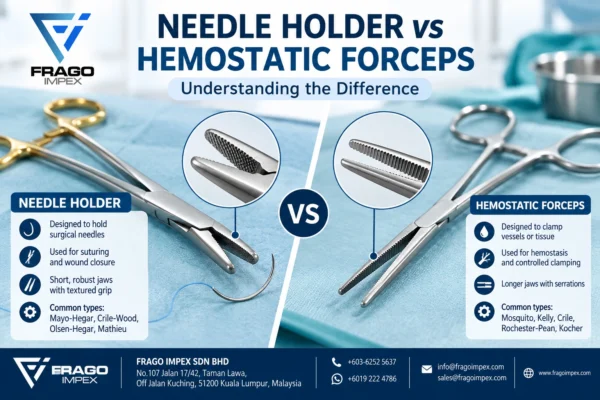
Artery forceps, also called hemostatic forceps or hemostats, are clamping instruments used for appropriate surgical applications.
Common designs include:
- Mosquito forceps
- Kelly forceps
- Crile forceps
- Straight artery forceps
- Curved artery forceps


Different sizes and jaw configurations serve different purposes.
When inspecting an artery forceps, check:
- Jaw alignment
- Serrations
- Ratchet engagement
- Hinge movement
- Tip condition
- Surface condition
- Corrosion or pitting
A damaged or poorly functioning clamp should be removed from service according to the facility’s instrument-management procedures.
6. Needle Holders
Needle holders are essential for surgical suturing.
They hold and control a suture needle while the surgeon passes it through tissue.


Mayo-Hegar Needle Holder
The Mayo-Hegar design is commonly encountered in general surgical instrument sets.
When selecting a needle holder, consider:
- Length
- Jaw design
- Grip
- Ratchet mechanism
- Jaw alignment
- Intended needle size
- Surgical application
The instrument should hold the needle securely without unnecessary movement.
7. Sponge-Holding Forceps
Sponge-holding forceps are designed to hold swabs or sponges during appropriate procedures.
They can be useful for:
- Handling surgical swabs
- Preparing an operative field
- Applying solutions where appropriate
- Handling materials during procedures


The exact design and size should be selected according to the clinic’s procedures and the intended application.
8. Allis Tissue Forceps
Allis forceps are grasping instruments with toothed jaws.
They are used for appropriate tissue-handling applications where their particular jaw design is suitable.


Because Allis forceps provide a relatively firm grip, they should be selected according to the tissue and surgical application rather than used as a universal grasping instrument.
9. Babcock Forceps
Babcock forceps have a characteristic rounded, fenestrated jaw design.
They are commonly associated with grasping selected delicate or tubular structures where the particular jaw configuration is appropriate.


The difference between Babcock and more aggressively toothed tissue forceps is important when selecting instruments for specific procedures.
10. Surgical Retractors
Retractors help maintain access and visibility by holding tissue or other structures away from the operative field.
They can be broadly divided into:
- Handheld retractors
- Self-retaining retractors


Common Retractor Types
Depending on the procedures performed, a general surgery clinic may require:
- Senn retractors
- Farabeuf retractors
- Richardson retractors
- Deaver retractors
- Morris retractors
- Doyen retractors
- Balfour retractors
- Gelpi retractors
Not every clinic needs every type.
The correct retractor depends on the operative area, required exposure, depth and surgical technique.
FRAGO IMPEX has a dedicated Surgical Retractors: Types, Uses, Names & Complete Guide covering common retractor designs and their applications.
11. Towel Clamps
Towel clamps can be used to secure surgical drapes or other materials where appropriate.


A commonly recognized design is the Backhaus towel clamp.
When purchasing towel clamps, check the closing mechanism, tips, hinge and overall condition.
The required quantity will depend on the procedure setup and facility workflow.
12. Probes and Directors
Probes and directors are relatively simple instruments, but they can have specific uses in surgical and clinical procedures.


They may be used for selected applications involving examination, exploration or guidance.
Their inclusion in an inventory should therefore be based on the actual procedures performed at the clinic.
13. Instrument Trays and Kidney Trays
A surgical instrument inventory is not complete without considering how instruments are organized and processed.
Instrument trays can help organize reusable instruments during processing, storage and preparation for procedures.


A well-organized tray system can help with:
- Instrument identification
- Inventory control
- Procedure preparation
- Safe handling
- Processing workflows
- Storage
The tray configuration should be compatible with the facility’s validated cleaning, packaging and sterilization processes.
Basic Surgical Instrument Checklist
The following checklist can serve as a starting point for a general surgery clinic.
| Instrument category | Examples |
|---|---|
| Scalpel handles | No. 3, No. 4 |
| Surgical scissors | Mayo, Metzenbaum, operating scissors |
| Tissue forceps | Adson, toothed, plain |
| Dressing forceps | Plain, toothed |
| Hemostatic forceps | Mosquito, Kelly, Crile |
| Needle holders | Mayo-Hegar and other suitable designs |
| Tissue grasping forceps | Allis, Babcock |
| Sponge holders | Foerster-style sponge forceps |
| Retractors | Senn, Richardson, Deaver, Balfour |
| Towel clamps | Backhaus and other suitable designs |
| Probes | Appropriate probe/director designs |
| Trays | Instrument trays and kidney trays |
This should be treated as a general planning checklist rather than a universal instrument list. The final inventory should reflect the clinic’s procedures, surgical techniques and processing capacity.
How to Decide How Many Instruments a Clinic Needs
There is no fixed number of instruments that every general surgery clinic should purchase.
Several factors should be considered.
Procedure Volume
A clinic performing procedures every day will normally have different inventory requirements from one performing occasional procedures.
Number of Procedure Rooms
Multiple rooms can increase the need for duplicate instruments or complete sets.
Sterilization Turnaround
The time required to clean, inspect, package and sterilize reusable instruments can affect how many instruments or sets need to be available.
Procedure Type
Minor procedures may require relatively small instrument sets, while more complex general surgical procedures can require a broader range of instruments.
Surgical Team Preferences
Surgeons may have preferred instrument designs, lengths and configurations.
For this reason, procurement decisions should ideally involve surgeons, operating-room staff, sterile-processing personnel and purchasing teams.
What to Check Before Buying Surgical Instruments
Price should not be the only consideration when purchasing surgical instruments.
1. Instrument Design
Make sure the instrument is appropriate for the intended clinical application.
2. Size and Configuration
Consider:
- Length
- Jaw shape
- Tip configuration
- Straight or curved design
- Serration
- Handle design
3. Mechanical Function
For hinged instruments, inspect:
- Opening and closing
- Ratchet engagement
- Jaw alignment
- Hinge movement
- Tip condition
For scissors, examine blade alignment and cutting performance.
4. Surface Condition
Look for a consistent surface finish without obvious defects, corrosion or damage.
5. Reprocessing Requirements
For reusable instruments, confirm that the device can be processed according to the manufacturer’s instructions and the facility’s validated procedures.
The FDA explains that reusable medical devices require a specific reprocessing regimen and that appropriate cleaning followed by disinfection or sterilization is essential for safe reuse. (U.S. Food and Drug Administration)
Surgical Instrument Maintenance Matters
Purchasing good instruments is only part of maintaining a reliable surgical inventory.
Reusable instruments should be properly managed throughout their service life.
A typical workflow may include:
Point-of-use care → Cleaning → Inspection → Drying → Packaging → Sterilization → Storage → Inspection before use
The exact process must follow the manufacturer’s instructions and the healthcare facility’s validated procedures.
The FDA notes that reusable surgical instruments such as forceps and clamps can become contaminated during use and require appropriate reprocessing between uses. (U.S. Food and Drug Administration)
For more information, read the FRAGO IMPEX guide on Surgical Instrument Care: How to Clean & Maintain Stainless Steel Instruments.
Common Mistakes When Building a Surgical Instrument Inventory
Buying Only on Price
A lower purchase price does not automatically mean lower total cost.
Instrument function, durability, maintenance, replacement requirements and suitability for the intended application should also be considered.
Buying Too Many Specialized Instruments
Not every clinic needs every surgical instrument.
Start with the procedures performed most frequently and build the inventory around those requirements.
Treating Similar Instruments as the Same
Two forceps can look similar but have different jaw designs and intended applications.
Instrument selection should be based on function rather than appearance alone.
Ignoring Instrument Inspection
Reusable instruments should be inspected for damage and proper function as part of the facility’s established processing workflow.
Ignoring Sterilization Capacity
The number of reusable instruments should make sense alongside the clinic’s cleaning and sterilization capacity.
Should a Clinic Buy Individual Instruments or Complete Surgical Sets?
Both options can be useful.
Individual Instruments
Individual purchasing can be useful when:
- Replacing damaged instruments
- Expanding an existing set
- Customizing an instrument inventory
- Adding a specific instrument for a new procedure
Surgical Sets
Procedure-specific sets can help with:
- Standardized preparation
- Inventory organization
- Faster setup
- Easier storage
- Consistent instrument selection
FRAGO IMPEX has also published 6 Essential Surgical Sets for GP Clinics for clinics reviewing their basic procedure-set requirements.
Medical Device Procurement in Malaysia
For Malaysian healthcare facilities and procurement teams, regulatory considerations should also form part of medical-device purchasing decisions.
The Medical Device Authority (MDA) states that establishments importing, exporting or placing registered medical devices on the Malaysian market must hold the applicable establishment licence under Section 15(1) of the Medical Device Act 2012 (Act 737). (Malaysian Department of Agriculture)
Procurement teams should therefore verify the applicable regulatory status and supplier requirements for the medical devices they purchase.
For current Malaysian regulatory information, refer to the official Medical Device Authority (MDA).
Why Work With an Experienced Surgical Instrument Supplier?
A surgical instrument supplier should be able to provide clear information about:
- Instrument type
- Size and configuration
- Intended application
- Available quantities
- Surgical sets
- Product specifications
- Reprocessing considerations
- Availability and replacement
For hospitals and clinics, having a supplier that understands the difference between various forceps, scissors, clamps, retractors and surgical sets can make procurement more straightforward.
FRAGO IMPEX SDN BHD supplies surgical instruments, medical devices, hospital equipment and healthcare supplies for hospitals, clinics, healthcare professionals and medical-equipment buyers.
Explore the FRAGO IMPEX surgical instrument range.
Frequently Asked Questions
What are the basic surgical instruments for a general surgery clinic?
Common basic instruments include scalpels, surgical scissors, tissue forceps, dressing forceps, artery forceps, needle holders, sponge holders, retractors, towel clamps and appropriate instrument trays.
Which surgical scissors should a general surgery clinic have?
A clinic may consider Mayo scissors, Metzenbaum scissors and suitable operating scissors. The final selection should depend on the procedures and intended applications.
What forceps are commonly used in general surgery?
Common categories include tissue forceps, dressing forceps, artery forceps, Allis forceps and Babcock forceps. Their different jaw designs make them suitable for different applications.
How many surgical instruments does a clinic need?
There is no universal number. The requirement depends on procedure volume, number of rooms, instrument sets, sterilization capacity and surgical team preferences.
Should a clinic purchase complete surgical sets?
Complete sets can simplify preparation and inventory management, while individual instruments are useful for customization and replacement. Many clinics use a combination of both.
How should reusable surgical instruments be cleaned?
Reusable instruments should be cleaned and reprocessed according to the manufacturer’s instructions and the healthcare facility’s validated procedures. The FDA emphasizes that adequate reprocessing is essential for safe reuse. (U.S. Food and Drug Administration)
What should procurement teams check before buying surgical instruments?
Consider intended use, instrument design, size, construction, mechanical function, surface condition, reprocessing requirements, quantity and supplier support.
Conclusion
A general surgery clinic does not need the largest possible instrument inventory. It needs an organized selection that matches its actual procedures.
The core inventory will often include scalpels, surgical scissors, tissue forceps, dressing forceps, artery forceps, needle holders, sponge holders and retractors, supported by instruments such as Allis forceps, Babcock forceps, towel clamps, probes and appropriate trays.
The most important step is to match each instrument to its intended application and then maintain a reliable inspection, cleaning, sterilization and storage process.
For Malaysian hospitals, clinics and healthcare procurement teams looking for surgical instruments or surgical sets, FRAGO IMPEX SDN BHD can provide product information and procurement assistance.
FRAGO IMPEX SDN BHD
No. 107, Jalan 17/42, Taman Lawa,
Off Jalan Kuching, 51200 Kuala Lumpur, Malaysia
Tel: +603-6252 5637
WhatsApp: +6019 222 4786
Email: info@fragoimpex.com
Sales: sales@fragoimpex.com