Surgical Instrument Materials: Stainless Steel, Titanium & More
Surgical instruments may look similar on the outside, but the material used to manufacture them can significantly influence their strength, flexibility, corrosion resistance, weight, surface finish, maintenance requirements and intended application.
For hospitals, clinics, operating theatres and medical-equipment procurement teams, understanding surgical instrument materials is useful when evaluating instruments and comparing products from different suppliers.
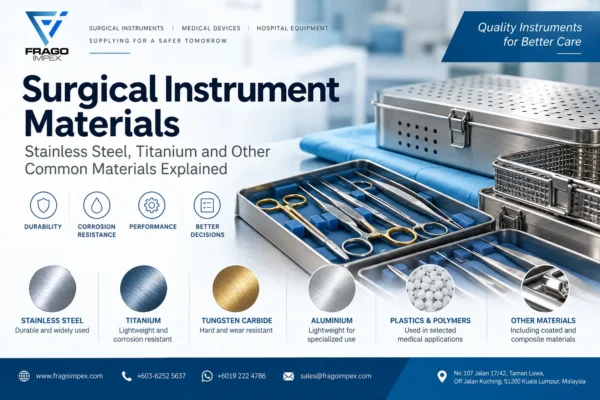
Stainless steel is the material most commonly associated with reusable surgical instruments, but it is not the only material used. Depending on the instrument and its application, manufacturers may also use titanium, tungsten carbide, aluminium, plastics and other specialized materials.

The International Organization for Standardization (ISO) specifically addresses metals used in surgical instruments through ISO 7153-1:2016, Surgical instruments — Materials — Part 1: Metals. The standard covers metals commonly used for standard surgical instruments in areas including general surgery, orthopaedics and dentistry. (ISO)
Why Does Material Matter in Surgical Instruments?
The material of an instrument is not simply a question of appearance.
A surgical instrument needs to perform its intended function while tolerating the handling, cleaning, inspection and sterilization processes specified by the manufacturer and healthcare facility.
Material selection can influence:
- Mechanical strength
- Hardness
- Flexibility
- Edge retention
- Corrosion resistance
- Weight
- Surface finish
- Wear resistance
- Resistance to repeated processing
- Compatibility with the instrument’s intended application
For example, a material suitable for a cutting edge may not be the same material or construction chosen for a lightweight delicate instrument.
The U.S. FDA recognizes ASTM F899-23, a specification covering wrought stainless steels used for surgical instruments. It identifies several stainless-steel classes used in surgical-instrument manufacturing, including austenitic, martensitic, precipitation-hardening and ferritic stainless steels. (FDA Access Data)
This illustrates an important point: “stainless steel” is a broad material category rather than one single type of steel.
1. Stainless Steel
Stainless steel is the most widely recognized material for reusable surgical instruments.
It is used for many types of instruments, including:
- Surgical scissors
- Tissue forceps
- Dressing forceps
- Artery forceps
- Needle holders
- Retractors
- Probes
- Surgical clamps
- Bone instruments
- Surgical trays
The exact stainless-steel grade and manufacturing process can vary according to the instrument’s intended function.
For example, an instrument that requires a relatively hard cutting edge may have different material requirements from an instrument that needs controlled flexibility.
The WHO has also described stainless steel as the predominant material used for surgical instruments and notes that the properties of stainless-steel instruments depend on factors including material quality, handling, storage and care. (WHO)


Why Is Stainless Steel Used So Widely?
Several characteristics make stainless steel suitable for many surgical instruments.
Strength
Many surgical instruments need to withstand repeated mechanical forces during normal use.
Forceps, clamps, needle holders and retractors, for example, need sufficient structural strength for their intended applications.
Corrosion Resistance
Stainless steel is designed to provide resistance to corrosion, but stainless does not mean corrosion-proof.
Poor cleaning, inappropriate chemicals, contaminated water, inadequate drying and improper handling can contribute to staining, corrosion or rust.
This is particularly important for reusable instruments.
FRAGO IMPEX has a dedicated guide covering why surgical instruments develop rust and how to prevent it.
Suitable Surface Finish
A properly manufactured and maintained instrument should have a surface finish appropriate for its intended application and processing requirements.
The surface condition can influence cleaning, inspection and resistance to staining or corrosion.
Availability
Stainless steel is widely used across surgical-instrument manufacturing, making it practical for a broad range of standard reusable instruments.
You can view the FRAGO IMPEX surgical instruments range for examples of stainless-steel surgical instruments across different categories.
2. Different Types of Stainless Steel
One of the most important things to understand when buying surgical instruments is that not all stainless steel is identical.
Stainless steels can have different compositions and properties.
ASTM F899-23, recognized by the FDA for surgical instruments, includes several classes of wrought stainless steel used for surgical-instrument applications. (FDA Access Data)
These include:
Austenitic Stainless Steel
Austenitic stainless steels are generally associated with good corrosion resistance and formability.
They can be suitable for applications where corrosion resistance and material flexibility are important.
Martensitic Stainless Steel
Martensitic stainless steels can be heat-treated to achieve higher hardness.
This characteristic makes suitable grades useful for instruments where hardness and edge performance are important.
Precipitation-Hardening Stainless Steel
These stainless steels can be strengthened through specific heat-treatment processes.
They may be selected for applications requiring particular combinations of strength and hardness.
Ferritic Stainless Steel
Ferritic stainless steels have their own combination of corrosion resistance and mechanical characteristics and are included among the stainless-steel classes referenced by ASTM F899.
The appropriate material depends on the instrument design and its required performance.
For buyers, simply asking whether an instrument is “stainless steel” may not provide enough information. When material specification is important, procurement teams should request the relevant grade or material documentation from the supplier.
3. Titanium
Titanium is another important material in medical applications and is used for certain surgical instruments and specialized applications.
Compared with conventional stainless steel, titanium is notably lightweight and has excellent corrosion resistance.


Key Characteristics of Titanium
Lightweight
Titanium has a lower density than stainless steel.
This can be useful where reducing instrument weight is desirable, particularly for certain specialized instruments.
Corrosion Resistance
Titanium has strong corrosion resistance, which is one reason it has been widely used in medical applications.
Biocompatibility
Certain titanium materials are widely used in implant applications because of their biocompatibility.
However, buyers should not assume that an instrument is suitable for an implant-related application simply because it is made from titanium.
The specific material, product design, intended use and applicable requirements must be considered.
The FDA’s recognized standards database includes specifications for several titanium materials used in surgical implant applications, illustrating the importance of distinguishing instrument materials from implant materials. (FDA Access Data)
When Is Titanium Useful?
Titanium can be relevant for specialized surgical instruments where characteristics such as low weight and corrosion resistance are valuable.
It should not, however, be treated as automatically superior to stainless steel for every surgical instrument.
The appropriate material depends on the instrument’s intended function.
4. Tungsten Carbide
Tungsten carbide is often used as an insert or working component rather than forming the entire instrument.
It is particularly relevant where high hardness and wear resistance are required.
Examples can include:
- Needle holders with tungsten-carbide inserts
- Certain surgical scissors
- Specialized cutting instruments
- Instruments requiring increased resistance to wear


The WHO notes that tungsten-carbide inserts can extend the working life of stainless-steel instruments and improve resistance to wear. It also notes that instruments containing tungsten carbide are commonly identifiable by gold-colored handle areas. (WHO)
This is one reason buyers may encounter a surgical instrument that is primarily stainless steel but has gold-colored sections.
The gold color does not necessarily mean that the entire instrument is made from gold or a different metal. It can indicate tungsten-carbide inserts.
5. Aluminium
Aluminium can be used in certain medical equipment and instrument-related applications because it is lightweight.
Anodized aluminium may also be used where additional surface protection and specific finish characteristics are required.
The WHO lists anodized aluminium among materials that may be used in medical and surgical equipment. (WHO)
However, aluminium is not a universal replacement for stainless steel.
Its suitability depends on:
- Mechanical requirements
- Intended application
- Surface treatment
- Cleaning and processing requirements
- Product design
For many traditional reusable surgical hand instruments, stainless steel remains the more typical material.
6. Plastics and Polymer Materials
Not every surgical or medical instrument is made entirely from metal.
Certain plastics and polymer materials may be used for:
- Handles
- Components
- Housings
- Disposable instruments
- Accessories
- Specialized medical devices
The specific polymer depends on the intended application and required characteristics.
Medical polymers can provide advantages such as low weight, electrical insulation or compatibility with specific device designs.
The FDA’s recognized standards database, for example, includes medical-material standards covering polymers such as polyoxymethylene (acetal). (FDA Access Data)
For reusable medical devices, material selection must also take account of the cleaning, disinfection and/or sterilization process specified for the product.
7. Chrome-Plated and Other Metal Components
Some medical and surgical equipment may contain other metals or surface treatments.
The WHO identifies chrome-plated non-ferrous heavy metals and silver among materials that have been used in surgical instruments and medical equipment. (WHO)
These materials are less representative of the standard reusable surgical hand instrument than stainless steel, but they demonstrate that medical instruments can involve multiple materials and construction methods.
When evaluating an older instrument or a specialized product, it is therefore important not to assume that every metallic-looking component is stainless steel.
Stainless Steel vs Titanium Surgical Instruments
A common question from healthcare buyers is whether titanium or stainless steel is the better material.
There is no universal answer.
The appropriate material depends on the instrument’s intended function, design and processing requirements.
| Feature | Stainless Steel | Titanium |
|---|---|---|
| Common use in surgical hand instruments | Very common | More specialized |
| Weight | Generally heavier | Generally lighter |
| Corrosion resistance | Good, depending on grade and care | Excellent |
| Hardness options | Wide range depending on grade and treatment | Depends on grade |
| Typical availability | Very broad | More specialized |
| Cutting instruments | Common | Application-dependent |
| General forceps | Very common | Specialized applications |
| Specialized instruments | Widely used | Useful in selected applications |
| Cost | Often more economical | Often higher |
| Material documentation | Grade should be specified when relevant | Grade should be specified when relevant |
The table should be viewed as a general comparison rather than a specification for a particular product.
How Material Affects Surgical Instrument Performance
Material is only one part of instrument performance.
A high-quality surgical instrument depends on the combination of:
Material + Manufacturing + Heat Treatment + Surface Finish + Instrument Design + Quality Control + Maintenance
For example, two instruments may both be manufactured from stainless steel but perform differently because of differences in:
- Steel grade
- Heat treatment
- Manufacturing tolerances
- Jaw alignment
- Hinge construction
- Cutting-edge geometry
- Surface finishing
- Quality control
This is particularly important when comparing surgical instruments from different manufacturers.
A procurement team should therefore avoid evaluating instruments based solely on the words “stainless steel.”
Does Stainless Steel Surgical Instrument Material Rust?
Yes.
Stainless steel is corrosion-resistant, but it can still develop staining, corrosion or rust when exposed to unsuitable conditions.
Common contributing factors can include:
- Inadequate cleaning
- Residual blood or tissue
- Incorrect chemical concentration
- Chloride exposure
- Poor water quality
- Inadequate rinsing
- Incomplete drying
- Improper storage
- Contact with unsuitable metals
- Damage to the instrument surface
The WHO specifically notes that stainless-steel instruments can stain, rust or corrode when they are not cleaned and sterilized correctly. (WHO)
For a more detailed guide, read Surgical Instrument Care: How to Clean & Maintain Stainless Steel Instruments.
How to Choose the Right Surgical Instrument Material
When purchasing instruments for a hospital or clinic, consider the following questions.
1. What Is the Intended Application?
A cutting instrument has different material requirements from a retractor or tissue forceps.
Start with the clinical application rather than the material alone.
2. What Mechanical Properties Are Required?
Consider whether the instrument needs:
- High hardness
- Flexibility
- Strength
- Wear resistance
- A durable cutting edge
- Precise jaw alignment
3. How Will the Instrument Be Reprocessed?
Reusable instruments should be compatible with the manufacturer’s specified cleaning, disinfection and sterilization procedures.
The FDA emphasizes that reusable medical devices require appropriate reprocessing between uses, with cleaning being an essential part of the process. (WHO)
4. What Material Specification Does the Supplier Provide?
For larger procurement projects, ask the supplier for relevant material information rather than relying on a generic statement such as “high-quality steel.”
Depending on the procurement requirements, documentation may include:
- Material grade
- Applicable material standard
- Product specifications
- Manufacturer information
- Instructions for use
- Reprocessing instructions
5. What Is the Total Cost Over the Instrument’s Service Life?
Purchase price is only one consideration.
A useful procurement assessment can also consider:
- Expected service life
- Maintenance
- Sharpening
- Repair
- Replacement frequency
- Reprocessing requirements
- Availability of replacement instruments
Material Is Not the Same as Quality
This distinction is important.
A titanium instrument is not automatically higher quality than a stainless-steel instrument.
Likewise, a stainless-steel instrument is not automatically better simply because it uses a particular steel grade.
Quality depends on whether the material and manufacturing process are appropriate for the intended application and whether the finished instrument meets the required performance and quality criteria.
For healthcare procurement teams, the better question is:
Is the instrument made from an appropriate material and manufactured to the required specification for its intended use?
That question provides a much more useful basis for comparison.
Surgical Instrument Material and Maintenance
Even an appropriately selected material requires proper handling.
A typical reusable-instrument workflow may include:
Point-of-use care → Cleaning → Inspection → Rinsing → Drying → Packaging → Sterilization → Storage → Pre-use inspection
The exact process must follow the instrument manufacturer’s instructions and the healthcare facility’s validated procedures.
During inspection, healthcare professionals should look for:
- Corrosion
- Surface damage
- Cracks
- Pitting
- Misalignment
- Damaged tips
- Loose components
- Stiff hinges
- Damaged cutting edges
- Abnormal discoloration
For example, if scissors are not cutting correctly, the problem may involve the blade edge, alignment, hinge or surface condition rather than simply the underlying steel.
FRAGO IMPEX also provides a practical guide on How to Inspect Surgical Scissors.


What Should Hospitals Ask a Surgical Instrument Supplier?
When evaluating a surgical instrument supplier, procurement teams can ask:
- What material is used for the instrument?
- Is the material grade available?
- What is the intended application?
- Is the instrument reusable or single-use?
- What are the manufacturer’s reprocessing instructions?
- What quality documentation is available?
- Are replacement instruments or components available?
- What sizes and configurations are available?
- Are there different material options for the same instrument?
- What is the recommended maintenance procedure?
These questions can help buyers move beyond price-based purchasing and evaluate whether an instrument is appropriate for the facility’s actual requirements.
For a broader procurement framework, see Surgical Instrument Supplier in Malaysia: A Guide for Hospitals and Clinics.
Frequently Asked Questions
What is the most common material used for surgical instruments?
Stainless steel is the predominant material used for many reusable surgical hand instruments. Different stainless-steel grades are selected according to the required properties and application. (WHO)
Are titanium surgical instruments better than stainless steel?
Not necessarily. Titanium offers characteristics such as low weight and strong corrosion resistance, while stainless steel is available in a wide range of grades and is extensively used for surgical instruments. The appropriate material depends on the intended application.
Why are some surgical instrument handles gold-colored?
Gold-colored handle areas can indicate tungsten-carbide inserts. Tungsten carbide can improve hardness and wear resistance in appropriate instruments. (WHO)
Can stainless-steel surgical instruments rust?
Yes. Stainless steel is corrosion-resistant but can still stain or corrode if cleaning, chemical exposure, water quality, drying, storage or handling are inappropriate. (WHO)
What stainless steel is used for surgical instruments?
Different stainless-steel classes and grades can be used. ASTM F899-23 covers wrought stainless steels for surgical instruments and includes austenitic, martensitic, precipitation-hardening and ferritic classes. (FDA Access Data)
Why is material grade important when purchasing surgical instruments?
The material grade can influence properties such as hardness, corrosion resistance, strength and suitability for a particular application. For larger procurement projects, buyers should request the relevant material specification from the supplier.
Are surgical instruments made from materials other than stainless steel?
Yes. Depending on the instrument and application, materials can include titanium, tungsten carbide, aluminium, plastics and other specialized materials. (WHO)
Conclusion
Understanding surgical instrument materials helps hospitals, clinics and procurement teams make more informed purchasing decisions.
Stainless steel remains the principal material for many reusable surgical instruments because different grades can provide combinations of strength, hardness, corrosion resistance and durability suited to a wide range of applications. Titanium can be useful where low weight and corrosion resistance are important, while tungsten carbide is commonly used as a hard, wear-resistant insert in selected instruments.
However, material alone does not determine instrument quality.
Instrument design, material grade, manufacturing quality, surface finish, intended application, reprocessing requirements and maintenance all need to be considered together.
For healthcare facilities reviewing their surgical-instrument inventory, selecting the appropriate material should therefore be part of a broader assessment of clinical requirements and product specifications.
FRAGO IMPEX SDN BHD supplies surgical instruments and medical equipment for hospitals, clinics and healthcare facilities, including surgical scissors, forceps, needle holders, retractors, surgical sets and specialty instruments.
Explore FRAGO IMPEX Surgical Instruments
FRAGO IMPEX SDN BHD
No. 107, Jalan 17/42, Taman Lawa, Off Jalan Kuching, 51200 Kuala Lumpur, Malaysia
Tel: +603-6252 5637
WhatsApp: +6019 222 4786
Email: sales@fragoimpex.com