Skip to content
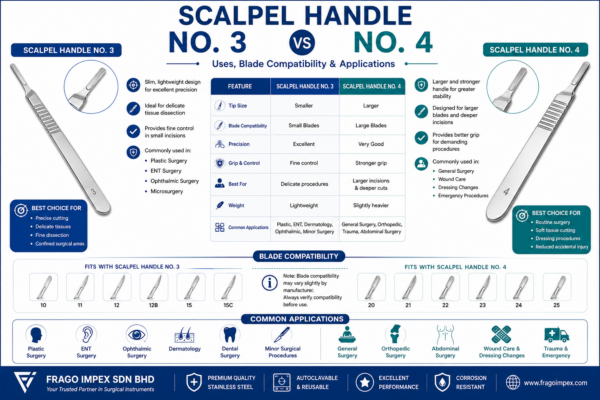
Scalpel Handle No. 3 vs No. 4: When it comes to performing precise surgical procedures, every instrument plays a crucial role in ensuring patient safety and achieving successful outcomes. Among these instruments, the surgical scalpel is one of the most essential tools in every operating room. While surgeons often focus on selecting the appropriate blade, choosing the correct scalpel handle is equally important.
The two most widely used reusable scalpel handles are Scalpel Handle No. 3 and Scalpel Handle No. 4. Although they appear similar at first glance, they differ significantly in size, blade compatibility, surgical applications, and handling characteristics. Selecting the wrong handle can reduce surgical precision, increase tissue trauma, and make delicate procedures unnecessarily difficult.
Whether you are a surgeon, medical student, hospital purchasing officer, or surgical instrument distributor, understanding these differences will help you choose the right instrument for every procedure.
At Frago Impex, we supply premium-quality surgical instruments trusted by healthcare professionals worldwide. In this comprehensive guide, we’ll explore everything you need to know about Scalpel Handle No. 3 and No. 4, including their dimensions, compatible blades, common surgical uses, advantages, maintenance tips, and buying considerations.
Understanding a Surgical Scalpel
A surgical scalpel is a precision cutting instrument consisting of two separate components:
- The reusable or disposable handle
- The detachable surgical blade
The handle provides grip and control, while the blade performs the incision. This modular design allows surgeons to replace dull blades quickly without changing the handle itself.
Because different surgical procedures require different incision depths and tissue characteristics, manufacturers developed multiple handle sizes to accommodate various blade types.
Among all available designs, Handle No. 3 and Handle No. 4 remain the global standards for reusable surgical scalpels.
What is Scalpel Handle No. 3?
Scalpel Handle No. 3 is the most commonly used surgical handle for fine and delicate procedures.
It is relatively slim, lightweight, and designed for smaller blades that allow exceptional precision. Surgeons performing detailed work appreciate its excellent balance and superior tactile feedback.
Because of its compact design, Handle No. 3 is commonly found in:
- General surgery
- Plastic surgery
- ENT surgery
- Dermatology
- Ophthalmic support procedures
- Podiatry
- Dental surgery
- Veterinary surgery
Its ergonomic profile minimizes hand fatigue during lengthy procedures requiring precise control.
Common Blade Compatibility for Handle No. 3
One of the biggest advantages of Handle No. 3 is its compatibility with many fine surgical blades.
Compatible blades include:
- Blade No. 10
- Blade No. 11
- Blade No. 12
- Blade No. 12B
- Blade No. 13
- Blade No. 14
- Blade No. 15
- Blade No. 15C
- Blade No. 15T
Each blade serves a unique purpose.
For example:
Blade No. 10
Ideal for large skin incisions in general surgery.
Blade No. 11
Designed for stab incisions, abscess drainage, vascular access, and laparoscopic entry.
Blade No. 12
Excellent for suture removal and ENT procedures because of its hook-shaped design.
Blade No. 15
The preferred blade for short, controlled incisions requiring exceptional precision.
These blades make Handle No. 3 extremely versatile.
What is Scalpel Handle No. 4?
Scalpel Handle No. 4 is a larger version specifically designed for bigger surgical blades.
Compared to Handle No. 3, it is longer, wider, and heavier.
This larger profile provides increased stability during procedures involving thicker tissue or larger operative fields.
Handle No. 4 is frequently used in:
- Orthopedic surgery
- Thoracic surgery
- Major abdominal surgery
- Trauma surgery
- Veterinary surgery
- Autopsy procedures
The additional size allows surgeons to generate greater cutting force while maintaining control.
Blade Compatibility for Handle No. 4
Handle No. 4 accepts larger blades including:
- Blade No. 20
- Blade No. 21
- Blade No. 22
- Blade No. 23
- Blade No. 24
- Blade No. 25
These blades are significantly larger than those used on Handle No. 3.
Examples include:
Blade No. 20
Suitable for abdominal and thoracic surgery.
Blade No. 21
Provides a slightly larger cutting edge for deeper incisions.
Blade No. 22
Frequently selected for major skin incisions.
Blade No. 23
Offers an extended cutting edge ideal for long surgical incisions.
Blade No. 24
Useful in orthopedic procedures where stronger cutting capability is required.
Why Blade Compatibility Matters
One of the most common mistakes among beginners is assuming every surgical blade fits every handle.
This is incorrect.
Handle No. 3 and Handle No. 4 use different mounting slots.
Attempting to install an incompatible blade can result in:
- Poor blade stability
- Blade movement during surgery
- Reduced cutting accuracy
- Increased tissue trauma
- Risk of accidental blade detachment
- Potential injury to surgical staff
Always verify compatibility before opening sterile packaging.
Size Comparison Between No. 3 and No. 4
Although both handles have similar designs, their physical dimensions differ considerably.
| Feature | Handle No. 3 | Handle No. 4 |
|---|---|---|
| Overall Size | Smaller | Larger |
| Weight | Lighter | Heavier |
| Blade Size | Small | Large |
| Precision | Excellent | Moderate |
| Cutting Power | Moderate | High |
| Fine Procedures | Excellent | Limited |
| Major Surgery | Limited | Excellent |
| User Comfort | High for delicate work | High for powerful cuts |
These differences directly influence surgical performance.
Design and Ergonomics
Both handles feature a flat profile with longitudinal grooves that improve grip.
However, subtle design differences affect handling.
Handle No. 3
Offers:
- Better fingertip control
- Reduced fatigue
- Increased precision
- Smooth maneuverability
- Excellent tactile feedback
Surgeons often compare it to holding a precision pen.
Handle No. 4
Provides:
- Stronger grip
- Greater leverage
- Enhanced stability
- Better control during forceful cutting
- Improved balance with larger blades
It performs more like a heavy-duty surgical knife.
Surgical Applications of Scalpel Handle No. 3
Handle No. 3 is particularly valuable in procedures requiring delicate tissue handling and controlled incisions. Its compatibility with smaller blades allows surgeons to work in confined anatomical spaces with exceptional accuracy.
Common applications include:
- Skin lesion excisions
- Plastic and reconstructive surgery
- Dermatological procedures
- Fine soft tissue dissection
- Small biopsy incisions
- Vascular procedures
- Pediatric surgery
- ENT operations
- Oral and maxillofacial surgery
- Cosmetic procedures
Its lightweight construction helps reduce hand fatigue during prolonged surgeries where precision is more important than cutting force.
Surgical Applications of Scalpel Handle No. 4
While Handle No. 3 excels in delicate surgical work, Scalpel Handle No. 4 is specifically designed for procedures that require larger, deeper, and more forceful incisions. Its larger size allows surgeons to maintain a secure grip while using bigger blades, making it ideal for operations involving thick skin, dense soft tissue, or muscle layers.
Because the handle accommodates larger blades, it provides greater leverage and stability, helping surgeons create long, smooth incisions with confidence.
Common procedures where Scalpel Handle No. 4 is preferred include:
- General surgery
- Orthopedic surgery
- Trauma surgery
- Cardiothoracic surgery
- Abdominal surgery
- Veterinary surgery
- Post-mortem examinations
- Emergency surgical procedures
- Large skin graft harvesting
- Extensive tissue dissections
The larger grip also makes it easier to control the instrument while wearing double surgical gloves or when operating in situations requiring additional cutting force.
Scalpel Handle No. 3 vs No. 4: Side-by-Side Comparison
Scalpel Handle No. 3 vs No. 4: Choosing between these two handles becomes easier when their features are compared directly.
| Feature | Scalpel Handle No. 3 | Scalpel Handle No. 4 |
|---|---|---|
| Handle Size | Small | Large |
| Weight | Lightweight | Heavier |
| Blade Compatibility | 10, 11, 12, 12B, 13, 14, 15, 15C, 15T | 20, 21, 22, 23, 24, 25 |
| Precision | Excellent | Good |
| Cutting Strength | Moderate | High |
| Fine Tissue Work | Excellent | Limited |
| Large Incisions | Limited | Excellent |
| Common Specialties | Plastic, ENT, Dermatology, Dental | Orthopedic, Trauma, General Surgery |
| Control | Superior for delicate work | Superior for forceful cutting |
| Learning Curve | Easy | Easy |
Although both handles share a similar appearance, they are designed for entirely different surgical tasks. Selecting the correct handle improves efficiency, reduces tissue trauma, and enhances surgeon comfort.
Which Scalpel Blades Fit Each Handle?
Scalpel Handle No. 3 vs No. 4: Understanding blade compatibility is one of the most important aspects of choosing a scalpel handle.
Scalpel Handle No. 3 Compatible Blades
- No. 10
- No. 11
- No. 12
- No. 12B
- No. 13
- No. 14
- No. 15
- No. 15C
- No. 15T
These blades are generally smaller and intended for precise, controlled incisions.
Scalpel Handle No. 4 Compatible Blades
- No. 20
- No. 21
- No. 22
- No. 23
- No. 24
- No. 25
These blades are larger and built for longer, deeper, and more powerful cuts.
Why Surgeons Often Keep Both Handles Available
Modern operating rooms rarely rely on just one scalpel handle. Instead, surgeons typically keep both No. 3 and No. 4 handles readily available because different stages of a procedure may require different levels of precision.
For example, a general surgeon performing an abdominal operation may begin with a Handle No. 4 fitted with a No. 22 blade to make the initial skin incision. Once the incision is complete and deeper tissue dissection begins, the surgeon may switch to a Handle No. 3 with a No. 15 blade for more delicate work around blood vessels and soft tissues.
This flexibility allows surgeons to work more efficiently while minimizing unnecessary tissue damage.
Advantages of Scalpel Handle No. 3
There are several reasons why Handle No. 3 remains one of the most widely used surgical instruments worldwide.
Exceptional Precision
Its smaller size allows for highly controlled movements, making it ideal for intricate surgical procedures.
Lightweight Design
The reduced weight minimizes hand fatigue during lengthy operations, improving surgeon comfort and accuracy.
Wide Blade Selection
Compatibility with multiple small blades makes it suitable for a broad range of specialties.
Improved Visibility
The compact profile provides a clearer view of the surgical field, especially in confined spaces.
Cost-Effective
Reusable stainless steel Handle No. 3 instruments are durable and can withstand repeated sterilization, offering excellent long-term value.
Advantages of Scalpel Handle No. 4
Handle No. 4 offers distinct benefits in surgeries where strength and stability are essential.
Greater Cutting Power
Its larger size provides increased leverage for thicker tissues and longer incisions.
Enhanced Stability
The heavier construction reduces unwanted movement during forceful cutting.
Ideal for Major Surgery
It is well-suited for orthopedic, trauma, and abdominal procedures that require larger blades.
Comfortable Grip
The wider handle is easier to hold securely, even when wearing thick surgical gloves.
Long-Term Durability
Like Handle No. 3, it is typically manufactured from high-quality surgical-grade stainless steel, ensuring years of reliable performance with proper care.
Limitations of Scalpel Handle No. 3
Despite its many advantages, Handle No. 3 is not suitable for every surgical situation.
Some limitations include:
- Not designed for large blades
- Less effective for deep or extensive incisions
- Requires more effort when cutting dense tissue
- May not provide sufficient leverage for orthopedic procedures
Using it beyond its intended purpose can reduce efficiency and compromise surgical performance.
Limitations of Scalpel Handle No. 4
Similarly, Handle No. 4 has certain drawbacks.
These include:
- Bulkier than Handle No. 3
- Less suitable for delicate microsurgical work
- Reduced maneuverability in confined spaces
- Can feel heavy during prolonged precision procedures
For surgeries requiring intricate dissection, a smaller handle often provides better control.
Materials Used in Scalpel Handles
Most reusable scalpel handles are manufactured from medical-grade stainless steel, chosen for its strength, corrosion resistance, and ability to withstand repeated sterilization.
High-quality stainless steel handles offer several benefits:
- Excellent durability
- Resistance to rust and staining
- Smooth surface for easy cleaning
- Compatibility with steam autoclaving
- Long service life
- Reliable blade locking mechanism
Some disposable handles are made from high-strength plastic or composite materials. These are commonly used in emergency departments, outpatient clinics, and settings where single-use instruments help reduce the risk of cross-contamination.
Regardless of the material, selecting instruments from a trusted manufacturer ensures consistent performance and patient safety.
Reusable vs Disposable Scalpel Handles
Healthcare facilities often choose between reusable and disposable scalpel handles based on their workflow, sterilization capabilities, and infection control policies.
Reusable Handles
Reusable handles are commonly made from stainless steel and are designed to withstand repeated sterilization cycles. They are widely used in hospitals and surgical centers due to their durability and long-term cost-effectiveness.
Advantages:
- Long service life
- Environmentally friendly
- Excellent grip and balance
- Lower cost over time
- High-quality construction
Disadvantages:
- Require proper cleaning and sterilization
- Initial purchase cost is higher than disposable options
Disposable Handles
Disposable handles are pre-sterilized and intended for single use, eliminating the need for reprocessing.
Advantages:
- Ready to use immediately
- No sterilization required
- Reduced risk of cross-contamination
- Convenient for outpatient settings
Disadvantages:
- Higher long-term cost
- Less environmentally sustainable
- May not offer the same feel or durability as reusable stainless steel handles
For most hospitals and surgical centers, reusable stainless steel handles remain the preferred choice due to their performance and longevity.
How to Choose the Right Scalpel Handle
Selecting the appropriate scalpel handle is about more than simply matching a blade. The type of surgery, tissue characteristics, surgeon preference, and overall procedural requirements all play important roles. Using the right combination of handle and blade improves precision, reduces hand fatigue, minimizes tissue trauma, and contributes to better surgical outcomes.
Below are the key factors to consider when choosing between Scalpel Handle No. 3 and No. 4.
1. Consider the Type of Procedure
The nature of the surgery is the first factor to evaluate.
If the procedure involves delicate tissue, fine dissection, or small incisions, Scalpel Handle No. 3 is usually the preferred option. It provides greater control for procedures where precision is essential.
For larger operations involving thick skin, muscle, or extensive dissections, Scalpel Handle No. 4 offers the strength and stability needed to make longer and deeper incisions efficiently.
2. Match the Blade Correctly
Every scalpel blade is engineered to fit a specific handle.
For example:
- Blade No. 10 works with Handle No. 3.
- Blade No. 11 works with Handle No. 3.
- Blade No. 15 works with Handle No. 3.
- Blade No. 22 works with Handle No. 4.
- Blade No. 23 works with Handle No. 4.
- Blade No. 24 works with Handle No. 4.
Using an incompatible blade can result in poor stability, reduced cutting accuracy, and potential safety hazards.
3. Think About Surgeon Comfort
Some surgeons naturally prefer lighter instruments for delicate work, while others feel more confident using a heavier handle during major procedures.
Comfort directly affects precision, especially during lengthy operations. A handle that fits comfortably in the surgeon’s hand can reduce fatigue and improve control throughout the procedure.
4. Evaluate the Surgical Environment
Different healthcare facilities have different needs.
For example:
- Large hospitals generally stock both Handle No. 3 and No. 4 to support a wide variety of surgical specialties.
- Ambulatory surgical centers often keep multiple handle sizes available to accommodate different procedures.
- Medical schools require both handles for training purposes.
- Veterinary clinics frequently use both depending on the size of the animal and the type of surgery.
Keeping multiple handle sizes available ensures the surgical team is prepared for a broad range of clinical situations.
Proper Blade Attachment and Removal
Safe blade handling is essential to protect healthcare professionals from accidental injuries and to maintain instrument integrity.
Attaching the Blade
- Verify that the handle and blade are compatible.
- Use a sterile needle holder or blade remover whenever possible.
- Align the slot on the blade with the mounting rail on the handle.
- Slide the blade forward until it locks securely into place.
- Confirm that the blade is firmly attached before use.
Removing the Blade
After the procedure:
- Never remove the blade using your fingers.
- Use a designated blade removal device or a needle holder.
- Dispose of the used blade immediately in an approved sharps container.
- Clean and sterilize the reusable handle according to hospital protocols.
Following these safety practices helps reduce the risk of sharps injuries and supports effective infection control.
Cleaning and Sterilization of Reusable Scalpel Handles
Reusable scalpel handles are designed to withstand repeated sterilization cycles. However, proper cleaning is essential to maintain their performance and extend their service life.
A recommended cleaning process includes:
Step 1: Pre-Cleaning
Immediately after surgery, rinse the handle with water to remove blood and tissue residues before they dry.
Step 2: Manual Cleaning
Use a soft brush and an approved enzymatic detergent to clean all grooves, slots, and surfaces thoroughly.
Step 3: Inspection
Carefully inspect the handle for:
- Corrosion
- Surface scratches
- Bent mounting rails
- Loose components
- Wear that could affect blade stability
Damaged handles should be removed from service.
Step 4: Sterilization
Most stainless steel handles can be sterilized using standard steam autoclave cycles in accordance with hospital guidelines.
Step 5: Storage
Store sterilized handles in a clean, dry, and protected environment to prevent contamination and physical damage.
Routine maintenance ensures reliable performance and helps maximize the lifespan of surgical instruments.
Common Mistakes When Choosing a Scalpel Handle
Even experienced professionals can encounter issues if the wrong handle or blade is selected. Avoiding these common mistakes improves efficiency and patient safety.
Using the Wrong Blade Size
Attempting to fit a large blade onto Handle No. 3—or a small blade onto Handle No. 4—can lead to instability and poor performance.
Prioritizing Price Over Quality
Low-quality instruments may lose blade retention, corrode more quickly, or fail to provide consistent performance. Investing in high-quality surgical instruments reduces long-term costs and enhances safety.
Ignoring Ergonomics
A handle that feels uncomfortable can increase hand fatigue during lengthy procedures, potentially affecting precision.
Improper Sterilization
Failure to clean and sterilize reusable handles correctly can compromise infection control and shorten the instrument’s lifespan.
Delaying Blade Replacement
A dull blade requires more force to cut tissue, increasing tissue trauma and reducing surgical efficiency. Replacing blades promptly helps maintain optimal performance.
Why High-Quality Scalpel Handles Matter
A surgical scalpel is one of the most frequently used instruments in the operating room. The quality of the handle influences blade stability, precision, and overall user confidence.
Premium surgical handles typically provide:
- Precise blade fit
- Strong blade retention
- Corrosion-resistant stainless steel
- Balanced weight distribution
- Comfortable grip
- Long service life
- Reliable performance after repeated sterilization
Choosing quality instruments contributes to smoother procedures and greater confidence for the surgical team.
Industries That Use Scalpel Handles No. 3 and No. 4
Although scalpels are primarily associated with hospitals, these handles are used across many healthcare and research environments.
Examples include:
- General hospitals
- Private surgical centers
- Dental clinics
- Dermatology practices
- Plastic surgery clinics
- Veterinary hospitals
- Medical universities
- Anatomy laboratories
- Research institutions
- Emergency care facilities
- Military medical units
- Humanitarian healthcare organizations
Their versatility makes them essential tools in numerous medical disciplines.
Why Buy Surgical Instruments from Frago Impex?
Choosing the right supplier is just as important as selecting the right instrument. At Frago Impex, we are committed to providing healthcare professionals with dependable, high-quality surgical instruments that meet international standards.
Our commitment includes:
- Premium-grade surgical stainless steel instruments
- Precision manufacturing for consistent performance
- Durable instruments designed for repeated sterilization
- Competitive pricing for hospitals, distributors, and clinics
- Strict quality control processes
- Reliable worldwide supply
- Professional customer support
- A comprehensive range of surgical instruments and medical equipment
Whether you need individual scalpel handles or complete surgical instrument sets, Frago Impex is dedicated to delivering products that support safe and efficient patient care.
Frequently Asked Questions (FAQs)
1. What is the main difference between Scalpel Handle No. 3 and No. 4?
The primary difference is size and blade compatibility. Handle No. 3 is designed for smaller blades and precision work, while Handle No. 4 accommodates larger blades for major surgical procedures.
2. Can I use Blade No. 22 on Handle No. 3?
No. Blade No. 22 is specifically designed for Scalpel Handle No. 4 and is not compatible with Handle No. 3.
3. Which handle is best for dermatology procedures?
Scalpel Handle No. 3 is generally preferred because it offers greater precision and works with smaller blades commonly used in dermatological surgery.
4. Are reusable scalpel handles safe?
Yes. When properly cleaned, inspected, and sterilized according to established protocols, reusable stainless steel scalpel handles are safe and highly reliable.
5. Which handle is used in orthopedic surgery?
Scalpel Handle No. 4 is commonly used in orthopedic procedures because it supports larger blades and provides greater cutting strength.
6. How long does a reusable scalpel handle last?
A high-quality stainless steel handle can remain in service for many years when maintained correctly and inspected regularly.
7. Why is blade compatibility important?
Correct blade compatibility ensures secure attachment, precise cutting, and minimizes the risk of blade movement during surgery.
Conclusion
Choosing between Scalpel Handle No. 3 and Scalpel Handle No. 4 is not simply a matter of size—it is about selecting the right instrument for the specific surgical procedure. Both handles have been designed to meet different clinical requirements, and each offers unique advantages depending on the type of incision, tissue characteristics, and surgeon preference.
If your work involves fine tissue dissection, short skin incisions, plastic surgery, dermatology, ENT procedures, dental surgery, or other precision-based operations, Scalpel Handle No. 3 is the ideal choice. Its lightweight construction, ergonomic design, and compatibility with smaller blades allow surgeons to achieve exceptional control and accuracy.
On the other hand, when performing general surgery, orthopedic procedures, trauma surgery, thoracic surgery, abdominal operations, or veterinary surgery, Scalpel Handle No. 4 provides the additional strength, stability, and leverage needed for larger incisions and thicker tissues. Its compatibility with larger blades makes it the preferred option for demanding surgical environments.
Rather than viewing one handle as superior to the other, experienced surgeons recognize that both handles complement each other. In many operating rooms, it is common practice to keep both Handle No. 3 and Handle No. 4 available, allowing the surgical team to select the most appropriate instrument at different stages of the procedure.
A high-quality scalpel handle should offer:
- Secure blade attachment
- Excellent balance
- Comfortable grip
- Corrosion resistance
- Long service life
- Reliable performance after repeated sterilization
Investing in premium surgical instruments not only improves surgical efficiency but also supports patient safety, reduces instrument replacement costs, and enhances the overall quality of care.
At Frago Impex, we understand the importance of precision and reliability in every surgical procedure. That’s why we supply high-quality surgical instruments, including reusable scalpel handles, surgical blades, forceps, scissors, needle holders, retractors, and complete surgical sets to hospitals, clinics, distributors, and healthcare professionals worldwide.
Whether you’re equipping a new operating theatre, upgrading your surgical instrument inventory, or sourcing products for distribution, Frago Impex is your trusted partner for quality, durability, and dependable service.
Explore our complete range of surgical instruments and discover solutions designed to meet the needs of modern healthcare.
Key Takeaways
- Scalpel Handle No. 3 is smaller, lighter, and designed for precision surgery.
- Scalpel Handle No. 4 is larger, heavier, and intended for major surgical procedures.
- Handle No. 3 is compatible with Blades 10, 11, 12, 12B, 13, 14, 15, 15C, and 15T.
- Handle No. 4 is compatible with Blades 20, 21, 22, 23, 24, and 25.
- Proper blade compatibility is essential for safety and surgical accuracy.
- Both handles are indispensable in modern operating rooms and serve different clinical purposes.
- High-quality stainless steel handles provide durability, corrosion resistance, and long-term value.
- Choosing the correct handle improves surgical precision, efficiency, and patient outcomes.