Operating Scissors Guide: Sharp-Sharp or Sharp-Blunt?
Introduction
In surgery, success often depends on the smallest decisions. While advanced surgical equipment and skilled hands play a significant role, the selection of the right surgical instrument can greatly influence precision, patient safety, and procedural efficiency. One such decision is choosing between sharp-sharp and sharp-blunt operating scissors.
At first glance, these two types of operating scissors may appear nearly identical. However, their tip configurations are designed for different surgical purposes. Selecting the wrong type can lead to unnecessary tissue trauma, slower procedures, and reduced surgical control.
This article presents an illustrative case study that demonstrates how surgeons determine whether to use sharp-sharp or sharp-blunt operating scissors in different situations. By understanding their design, applications, advantages, and limitations, healthcare professionals can make better instrument choices that support safer surgical outcomes.
Understanding Operating Scissors
Operating scissors are among the most commonly used surgical instruments in operating rooms worldwide. They are designed to cut tissues, dissect anatomical structures, trim sutures, and assist surgeons throughout various procedures.
Although operating scissors come in multiple designs and sizes, one of the most important distinctions lies in the tip configuration:
Each design serves a specific surgical purpose.
What Are Sharp-Sharp Operating Scissors?
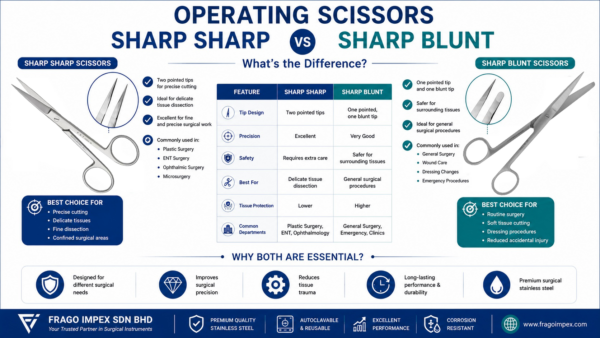
Sharp-sharp operating scissors feature pointed tips on both blades. This design allows surgeons to penetrate tissue easily and make precise cuts where accuracy is essential.
These scissors are particularly useful when:
- Beginning tissue dissection
- Cutting delicate membranes
- Creating small surgical openings
- Performing controlled incisions
- Working in confined anatomical spaces
Because both blades are pointed, they provide excellent cutting precision but require careful handling to avoid damaging surrounding structures.
What Are Sharp-Blunt Operating Scissors?
Sharp-blunt operating scissors have one pointed blade and one rounded blade.
The blunt tip acts as a protective guide beneath tissues while the sharp blade performs the cutting action. This design minimizes the risk of accidental puncture or injury to nearby organs, vessels, nerves, or soft tissues.
These scissors are commonly selected for:
- Tissue dissection
- Extending surgical incisions
- Separating soft tissue layers
- General surgical procedures
- Safe cutting near delicate structures
They offer a balance between precision and safety.
Case Study: Selecting the Right Operating Scissors During Abdominal Surgery
Patient Background
A 52-year-old patient is scheduled for an elective abdominal procedure to remove a benign intestinal lesion. The operation requires multiple stages, including:
- Initial skin incision
- Fascial opening
- Soft tissue dissection
- Exposure of the surgical field
- Removal of the lesion
- Closure
Throughout the operation, the surgeon must choose instruments that provide the highest level of precision while minimizing tissue damage.
Stage 1: Initial Delicate Tissue Opening
After the skin incision has been completed using a scalpel, the surgeon encounters a thin connective tissue layer that requires careful entry.
The tissue is delicate and tightly attached to underlying structures.
Instrument Selection
The surgeon chooses Sharp-Sharp Operating Scissors.
Why?
The pointed tips allow:
- Easy tissue penetration
- Precise entry into thin tissue
- Controlled cutting
- Minimal force during dissection
Using sharp-blunt scissors at this stage would require slightly more manipulation before entering the tissue.
Stage 2: Extending the Incision
Once the initial opening has been created, the incision needs to be extended.
However, there are blood vessels and soft tissue lying directly beneath the incision line.
Instrument Selection
The surgeon switches to Sharp-Blunt Operating Scissors.
Why?
The blunt tip slides safely beneath the tissue while:
- Protecting underlying structures
- Preventing accidental puncture
- Guiding the cutting direction
- Maintaining surgical control
This greatly reduces the risk of unintended injury.
Stage 3: Soft Tissue Dissection
As the procedure continues, multiple tissue layers must be separated.
The tissues are fragile and closely attached.
Instrument Selection
Again, the surgeon prefers Sharp-Blunt Operating Scissors.
Benefits
The rounded blade:
- Gently separates tissue planes
- Reduces accidental tearing
- Prevents excessive penetration
- Improves tissue preservation
Stage 4: Removing Dense Fibrous Tissue
Near the lesion, the surgeon encounters dense fibrous tissue that requires precise cutting.
Instrument Selection
The surgeon temporarily returns to Sharp-Sharp Operating Scissors.
Reason
The pointed blades provide:
- Better control
- Greater cutting accuracy
- Easier penetration into dense tissue
- Cleaner dissection
Stage 5: Completing the Procedure
As surgery nears completion, final tissue trimming and minor adjustments are required.
Most remaining cuts occur near important anatomical structures.
Instrument Selection
The surgeon once again chooses Sharp-Blunt Operating Scissors.
The blunt tip offers additional protection during the final stages of surgery where visibility may be reduced and tissue preservation is especially important.
Lessons Learned from This Case Study
The procedure demonstrates that surgeons rarely rely on only one type of operating scissors.
Instead, they select the instrument that best matches the specific surgical task.
Sharp-sharp scissors excel when:
- Precision is the highest priority
- Tissue entry is required
- Fine dissection is necessary
- Small controlled incisions must be created
Sharp-blunt scissors become the preferred option when:
- Safety is essential
- Tissue layers require separation
- Incisions need extension
- Delicate structures require protection
This flexibility helps surgeons maintain efficiency while minimizing complications.
Comparing Sharp-Sharp and Sharp-Blunt Operating Scissors
| Feature | Sharp-Sharp | Sharp-Blunt |
|---|---|---|
| Blade Tips | Both pointed | One pointed, one rounded |
| Tissue Entry | Excellent | Good |
| Precision | Excellent | Very Good |
| Tissue Protection | Moderate | Excellent |
| Risk of Accidental Injury | Higher if misused | Lower |
| Soft Tissue Dissection | Good | Excellent |
| General Surgery | Frequently used | Extremely common |
| Delicate Tissue Work | Excellent | Excellent with added safety |
Advantages of Sharp-Sharp Operating Scissors
Surgeons appreciate sharp-sharp scissors because they provide:
- Outstanding cutting precision
- Easy penetration into tissue
- Better access to confined spaces
- Smooth controlled incisions
- Excellent performance in delicate surgical procedures
They are particularly useful when every millimeter of accuracy matters.
Advantages of Sharp-Blunt Operating Scissors
Sharp-blunt operating scissors remain one of the most versatile instruments in surgery.
Their benefits include:
- Improved patient safety
- Reduced tissue trauma
- Protection of underlying structures
- Smooth tissue dissection
- Greater confidence during extended cuts
These qualities make them a preferred choice for many general surgical procedures.
Common Surgical Specialties Using Both Types
Both sharp-sharp and sharp-blunt operating scissors are widely used in:
- General surgery
- Gynecological surgery
- Plastic surgery
- Orthopedic surgery
- Urological surgery
- ENT surgery
- Cardiovascular surgery
- Pediatric surgery
- Veterinary surgery
The choice depends more on the surgical task than the specialty itself.
Factors Surgeons Consider Before Choosing
Experienced surgeons evaluate several factors before selecting operating scissors:
Tissue Type
Delicate tissues require maximum precision, while thicker tissues may benefit from added safety.
Surgical Depth
Deep surgical fields often favor blunt tips to reduce accidental injury.
Visibility
Limited visibility increases the value of protective blunt blades.
Procedure Stage
Early dissection, tissue separation, and final trimming may each require different scissors.
Surgeon Preference
Many surgeons develop preferences based on training, specialty, and clinical experience, though patient safety and procedural requirements always guide the final decision.
Best Practices for Safe Use
To maximize performance and extend instrument life:
- Inspect scissors before every procedure.
- Ensure blade alignment remains accurate.
- Use scissors only for their intended purpose.
- Avoid cutting materials they were not designed for.
- Clean thoroughly after use.
- Sterilize according to hospital protocols.
- Store instruments carefully to protect blade tips.
Proper maintenance ensures consistent cutting performance and long-term reliability.
Conclusion
Choosing between sharp-sharp and sharp-blunt operating scissors is not simply a matter of personal preference—it is a clinical decision that directly affects precision, efficiency, and patient safety.
As illustrated in this case study, experienced surgeons often alternate between both types during a single procedure. Sharp-sharp scissors provide exceptional precision when creating initial tissue openings or performing fine dissection, while sharp-blunt scissors offer added protection when extending incisions or working near sensitive anatomical structures.
Understanding the strengths of each design allows surgical teams to select the most appropriate instrument for every stage of an operation. By matching the scissors to the surgical task, healthcare professionals can improve control, reduce tissue trauma, and support better patient outcomes.