Skip to content

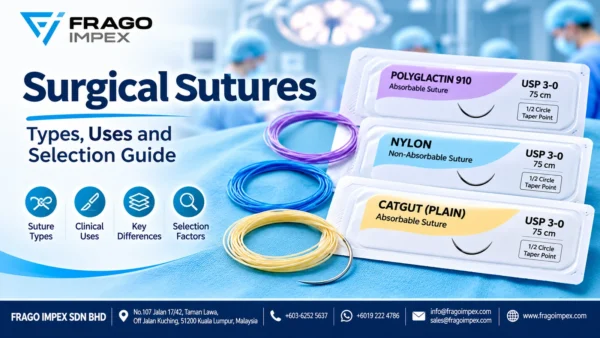
Absorbable vs Non-Absorbable Sutures: Surgical sutures are essential medical supplies used to bring tissues together, close wounds and ligate blood vessels during surgical procedures. However, not every wound requires the same suture material. The choice depends on the tissue being repaired, the expected healing time, the amount of support required and the clinical purpose of the procedure.
One of the most important distinctions is between absorbable and non-absorbable sutures. Absorbable sutures gradually break down in the body, while non-absorbable sutures are designed to retain their structure for longer and may require removal when used for external skin closure.
Understanding these differences helps surgeons, nurses, healthcare professionals and procurement teams select suitable products for different clinical applications.
This guide explains the main types of absorbable and non-absorbable sutures, their characteristics, common uses and the factors to consider when selecting surgical sutures.
What Are Absorbable Sutures?

Absorbable sutures are surgical threads designed to lose their tensile strength and break down within the body over time. They are commonly used when tissue needs temporary support during healing and permanent retention of the suture is unnecessary.
Absorption time varies according to the material, suture construction, tissue environment and product design. Losing tensile strength and being completely absorbed are not the same event; a suture may lose much of its strength before the material has disappeared.
Absorbable sutures are often used for:
- Closing deeper tissue layers.
- Subcutaneous and selected soft-tissue closure.
- Certain gastrointestinal and gynaecological procedures.
- Selected oral and dental procedures.
- Tissue approximation where long-term suture retention is not required.
The suitability of a particular suture depends on its labelled indications and the clinical requirements of the procedure.
Common types of absorbable sutures
1. Plain catgut

Plain catgut is a natural absorbable suture made from processed animal-derived collagen. It breaks down primarily through enzymatic degradation.
It may be used for selected procedures requiring relatively short-term wound support. Its absorption and strength retention can be less predictable than those of synthetic absorbable materials, so the clinical team must consider the specific application and product instructions.
Explore Catgut Plain Sutures available through FRAGO IMPEX.

Chromic catgut is treated to modify its absorption characteristics compared with plain catgut. It is used in selected procedures where an absorbable natural suture is appropriate.
Its performance depends on the product, tissue conditions and intended application. It should not be assumed to provide the same strength retention or absorption profile as every synthetic absorbable suture.
Browse Catgut Chromic Sutures on the FRAGO IMPEX website.
3. Polyglycolic acid (PGA)
PGA is a synthetic absorbable suture material. Depending on the product design, it may be supplied as a braided thread and is used for selected soft-tissue approximation and ligation procedures.
Braided construction can offer handling and knot-security characteristics valued in some applications. The trade-off is that braided materials may behave differently from monofilaments in contaminated or infection-prone environments.
4. Polyglactin 910
Polyglactin 910 is a synthetic absorbable copolymer used in a range of surgical closure applications. Products made from this material are commonly available in braided form.
Its use depends on the required strength retention, absorption profile, tissue type and product-specific indications.
5. Poliglecaprone 25
Poliglecaprone 25 is a synthetic absorbable monofilament material used for selected soft-tissue closure procedures, including some subcuticular skin closures.
Its monofilament construction supports smooth passage through tissue. The appropriate application depends on the product’s strength-retention profile and intended use.
6. Polydioxanone (PDS)
Polydioxanone is a synthetic absorbable monofilament material designed to retain strength longer than many faster-absorbing materials. It may be selected when tissue needs extended temporary support.
The required duration of support and the manufacturer’s absorption data should be considered before selecting it for a specific procedure.
What Are Non-Absorbable Sutures?

Non-absorbable sutures are designed to maintain their structure for an extended period rather than being rapidly broken down by the body. They are used when continued mechanical support is required or when the clinical application calls for a suture that remains in place.
Some non-absorbable sutures used for external skin closure are removed after sufficient healing. Others may remain in the body when indicated for the particular repair.
Common applications include:
- External skin closure.
- Selected cardiovascular procedures.
- Tendon, ligament or other repairs requiring appropriate long-term support.
- Certain hernia and abdominal wall repairs.
- Selected ophthalmic and other specialist procedures.
- Ligation and other soft-tissue applications, depending on the material.
Not all non-absorbable materials are identical. Some may gradually lose tensile strength or undergo changes in the body despite being classified as non-absorbable.
Common types of non-absorbable sutures

Nylon is a synthetic polyamide material widely used for external skin closure and selected surgical applications. It is commonly supplied as a monofilament, although construction can vary.
Its relatively smooth surface can support passage through tissue, while knot security and handling require appropriate technique.
FRAGO IMPEX lists Nylon Sutures – Blue Monofilament in its product range.
2. Polypropylene sutures
Polypropylene is a synthetic non-absorbable material used in various soft-tissue and specialist surgical applications. It is commonly supplied as a monofilament.
Its handling, flexibility and knot security differ from those of nylon, silk and braided polyester. Selection should be based on the intended procedure and the product’s specifications.
3. Silk sutures

Silk is a natural-origin, typically braided non-absorbable suture material known for its handling characteristics and knot security. Although classified as non-absorbable, silk can gradually lose strength in the body.
It is used in selected soft-tissue and ligation applications. Its braided construction and tissue response should be considered when choosing it for a particular procedure.
See FRAGO IMPEX’s Silk Sutures – Black Braided range.
4. Polyester sutures
Polyester sutures are synthetic non-absorbable materials available in different constructions and configurations. They may be used where durable support is required for suitable soft-tissue repairs.
The material’s coating, filament structure, needle configuration and intended application should be checked against the product documentation.
5. Stainless steel sutures
Stainless steel suture wire is used in selected applications where its mechanical properties are appropriate, including certain sternal and orthopaedic procedures.
It requires suitable handling and application technique. It is not a general substitute for flexible polymer sutures in routine wound closure.
Absorbable vs Non-Absorbable Sutures: Key Differences
| Feature | Absorbable sutures | Non-absorbable sutures |
|---|---|---|
| Material behaviour | Gradually loses strength and breaks down in the body | Designed for prolonged retention; degradation varies by material |
| Common purpose | Temporary support during healing | Continued support or applications requiring retained material |
| Removal | Usually does not require removal solely to eliminate the suture | May require removal for external skin closure |
| Common examples | Catgut, PGA, polyglactin 910, poliglecaprone 25, polydioxanone | Nylon, polypropylene, silk, polyester, stainless steel |
| Typical applications | Selected internal layers and soft-tissue closure | Skin closure, ligation and selected repairs requiring continued support |
| Main selection consideration | Strength retention and absorption profile | Required durability, handling and whether removal is appropriate |
| Available constructions | Monofilament or multifilament, depending on material | Monofilament or multifilament, depending on material |
These are general characteristics, not universal rules. Product specifications and clinical requirements determine whether a particular suture is appropriate.
Monofilament vs Multifilament Sutures
Absorbability is only one way to classify surgical sutures. Their physical construction also affects handling, knot security and passage through tissue.
Monofilament sutures
Monofilament sutures consist of a single strand.
Potential characteristics include:
- A relatively smooth surface.
- Less space between filaments for fluid and microorganisms to collect.
- Different handling and knot-security requirements compared with braided sutures.
- Greater susceptibility to kinking or damage if handled improperly, depending on the material.
Nylon, polypropylene and polydioxanone are examples of materials commonly available as monofilaments.
Multifilament or braided sutures
Multifilament sutures consist of multiple strands twisted or braided together.
Potential characteristics include:
- Flexible handling.
- Good knot security in many applications.
- Different friction and tissue-drag characteristics from monofilaments.
- Greater potential for fluid and microorganism retention within the braided structure.
Silk, PGA and polyglactin 910 are examples of materials commonly available in braided form.
Neither construction is universally better. The appropriate choice depends on tissue type, wound conditions, surgical technique and the product’s intended use.
How to Choose the Right Surgical Suture
Suture selection should be based on clinical requirements rather than absorbability alone.
1. Consider the tissue being repaired
Different tissues heal at different rates and require different levels and durations of support. Skin, fascia, mucosa, blood vessels and other tissues may require different suture characteristics.
The selected material must be appropriate for the intended tissue and procedure.
2. Assess the required strength retention
A suture should provide adequate support for the period during which the tissue needs assistance.
For absorbable sutures, compare the strength-retention profile with the expected healing process. For non-absorbable sutures, consider whether prolonged mechanical support is required and whether removal is planned.
3. Evaluate wound tension
Wounds under greater tension may require a different suture material, size or closure technique from wounds under minimal tension.
Suture selection must be considered alongside appropriate surgical technique and management of the underlying tissue.
4. Consider infection risk
The choice between monofilament and braided construction may be relevant when infection risk is a concern.
Monofilaments generally have fewer interstices than braided sutures, but material choice alone does not prevent infection. Sterile technique, appropriate wound management and clinical protocols remain essential.
5. Review tissue response
Different materials can produce different tissue responses. This matters particularly in delicate tissues, selected cosmetic procedures and applications where local reaction may affect healing.
Product composition, coating, construction and clinical evidence should inform the choice.
6. Check needle type and size
Suture selection also includes the attached needle, where supplied.
Important considerations include:
- Needle curvature and length.
- Needle-point design.
- Tissue type and thickness.
- Suture diameter.
- Compatibility with the required suturing technique.
A suitable thread with an inappropriate needle configuration may not meet the procedural requirements.
7. Consider whether external removal is practical
For some external wounds, non-absorbable sutures may be removed after appropriate healing. In other situations, follow-up for removal may be difficult, making an absorbable option worth considering where clinically suitable.
The decision should be made by the treating clinician based on the wound, patient and expected follow-up.
8. Verify product documentation
Before purchasing sutures, healthcare facilities and distributors should check:
- Material composition.
- Absorbability classification.
- Suture size and length.
- Needle type and dimensions.
- Sterile packaging and intended use.
- Strength-retention and absorption information, where applicable.
- Storage conditions and expiry date.
- Relevant regulatory documentation.
The US Food and Drug Administration’s Surgical Sutures guidance discusses suture identification, material composition, sterility, performance and labelling considerations.
Common Mistakes When Selecting Sutures
Choosing based only on price: A low purchase price does not establish clinical suitability. Compare specifications, intended use, documentation and supply continuity.
Assuming all absorbable sutures disappear at the same rate: Different materials have different strength-retention and absorption profiles.
Treating all non-absorbable sutures as permanent: Some are removed after external wound closure, while other applications may require long-term retention.
Ignoring filament construction: Monofilament and braided sutures differ in handling, knot security and behaviour in tissue.
Selecting the wrong needle: Needle design and dimensions should match the tissue and procedure.
Overlooking storage and expiry: Sterile sutures should be stored according to the manufacturer’s instructions and should not be used beyond their labelled expiry date.
Surgical Sutures Available from FRAGO IMPEX
FRAGO IMPEX SDN BHD supplies surgical sutures for healthcare facilities and medical-equipment buyers. Its website lists absorbable and non-absorbable options, including catgut, nylon and silk sutures.
Explore the following categories:
- All Surgical Sutures
- Catgut Plain Sutures
- Catgut Chromic Sutures
- Nylon Blue Monofilament Sutures
- Silk Black Braided Sutures
Healthcare professionals and procurement teams should confirm the available sizes, needle configurations, product documentation and suitability for the intended procedure before ordering.
Frequently Asked Questions
What is the main difference between absorbable and non-absorbable sutures?
Absorbable sutures gradually lose strength and break down in the body. Non-absorbable sutures are designed for longer-term retention, although external sutures may be removed after sufficient healing.
Which sutures are commonly used for internal stitches?
Absorbable sutures are commonly used for selected internal tissue layers, but the appropriate material depends on the tissue, healing time, required strength and procedure. Some internal repairs require non-absorbable sutures.
Are nylon sutures absorbable?
Nylon surgical sutures are generally classified as non-absorbable. They are commonly used for external skin closure and selected other procedures.
Is silk an absorbable or non-absorbable suture?
Silk is classified as non-absorbable. However, it may gradually lose tensile strength in the body, so its long-term behaviour is not identical to that of every synthetic non-absorbable material.
What is the difference between plain catgut and chromic catgut?
Both are natural absorbable collagen sutures. Chromic catgut is treated to modify its absorption characteristics compared with plain catgut. Product-specific performance and suitability should be checked before use.
Which suture is best for skin closure?
There is no single best suture for every skin wound. The decision depends on wound location, tension, healing requirements, cosmetic considerations, infection risk and whether follow-up for removal is practical.
Do absorbable sutures always need no follow-up?
No. Although they generally do not require removal solely to eliminate the suture, patients may still need follow-up based on the wound, procedure and clinical instructions. Absorbable sutures can also sometimes cause local irritation or become visible during healing.
Conclusion
The choice between absorbable and non-absorbable sutures depends on the tissue being repaired, the required duration of support, wound tension, infection risk and procedural requirements.
Absorbable sutures are useful when temporary support is needed and the material can break down as healing progresses. Non-absorbable sutures are suitable when longer-term retention or removal after external closure is required. Material type, filament construction, needle design and product-specific performance are equally important considerations.
For healthcare professionals and procurement teams, understanding these differences supports more informed product selection. FRAGO IMPEX SDN BHD provides a range of surgical suture options for review, with product suitability and specifications to be confirmed before purchase.
Contact FRAGO IMPEX SDN BHD
Website: https://www.fragoimpex.com
Address: No.107 Jalan 17/42, Taman Lawa, Off Jalan Kuching, 51200 Kuala Lumpur, Malaysia
Tel: +603-6252 5637
WhatsApp: +6019 222 4786
Email: info@fragoimpex.com
Sales: sales@fragoimpex.com
This article is for educational and procurement information. Suture selection should be made by qualified healthcare professionals using the manufacturer’s instructions, applicable clinical guidance and the requirements of the specific procedure.