Skip to content
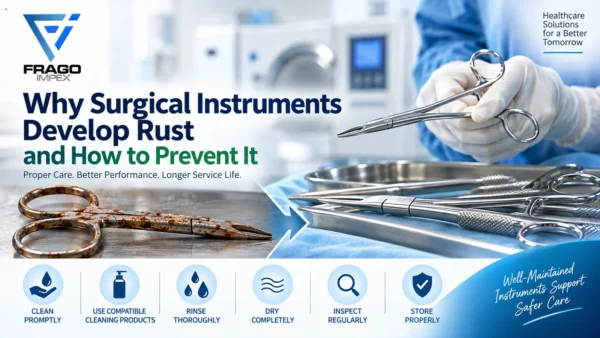
Why Surgical Instruments Develop Rust
Surgical instruments are designed to withstand repeated cleaning, disinfection, sterilization and handling. However, even high-quality stainless-steel instruments can develop staining, corrosion or rust when cleaning, water quality, chemicals, drying or storage conditions are not properly controlled.
Rust on surgical instruments is not simply a cosmetic issue. Corrosion can affect the instrument surface, joints, serrations, cutting edges and other working areas. In more advanced cases, pitting and surface damage can make instruments harder to clean and may affect their function.
For hospitals, clinics and sterile processing departments, understanding why surgical instruments develop rust is important for maintaining instrument performance, protecting equipment investments and supporting proper reprocessing.


6
What Causes Rust on Surgical Instruments?
Although surgical instruments are commonly manufactured from corrosion-resistant stainless steel, stainless steel is not completely corrosion-proof.
Its corrosion resistance depends partly on a protective passive layer on the metal surface. Certain chemicals, residues, moisture, mechanical damage and environmental conditions can interfere with this protection.
Here are some of the most common causes.
1. Inadequate or Delayed Cleaning
Blood, tissue, saline and other organic material can remain on an instrument after a procedure.
If instruments are left contaminated for too long, the material can dry onto the surface and become significantly harder to remove.
Pay particular attention to:
- Box locks
- Hinges
- Serrations
- Ratchets
- Cutting edges
- Fine tips
- Joints
- Cannulated or hollow areas
The CDC recommends prompt cleaning because dried soil is more difficult to remove and thorough cleaning is necessary before effective disinfection or sterilization. CDC — Cleaning Medical Devices
2. Leaving Instruments Wet
Moisture is another common contributor to corrosion.
Water can remain trapped inside:
- Hinges
- Box locks
- Serrations
- Joints
- Cannulated instruments
- Instrument trays
If instruments are stored or packaged while moisture remains present, the prolonged exposure can contribute to staining and corrosion.
Proper drying should therefore be treated as an important part of instrument care rather than an optional final step.
3. Poor Water Quality
The water used during cleaning and rinsing can affect surgical instruments.
Minerals and other contaminants can leave deposits on metal surfaces. Depending on the water chemistry and processing conditions, these deposits may contribute to staining, scaling or corrosion.
If a hospital notices recurring discoloration across many instruments, it can be useful to investigate the water quality as well as the cleaning chemicals and processing equipment.
4. Incorrect Cleaning Chemicals
Not every cleaning product is suitable for surgical instruments.
Problems may occur when:
- The wrong detergent is selected
- The concentration is incorrect
- Chemicals are left on instruments too long
- Products are not compatible with the instrument material
- Instruments are not rinsed adequately afterward
Cleaning products should always be used according to their manufacturer’s instructions and should be compatible with the instruments being processed.
5. Saline and Chloride Exposure
Saline and chloride-containing residues can be particularly problematic for stainless steel.
Instruments should not be left unnecessarily exposed to saline after use. Prompt processing and appropriate cleaning can help reduce the risk of chloride-related corrosion.
6. Mixing Incompatible Metals
Contact between different metals under certain conditions can contribute to corrosion or discoloration.
For this reason, sterile processing procedures should follow the recommendations of the instrument and equipment manufacturers.
7. Scratches and Surface Damage
Surgical instruments can also be damaged through rough handling.
Dropping instruments, using excessively abrasive cleaning materials or aggressively scrubbing surfaces can damage the protective surface of stainless steel.
Once the surface is damaged, localized corrosion may become more likely.
What Does Rust on a Surgical Instrument Look Like?
Corrosion does not always appear as obvious red-orange rust.
Depending on the cause and severity, an instrument may show:
- Brown or orange discoloration
- Dark spots
- Surface staining
- Rough areas
- Pitting
- Flaking
- Discoloration around hinges
- Corrosion around serrations
- Damage near cutting edges
Not every dark or brown mark is necessarily rust. Mineral deposits, chemical staining and other surface changes can have different causes.
That is why unusual discoloration should be investigated rather than automatically treated as ordinary rust.
How to Prevent Rust on Surgical Instruments
The most effective approach is to prevent corrosion before it develops.
1. Clean Instruments Promptly
Do not allow blood and tissue to dry unnecessarily on surgical instruments.
Follow the facility’s validated point-of-use treatment and cleaning procedures and the manufacturer’s instructions for the specific instrument.
Prompt cleaning helps prevent organic material from becoming difficult to remove.
2. Use Compatible Cleaning Products
Use detergents or enzymatic cleaners specifically intended for medical instruments and compatible with the instrument materials.
Follow the product instructions for:
- Concentration
- Contact time
- Temperature
- Dilution
- Rinsing
- Material compatibility
Using a stronger concentration does not automatically produce better cleaning.
3. Rinse Thoroughly
After cleaning, instruments need adequate rinsing to remove detergent and other residues.
Chemical residue left on the metal surface can contribute to staining or corrosion.


6
4. Pay Attention to Water Quality
Water quality should be managed according to the requirements of the healthcare facility and the recommendations of the equipment and instrument manufacturers.
If corrosion keeps appearing despite apparently correct cleaning procedures, investigate whether water chemistry could be contributing to the problem.
5. Dry Instruments Completely
After cleaning and rinsing, instruments should be dried appropriately.
Pay special attention to:
- Hinges
- Box locks
- Serrations
- Ratchets
- Cannulated areas
- Fine instrument tips
Moisture trapped in these areas can remain unnoticed and contribute to corrosion.
6. Inspect Instruments After Cleaning
Cleaning and inspection are two different steps.
Once an instrument has been cleaned, inspect it carefully for:
- Residual contamination
- Staining
- Corrosion
- Pitting
- Cracks
- Damaged tips
- Dull cutting edges
- Misalignment
- Loose joints
- Abnormal movement
The CDC recommends inspecting instruments after cleaning and removing from service items that cannot be properly cleaned, sterilized or safely used. CDC — Summary Recommendations for Disinfection and Sterilization
How to Inspect Surgical Instruments for Corrosion
Inspection should be systematic rather than simply looking at the instrument from a distance.
For scissors, check the blades, tips, screw area and handles.
For forceps, examine the tips, serrations, box lock and alignment.
For needle holders, inspect the jaws, locking mechanism and working surfaces.
For retractors, look for surface damage, cracks, corrosion and deformation.
For hinged instruments, open and close the instrument during inspection. Unusual stiffness, rough movement or resistance may indicate a maintenance problem.
You can also read our detailed guide:
How to Inspect Surgical Scissors


6
Can Rusty Surgical Instruments Be Reused?
It depends on the condition and type of damage.
A minor discoloration may have a different cause from actual corrosion or pitting. Instruments showing significant corrosion, surface damage, cracks, damaged working edges or compromised function should be evaluated according to the manufacturer’s instructions and the healthcare facility’s procedures.
Do not simply scrub aggressively with abrasive materials to remove a stain.
Aggressive treatment can damage the instrument surface and potentially make the problem worse.
If an instrument cannot be properly cleaned, sterilized or safely used, it should be handled according to the facility’s instrument management and replacement procedures.
Does Sterilization Cause Surgical Instruments to Rust?
Sterilization should not automatically be considered the sole cause of corrosion.
In many cases, the problem is related to the complete reprocessing cycle, including:
- Cleaning
- Rinsing
- Water quality
- Chemical exposure
- Drying
- Handling
- Sterilization conditions
- Storage
For heat- and moisture-stable critical instruments, steam sterilization is widely used when appropriate. However, the sterilization process must follow validated parameters and the manufacturer’s instructions.
Proper sterilization cannot compensate for inadequate cleaning.
Can Lubrication Help Prevent Instrument Problems?
Some hinged surgical instruments may require lubrication as part of their recommended maintenance.
Where lubrication is applicable, use a lubricant specifically designed for surgical instruments and compatible with the applicable sterilization process.
Lubrication should never replace cleaning.
The instrument should first be properly cleaned and rinsed before approved maintenance lubricant is applied.
For a broader overview of cleaning, inspection, drying, lubrication, sterilization and storage, see:
Surgical Instrument Care — FRAGO IMPEX
A Simple Surgical Instrument Maintenance Checklist
| Check | What to Look For |
|---|---|
| Cleaning | No visible blood, tissue or other residue |
| Rinsing | No remaining detergent or chemical residue |
| Drying | No trapped moisture |
| Surface | No unusual staining, corrosion or pitting |
| Hinges | Smooth movement |
| Ratchets | Correct engagement and release |
| Serrations | Clean and undamaged |
| Cutting edges | Sharp and free from visible damage |
| Tips | Correct alignment and no deformation |
| Lubrication | Applied when recommended |
| Packaging | Suitable for the validated sterilization process |
| Storage | Clean, dry and protected |
Common Mistakes That Can Cause Instrument Corrosion
Leaving instruments contaminated after surgery
Dried blood and tissue can become much more difficult to remove.
Leaving instruments in saline
Chloride-containing exposure can contribute to corrosion.
Using unsuitable chemicals
Cleaning products must be compatible with the instrument material and used at the recommended concentration.
Failing to rinse properly
Chemical residue can remain on instrument surfaces.
Storing instruments while damp
Moisture can become trapped inside hinges, joints and other difficult-to-dry areas.
Using abrasive materials
Aggressive cleaning can scratch and damage instrument surfaces.
Ignoring recurring discoloration
If many instruments develop similar staining, investigate the cleaning process, water quality and chemicals instead of treating each instrument individually.
Continuing to use damaged instruments
Severe corrosion, pitting, cracks or damaged working surfaces should be assessed before the instrument is returned to service.
How Long Do Surgical Instruments Last?
There is no single lifespan that applies to every surgical instrument.
Service life depends on factors such as:
- Instrument material
- Instrument design
- Frequency of use
- Cleaning procedures
- Water quality
- Chemical exposure
- Sterilization cycles
- Handling
- Storage
- Maintenance
- Repair history
A properly maintained instrument can remain functional for a long time, while poor reprocessing practices can shorten its useful life.
For this reason, hospitals should evaluate instruments based on condition and performance, rather than replacing them simply because they have reached a certain age.
Why Proper Surgical Instrument Care Matters
Surgical instruments represent a significant investment for hospitals, clinics and surgical centres.
Proper care can help healthcare facilities:
- Maintain instrument performance
- Reduce avoidable damage
- Identify problems earlier
- Improve reprocessing consistency
- Reduce unnecessary replacement
- Support effective cleaning and sterilization
- Maintain reliable surgical instrument sets
FRAGO IMPEX provides surgical instruments and related hospital equipment for healthcare facilities and medical professionals.
Explore Surgical Instruments from FRAGO IMPEX
For facilities using sterilization equipment, FRAGO IMPEX also provides autoclave equipment:
View Autoclaves from FRAGO IMPEX


6
Frequently Asked Questions
Why do stainless steel surgical instruments rust?
Stainless steel is corrosion-resistant but not completely corrosion-proof. Inadequate cleaning, moisture, unsuitable chemicals, chloride exposure, poor water quality and surface damage can contribute to corrosion.
Can rusty surgical instruments be reused?
It depends on the type and severity of the damage. Instruments showing corrosion or pitting should be assessed according to the manufacturer’s instructions and the healthcare facility’s procedures before being returned to service.
Does saline cause surgical instruments to rust?
Saline and chloride-containing residues can contribute to corrosion. Instruments should be processed promptly rather than being left unnecessarily exposed to saline.
How can hospitals prevent surgical instrument rust?
Key measures include prompt cleaning, compatible detergents, adequate rinsing, appropriate water quality, complete drying, careful handling, inspection and manufacturer-recommended maintenance.
Should surgical instruments be lubricated?
Some hinged instruments may require lubrication. When applicable, use a compatible surgical-instrument lubricant according to the manufacturer’s instructions.
Can autoclaving damage surgical instruments?
Steam sterilization is appropriate for many heat- and moisture-stable surgical instruments when the correct validated parameters are used. However, cleaning, water quality, chemical residues and processing conditions can all influence corrosion and instrument condition.
Conclusion
Rust and corrosion on surgical instruments are often connected to problems in the overall cleaning, rinsing, drying, chemical, water-quality or handling process.
A practical prevention routine is:
Clean promptly → rinse properly → dry completely → inspect carefully → maintain appropriately → store correctly.
Healthcare facilities should always follow the surgical instrument manufacturer’s instructions, validated reprocessing procedures and applicable institutional protocols.
Good instrument care protects the condition and functionality of surgical instruments while helping healthcare facilities get more reliable service from their instrument sets.