Skip to content
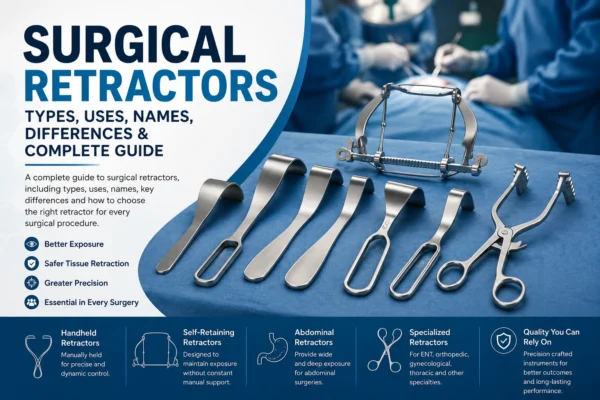
Surgical Retractors: Surgical exposure is one of the most important parts of any operation. Before a surgeon can carefully examine, access, repair, remove, or reconstruct a structure, the operative field must be clearly visible and accessible. This is where surgical retractors play an essential role.
A surgical retractor is an instrument used to hold tissue, organs, skin, or other anatomical structures away from the surgical site. Retractors help create a clearer operative field and provide the working space required for surgical instruments.
However, not all retractors perform the same job. Some are designed for superficial tissue, while others are made for deep anatomical structures. Some are held manually by a surgeon or assistant, whereas others are designed to remain in position using a self-retaining mechanism.
Understanding the different types of surgical retractors, their names, uses, designs, and applications can help healthcare professionals choose the appropriate instrument for a particular procedure.
This guide explains the most commonly encountered surgical retractors, how they differ, and what factors should be considered when selecting one.
What Is a Surgical Retractor?
A surgical retractor is a hand-held or self-retaining surgical instrument designed to move and hold tissues away from the operative field.
The basic purpose is simple: provide adequate exposure without unnecessarily interfering with the surgical procedure.
Retractors may be used to:
- Hold back skin and superficial tissue
- Separate muscles
- Retract abdominal walls
- Move organs away from the operative field
- Provide access to deep anatomical structures
- Maintain exposure during longer procedures
- Improve visibility of the surgical site
The design of a retractor determines how it interacts with tissue and where it is most useful.
For example, a broad curved blade may be suitable for deep abdominal exposure, while a small double-ended retractor may be more appropriate for superficial tissue.
The British Journal of Surgery has discussed both handheld and self-retaining retractors as important instruments for maintaining surgical exposure.
Main Types of Surgical Retractors
Although there are many specialized designs, surgical retractors can broadly be divided into two main groups:
They can also be classified according to their surgical application, such as abdominal, orthopedic, thoracic, gynecological, ENT, or superficial tissue retraction.
Handheld Surgical Retractors
Handheld retractors are manually positioned and held by a surgeon or surgical assistant.
One of their major advantages is flexibility. During an operation, the assistant can change the angle, depth, or direction of retraction immediately according to the surgeon’s requirements.
Common handheld retractors include:
- Deaver
- Richardson
- Morris
- Doyen
- Roux
- Senn-Green
- Farabeuf
- Kocher
The design and blade shape of each instrument determine where it is most effective.
Deaver Retractor
The Deaver Retractor is one of the best-known deep tissue retractors.
It has a broad, curved blade that can be used to retract organs and deeper tissues. The large surface of the blade allows the retractor to provide broad contact with tissue rather than concentrating force on a very small area.
The Deaver is commonly associated with abdominal, thoracic, and gynecological procedures.
A useful example is the Deaver Retractor from Frago Impex, which is available in different configurations for surgical applications.
Why is a Deaver Retractor used?
A Deaver may be selected when the surgeon needs:
- Deep tissue exposure
- Organ retraction
- Broad tissue contact
- Access to deeper operative fields
- A manually controlled retractor
Its curved profile makes it particularly useful when straight access is difficult.
Richardson Retractor
The Richardson Retractor is another important handheld instrument used for tissue and abdominal retraction.
Compared with a broad curved Deaver, the Richardson has a different blade profile and is commonly used where a surgeon needs a more defined edge of tissue retraction.
Richardson retractors are frequently associated with general and abdominal surgery.
When selecting between retractors, the important consideration is not simply the name of the instrument. Blade depth, width, angle, and the anatomy being exposed all influence the choice.
A Richardson Retractor is one example of this style of surgical instrument.
Morris Retractor
The Morris Retractor is designed for deep tissue and abdominal exposure.
Its broad, curved blade makes it useful when deeper structures need to be held away from the operative field.
Morris retractors are particularly relevant to procedures where the surgeon requires stable manual retraction of abdominal tissues.
The Morris Retractor is an example of this traditional deep-retraction design.
Deaver vs Morris Retractor
Both may be used for deep exposure, but their blade designs differ.
A Deaver generally provides a broad curved surface, while a Morris retractor has a different blade geometry intended for deep abdominal retraction.
The final selection depends on the procedure, incision, anatomy, and surgeon preference.
Doyen Retractor
The Doyen Retractor is a handheld instrument commonly associated with abdominal and gynecological surgery.
Its broad blade can be useful for retracting abdominal tissues and providing exposure without relying on a self-retaining mechanism.
The Doyen Abdominal Retractor is an example of this type of instrument.
Doyen retractors are particularly useful when controlled manual retraction is preferred and the surgical assistant needs to continuously adjust the position.
Roux Retractor
The Roux Retractor is a double-ended handheld retractor. Its different ends can provide versatility when working with tissues of different depths or sizes.
This makes the Roux useful when a single instrument needs to accommodate more than one retraction requirement.
The Roux Retractor is an example of this double-ended design.
Double-ended retractors can be particularly practical in surgical instrument sets because they provide more than one blade configuration within a single instrument.
Senn-Green Retractor
The Senn-Green Retractor is a smaller handheld retractor commonly used for superficial soft-tissue exposure.
Its compact design makes it suitable when the operative site does not require the depth or blade size of an abdominal retractor.
The Senn-Green Retractor is an example of this type of instrument.
It may be encountered in general surgery, plastic surgery, orthopedic procedures, and other operations involving relatively superficial tissue.
Farabeuf Retractor
The Farabeuf Retractor is a simple double-ended handheld retractor.
Its relatively compact design makes it useful for superficial and moderate tissue retraction.
The Farabeuf Retractor demonstrates why double-ended retractors remain useful in general surgical instrument sets.
One advantage of this type of design is versatility: the surgeon can select the end that best matches the required exposure.
Self-Retaining Surgical Retractors
Unlike handheld retractors, self-retaining retractors incorporate a mechanism that helps maintain tissue separation after the instrument has been positioned.
This can be particularly useful when sustained exposure is required and the surgical team wants to reduce the need for continuous manual holding.
Self-retaining mechanisms can include:
- Ratchets
- Hinged arms
- Screws
- Spring mechanisms
- Adjustable frames
However, self-retaining does not mean that the instrument can simply be positioned and ignored. Proper placement, adjustment, and monitoring remain important.
The British Journal of Surgery has highlighted the importance of appropriate use of self-retaining retractors and attention to tissue pressure.
Balfour Abdominal Retractor
The Balfour Retractor is one of the classic self-retaining retractors used for abdominal exposure.
Its frame and adjustable blades are designed to maintain separation of the abdominal wall and provide a relatively broad operative field.
The Balfour Abdominal Retractor is an example of this type of surgical retractor.
When is a Balfour used?
A Balfour may be considered when:
- Wide abdominal exposure is required
- A self-retaining mechanism is preferred
- The operative field needs sustained retraction
- Multiple surgical instruments need to be used without an assistant continuously holding a retractor
The size and configuration should always be appropriate for the operative site.
Gelpi Retractor
The Gelpi Retractor is a compact self-retaining retractor recognized by its pointed or blunt tips and spring-like opening mechanism.
It is useful when a relatively small operative field needs controlled self-retaining exposure.
There are different configurations depending on the required tissue interaction.
For example, Frago Impex lists both a Gelpi Self-Retaining Retractor and a Gelpi Self-Retaining Retractor – Blunt.
Sharp vs blunt Gelpi retractors
The difference is primarily the tip configuration.
A sharp tip can provide a more secure grip where appropriate, while a blunt configuration may be selected when a less penetrating tip is preferred.
The choice should be based on the anatomy, procedure, and tissue-handling requirements.
Jansen Self-Retaining Retractor
The Jansen Self-Retaining Retractor is a compact instrument commonly associated with ENT and nasal procedures.
Its relatively small design makes it suitable for confined operative areas where a large abdominal retractor would obviously be inappropriate.
The Jansen Self-Retaining Retractor demonstrates how specialized retractors can be designed around the anatomical requirements of a particular surgical field.
This is an important principle when selecting retractors:
The best retractor is not necessarily the largest or strongest one; it is the one that provides the required exposure while being appropriate for the anatomy and procedure.
Adson Self-Retaining Retractor
The Adson Self-Retaining Retractor is another compact self-retaining design.
Different tip configurations can be selected depending on the intended application.
Frago Impex provides both an Adson Self-Retaining Retractor – Blunt and an Adson Self-Retaining Retractor – Sharp.
These variations demonstrate an important point: two retractors can have a similar overall purpose while differing significantly in how their tips interact with tissue.
Abdominal Surgical Retractors
Abdominal surgery often requires retractors capable of providing exposure at different depths.
Common abdominal retractor names include:
- Balfour
- Deaver
- Doyen
- Richardson
- Morris
- Kocher
- Fritsch
- Collin
- Ricard
No single abdominal retractor is ideal for every procedure.
The surgeon may require a large self-retaining system for broad exposure, a handheld retractor for precise positioning, or a deep curved retractor for organ displacement.
For example, the Kocher Abdominal Retractor represents another design intended for abdominal exposure.
Superficial vs Deep Retractors
One of the simplest ways to understand surgical retractors is to consider how deep the operative field is.
Superficial retractors
These are generally smaller and easier to control.
Examples include:
- Senn-Green
- Farabeuf
- Small self-retaining retractors
They may be useful for skin, subcutaneous tissue, and relatively superficial operative sites.
Deep retractors
These are generally designed with longer or broader blades.
Examples include:
- Deaver
- Morris
- Richardson
- Doyen
They are useful when deeper tissues or organs must be moved away from the operative field.
Handheld vs Self-Retaining Retractors
The difference between handheld and self-retaining retractors is not simply whether someone holds the instrument.
Each design provides different advantages.
| Feature | Handheld Retractor | Self-Retaining Retractor |
|---|---|---|
| Position | Manually controlled | Mechanically maintained |
| Adjustment | Immediate and flexible | Adjusted through mechanism |
| Assistant | Usually required | Reduced need for continuous holding |
| Best suited for | Dynamic exposure | Sustained exposure |
| Examples | Deaver, Morris, Doyen | Balfour, Gelpi, Jansen |
| Main advantage | Precise control | Consistent sustained exposure |
A surgeon may prefer a handheld retractor when continuous adjustment is important, while a self-retaining design may be advantageous when stable exposure is required for an extended period.
Sharp vs Blunt Retractors
Retractors may also be differentiated by the shape of their tissue-contacting tips.
Sharp retractors
Sharp tips can provide a secure grip on appropriate tissue edges.
They are useful in situations where controlled engagement is required.
Blunt retractors
Blunt tips are designed to reduce penetration and can be preferable for tissues where a less aggressive contact profile is desired.
There is no universal rule that one is better than the other.
The correct choice depends on the surgical procedure and the anatomical structures being retracted.
How to Choose the Right Surgical Retractor
Choosing a surgical retractor should begin with the procedure, not the instrument name.
Consider the following factors.
1. Surgical Procedure
Start by identifying the type of surgery.
An abdominal operation may require completely different retractors from ENT, orthopedic, or superficial soft-tissue surgery.
2. Depth of the Operative Field
Determine how deep the target structure is.
A shallow operative site may require a small retractor, while deeper exposure may require a long or curved blade.
3. Required Width of Exposure
Some procedures require a narrow area of exposure, while others require broad separation.
A Balfour-type system, for example, is fundamentally different from a small Senn-Green retractor.
4. Tissue Characteristics
Consider the tissue being retracted.
The blade shape and tip configuration should be appropriate for the tissue and procedure.
5. Handheld or Self-Retaining
Ask whether continuous manual control is beneficial.
If the retractor needs frequent repositioning, handheld instruments can provide excellent flexibility.
If stable exposure is required, a self-retaining retractor may be more practical.
6. Blade Size
The blade should be large enough to provide the required exposure without being unnecessarily large.
Choosing the correct dimensions is an important part of instrument selection.
7. Instrument Quality
For reusable surgical instruments, important considerations include:
- Stainless-steel quality
- Surface finish
- Mechanical strength
- Smooth operation
- Secure locking mechanisms
- Resistance to corrosion
- Ease of cleaning
- Sterilization compatibility
Common Mistakes When Selecting Surgical Retractors
Choosing retractors only by name can lead to poor instrument selection.
Mistake 1: Choosing the largest retractor
A larger retractor does not automatically provide better exposure.
The instrument should match the surgical field.
Mistake 2: Ignoring blade geometry
Two retractors with similar lengths can behave very differently because of blade shape, curvature, and width.
Mistake 3: Using a self-retaining retractor without monitoring pressure
Self-retaining instruments can maintain exposure, but appropriate positioning and tissue pressure still need attention.
Mistake 4: Using one retractor for every procedure
Different procedures require different exposure strategies.
A well-planned surgical instrument set should include retractors suited to the procedures performed by that department.
Mistake 5: Ignoring instrument maintenance
A retractor with a damaged blade, stiff joint, weak ratchet, or corroded surface may not perform as intended.
Cleaning and Maintenance of Surgical Retractors
Surgical retractors are reusable instruments in many healthcare settings and require proper processing after use.
The exact cleaning and sterilization process should follow the instrument manufacturer’s instructions and the healthcare facility’s validated procedures.
General considerations include:
- Remove contamination promptly according to the facility’s protocol.
- Clean the instrument thoroughly.
- Inspect blades and edges.
- Check moving components.
- Test self-retaining mechanisms.
- Look for corrosion or surface damage.
- Sterilize using the validated method.
- Store instruments appropriately after processing.
Self-retaining retractors deserve particular attention because their mechanical components need to open, close, and lock correctly.
Why Retractor Design Matters
At first glance, surgical retractors may appear to be simple instruments. In practice, small differences in blade shape, depth, curvature, tip design, and mechanism can significantly affect how an instrument performs.
For example:
- A broad curved blade may distribute pressure over a larger area.
- A narrow blade may provide access to a more confined space.
- A pointed tip may provide secure engagement.
- A blunt tip may provide a different tissue-contact profile.
- A self-retaining mechanism can maintain exposure.
- A handheld instrument allows continuous adjustment.
Understanding these differences is more useful than simply memorizing a list of surgical retractor names.
Common Surgical Retractor Names at a Glance
Some of the most commonly encountered names include:
Deaver Retractor – deep tissue and organ retraction.
Richardson Retractor – abdominal and deep tissue exposure.
Morris Retractor – deep abdominal retraction.
Doyen Retractor – abdominal and gynecological applications.
Roux Retractor – versatile double-ended retraction.
Senn-Green Retractor – superficial tissue exposure.
Balfour Retractor – self-retaining abdominal exposure.
Gelpi Retractor – compact self-retaining retraction.
Jansen Retractor – specialized self-retaining retraction, particularly in ENT applications.
Adson Retractor – compact self-retaining tissue retraction.
Farabeuf Retractor – double-ended handheld retraction.
Kocher Retractor – abdominal and general surgical applications.
This list is only a starting point. Surgical departments may use many additional specialized retractors depending on their procedures.
How Many Surgical Retractors Does a Hospital Need?
There is no universal number.
The required range depends on:
- Number of operating rooms
- Surgical specialties
- Types of procedures performed
- Instrument set design
- Hospital size
- Frequency of procedures
- Sterilization and instrument-processing capacity
A general surgery department may require several different sizes and styles of retractors because no single instrument can provide ideal exposure for every operative situation.
The goal should be to build an instrument range around the actual procedures performed rather than purchasing large quantities of similar instruments without a specific purpose.
Final Thoughts
Surgical retractors are fundamental instruments for creating and maintaining an effective operative field. Their importance goes far beyond simply “holding tissue back.”
The design of a retractor determines how it interacts with tissue, how deeply it can reach, how much exposure it can provide, and how easily the surgical team can control it.
The most important distinction is between handheld and self-retaining retractors, but other factors—including blade shape, depth, width, tip configuration, and intended surgical application—are equally important.
A Deaver may be appropriate when broad deep exposure is needed. A Senn-Green may be better suited to a superficial operative site. A Balfour can provide sustained abdominal exposure, while a Gelpi or Jansen may be more appropriate for smaller operative fields.
Understanding these differences allows surgeons, operating-room staff, hospital procurement teams, and medical professionals to make more informed decisions when selecting surgical instruments.
For a broader selection of designs and sizes, you can explore the complete Surgical Retractors collection from Frago Impex.
The right retractor is ultimately the one that provides adequate surgical exposure while being appropriate for the anatomy, procedure, and tissue being handled.